Sunday, December 27, 2009

Side-effect

---The News International - Internet Edition, Pakistan
Friday, December 25, 2009,
Muharram 07, 1431 A.H
Side-effect

Christmas 2009
Harris Khalique

On Christmas this year, my heart goes out to the families, relatives and friends of those innocent Christian Pakistanis who suffered death, destruction and gross injustice at the hands of misguided fanatics brandishing batons, clubs and guns all over Pakistan. They attacked the Christian community in Gojra, Toba Tek Singh, resulting in seven deaths and causing severe damage to property. This was the bloodiest in the series of attacks on Christians and their neighbourhoods and villages across the country, particularly in Punjab. In March, a woman was killed in Gujranwala when the community was protesting against the encroachment on a piece of land owned by the local church. In April, Karachi witnessed the death of a young man in Taiser Town. In September, Robert Masih, a poor teenager, was found dead while in jail.

In other attacks, people were wounded and their belongings were either looted or set on fire. As far as I could recall, this happened in Chak 90 of Sahiwal in May, in village Bahmianwala of Kasur in June and in Korian in July. There was an incident in Quetta also where four Christian young men were killed but apparently it was the result of the ethnic-based violence. There are frequent reports of Hindus being treated shabbily in some parts of Sindh although the incidents are not as bloody and widespread as against Christians in Punjab. Sikhs were dislodged by extremists in the north-west of the country and besides the killing of two Ahmadis in Sindh, some students of the Ahmadiya community were rusticated from an educational institution in Faisalabad.

There is no denying the fact that Shia-Sunni strife has caused many more deaths than those of non-Muslims. Indiscriminate terror attacks made more than 11,000 Pakistanis lose their lives in the last four years. Brutality and terrorism have to be condemned in all shapes and forms. But the violence against non-Muslim Pakistanis has another dimension. The discrimination is now embedded in our constitution and law books besides the dated and prejudiced curriculum taught in schools and colleges. This relegates them to being second-class citizens. Not only what is being legitimised in Pakistan is against the spirit of any faith, including Islam, but also against the thinking and wishes of the founder of this country whose own birth anniversary falls on the Christmas day. On many occasions he clearly spelled out the right of non-Muslim Pakistanis to be equal citizens in the state of Pakistan.

It is a fad among the liberals and the semi-literate intelligentsia to castigate Jinnah for all our ills rather than the perpetual failure of the ruling elite to govern in this country since his death. On the other hand, religious right tries to appropriate Jinnah and doctor his progressive ideals. He is misquoted and misinterpreted by many observers, whether from the bigoted right, progressive left or those waging just struggles for the rights of provinces. Like any other politician he committed mistakes and one may not agree with all of his positions. But that man of integrity is continued to be betrayed by our elite.

The dilapidated Quaid-e-Azam House Museum in Karachi, which I visited last week with a colleague, is a reflection of what importance Jinnah really enjoys. Neither there is water to maintain the lawn nor does the building structure is lit up in the night. Remember, we do have resources to build lush green parks by the sea in posh neighbourhoods and maintain a palatial Governor’s House in the vicinity.

The writer is an Islamabad-based poet and rights campaigner. Email: harris @ spopk.org

URL: www.thenews.com.pk/daily_detail.asp?id=215153

Tuesday, December 22, 2009

Pakistan’s persecuted Muslims

---The Whig Standard, Canada

Pakistan's persecuted Muslims [Editorial]

Posted By GEOFFREY P. JOHNSTON

Friday, December 18, 2009

Now that the ice and snow are upon us, many Kingstonians are out in the cold, enjoying the skating rink at Market Square or hitting the local cross-country ski trails for a winter workout. Others, however, dream of the warmth and sunshine of Canada’s all-too-brief summer – a season that allows those living in the Limestone City to demonstrate their respect for other cultures and religions.

For example, if you regularly visit Rotary Park during summer, you may encounter a Christian youth group enjoying a picnic. Other times, you will see Muslims praying toward Mecca before tucking into a barbecued meal. Such scenes of religious diversity make Canada attractive to so many newcomers.

Contrary to overblown allegations of Islamophobia, Canada respects the United Nations Universal Declaration on Human Rights, which guarantees freedom of religion, belief or conscience. And Canada consistently ranks at or near the top of the annual international survey of religious freedom conducted by Freedom House, a U. S.-based think tank.

Ironically, the worst violators of Muslims’ religious rights are Muslim-majority countries, including Pakistan, which blatantly oppresses Ahmadi Muslims. According to Amnesty International, Ahmadis, who adhere to a unique interpretation of Islam, are viewed by orthodox Muslims as heretics.

The Ahmadi consider themselves to be Muslim, explains Knox Thames, a policy analyst with the nonpartisan United States Commission on International Religious Freedom. However, a despicable amendment to Pakistan’s constitution in 1974 deemed the Ahmadi to be “non- Muslims.”

“It is inappropriate for governments to be speaking to the question of what faith is or is not true,” Thames says. But that is precisely what is happening in Pakistan.

“The constitution basically bans them [from participating in society],” Thames explains. “They can’t vote. They have difficulty attending public schools. They have great difficulty worshipping openly.”

Amnesty International has repeatedly called for the abolition of Pakistan’s laws that “effectively criminalize any exercise of the right to freedom of religion by Ahmadis.” Members of the minority sect, estimated to have three to four million adherents in Pakistan, are prohibited by law from referring to their houses of worship as mosques. In addition, Ahmadis are banned from preaching in public, proselytizing or producing religious literature.

Pakistan’s anti-Ahmadi laws “really force them into the margins of society and leave them very vulnerable to extremist attacks,” Thames says. And over the years, reports Amnesty International, there have been “numerous targeted killings of Ahmadis, usually carried out with impunity.”

According to Human Rights Watch’s 2009 annual report, two Ahmadis were murdered last year after “a popular talk-show host … declared Ahmadis appropriate targets for murder under Islamic law.” The United States Commission on International Religious Freedom alleges that Sunni Muslim extremists are often responsible for attacks on Ahmadis. It also alleges that the government sometimes collaborates with the attackers.

When the central government isn’t turning a blind eye to religiously motivated murder, it is actively harassing the Ahmadi. For instance, the U. S. Commission on International Religious Freedom reports that in May of 2008, Ahmadis in the town of Rabwah openly “celebrated their faith through distinctive clothing, badges with religious slogans, lighting displays, and fireworks.” The police responded by charging the whole community under the anti-Ahmadi laws.

Curiously, the Muslim world has remained silent about the oppression of the Ahmadi. Prime Minister Stephen Harper, however, has publicly acknowledged and condemned the persecution of the Ahmadi in central and south Asia.

In the summer of 2008, the prime minister travelled to Calgary to take part in the opening of the Baitun Nur mosque, built by the city’s Ahmadi community, which numbers an estimated 5,000 people. In his address, he noted that the Ahmadis are renowned for their devotion to “peacefully co-existing with people of all faiths, languages and cultures.” And in the Ahmadis, said Harper, Canadians will see “the moderate, benevolent face of Islam.”

As long as Muslim countries like Pakistan persecute the Ahmadis, Canada should attempt to rescue as many as possible by fast-tracking their immigration and refugee applications. And in return for sanctuary, Ahmadi newcomers could provide a much-needed antidote to radical Islamist ideology that is poisoning the minds of some Canadian Muslims and colouring the country’s perception of Islam.

Defending the individual’s right to freedom of religion is one of the hallmarks of Canadian democracy, ensuring that Kingston’s Rotary Park and other parks like it across Canada are open to different faith groups whose members only wish to enjoy fellowship in a green space. After all, what could be more Canadian than dreaming of a summer picnic in the dead of winter?

Geoffrey P. Johnston is a local writer.

URL: www.thewhig.com/ArticleDisplay.aspx?e=2227342

Babar Awan elevated as law minister

--- The News International, Pakistan
Friday, December 18, 2009,
Zil’Hajj 30, 1430 A.H
Babar Awan elevated as law minister

By Ansar Abbasi

ISLAMABAD: A day after Pakistan witnessed one of the greatest day in its history towards checking corruption, we have one good piece of news and one bad.

The good news is that President Asif Ali Zardari on Thursday administered oath to one of the most respected retired judges Justice (R) Rana Baghwandas as Chairman Federal Public Service Commission (FPSC). The bad news is that the elevation of Babar Awan as Law Minister comes at a time when he is alleged to have taken Rs35 million as bribe from the owners of Haris Steel, and on the very day when the full court handed down its landmark verdict to curb the menace of corruption.

There is no explanation available as to what really made Prime Minister Yousuf Raza Gilani to pick this great Wednesday to shower his bounties on a man who is included in the list of those ministers, advisers, ambassadors and top bureaucrats, whose resignation is sought.

Babar Awan is undoubtedly a talented minister and has not been involved in any financial scam or corruption ever since he joined the federal cabinet. However, the Haris Steel owner Shaikh Afzal’s statement given before the Supreme Court is also too serious to be taken so lightly or ignored to the extent that the premier waited for December 16, 2009 to promote Awan in the cabinet from an average Parliamentary Affairs Ministry to the important Law Ministry.

It is believed that it would have been better for the prime minister to change Awan’s portfolio only once he had been cleared from these allegations that are now part of the Supreme Court record. Awan was considered to be among a group of lawyers who were considered the Dogar court’s favourites, he has never faced the kind of charges levelled against him and a few others by Shaikh Afzal, who is an accused himself.

Awan’s spokesman has already termed it a conspiracy against the minister by the ‘Qadiani lobby’. NAB has, however, already summoned Babar Awan and all others charged by Shaikh Afzal of taking bribes in the BoP Rs9 billion Haris Steel loan case to win over Dogar court in favour of the accused. His promotion as Law Minister came within a few days of NAB action against him and others. Interestingly, NAB has now been brought under the control of Babar Awan following his elevation as Law Minister.

After his induction in Gilani’s cabinet, Awan first hit a controversy when The News published a story about his fake doctorate (Ph.D) degree that was wrongfully awarded by a United States University, which was never accredited for such degree programme and closed down in the year 2000 for being a fraud.

Both the United States Educational Foundation (USEF) as well as Higher Education Commissioner of Pakistan had confirmed that the said University was never allowed to offer degree programmes including the Ph.D. “It was a fraud,” the USEF Pakistan had said.

The minister, who admitted to have done his Ph.D in the University of Monticello USA in 1997-98 through its distant learning programme, however, had insisted that his Ph.D was valid. Prior to Awan, the prime minister appointed Sardar Latif Khosa, former attorney general, adviser after he was removed as top law officer following allegations that he got Rs3 million from a client to get from Dogar court a decision in her favour. Khosa too denied these allegations but is presently facing the court in the same case.

On Thursday respected Justice (R) Rana Baghwandas took over as Chairman Federal Public Service Commission. The president’s decision to appoint Baghwandas as head of the FPSC is widely appreciated particularly in a situation where the government is generally found lacking on governance issues.

Bhagwandas, however, is joining his new assignment within a few months after the government had already slashed the authority of Chairman FPSC to head top promotion boards for the civilian bureaucracy. The bureaucracy now expects that the government would not only restore these powers to ensure promotions on merit but also seeks the role of the FPSC chairman in the top bureaucratic appointments to depoliticise the bureaucracy by securing the senior members of the bureaucracy from being removed on the whims of political masters.

Like the head of the promotion boards, it is suggested that the chairman FPSC should also lead a committee, comprising some key federal secretaries and a few ministers, to recommend to the prime minister every top appointment- in BS-21 and BS-22- in the civil bureaucracy. It is believed that such a mechanism would allow the bureaucracy to operate independently besides preventing from being removed for refusing to follow unlawful orders of their superior/political masters.

URL: www.thenews.com.pk/top_story_detail.asp?Id=26149

The tempest strikes — and leaves the presidency bare

--- The News International, Pakistan
Friday, December 18, 2009,
Zil’Hajj 30, 1430 A.H
The tempest strikes — and leaves the presidency bare

Islamabad diary
By Ayaz Amir

A three-member bench of the Supreme Court could have taken care of the dead sparrow that was the NRO. But aware of the possible implications of this case, my lord the CJ constituted the largest bench in our history, all 17 of their lordships.

So the tempest was brewing and now it has struck, leaving the Presidency bare – naked to laughter (a phrase out of Shelley) and the elements. The Presidency or its occupant are not mentioned at all in the short judgment. But in this Hamlet we all know who is the Prince.

When the Supreme Court directs the government to write to the Swiss authorities that the money-laundering cases (SGS Cotecna, etc) should be revived, we all know who is involved in those cases. Even today when a billion dollars is of little account, sixty million US dollars stashed away in Swiss vaults is not small change. To whom does this treasure belong? How was it amassed?

So if the money-laundering and bribery cases – for that is what they are – stand revived against one Asif Ali Zardari, what becomes of His Excellency Asif Ali Zardari, President of the Islamic Republic of Pakistan, Supreme Commander of its Armed Forces?

This is a fine mess we are in. The dignity of the Republic! We shall have to redefine the term.

The NRO was the dry-cleaning laundry set up by Pervez Musharraf (of how many of humiliations must he be the source?). With it gone, cases stand revived against all of its beneficiaries. Their number runs into the thousands, the majority relating to criminal charges against workers and leaders of the MQM. That’s a separate matter. There are important figures in the government who will now have to appear in court – among them the Secretary General to the President, Salman Farooqi, and my friend Rehman Malik.

The president may enjoy immunity from criminal proceedings and from appearing in any court. But what becomes of the authority that he is supposed to command? His position was already diminished. It stands further eroded after this judgment.

He won’t quit or step down. Of that we can be sure. He steps down and he will either become a fugitive from justice (decamping abroad) or he will be running from one court to another. If for nothing else, to secure himself from this fate he will stick to the Presidency, invoking Article 248 of the Constitution – of which we are already hearing so much – which grants him immunity. But this doesn’t leave him with much of a shine, does it?

I almost said it doesn’t leave him with much moral authority but any invocation of morality is almost calculated to stick in one’s throat. Moral authority? When was the last time we saw such a thing in the Islamic Republic? A few days ago General Ashfaq Kayani, the army commander, was saying Pakistan was a bastion of Islam. Hmm. Isn’t it time we left this fortress-of-Islam business to one side and got on with life? In our hands Islam could do with a little less of preaching and more of action.

Senior military commanders (let no names be taken) already look at Zardari with a certain look in their eyes. It is a distant look, or call it a look with the eyes slightly screwed up. This look is not going to improve after this devastation visited upon the NRO and its beneficiaries. For who is the biggest beneficiary of them all? The Supreme Commander of the Armed Forces. Not a pretty picture for the Republic or its armed forces.

In many respects, although certainly not all, Zardari has led a charmed life. So far he has stayed one step ahead of his past. Now finally it has caught up with him. If there was ever an Emperor without his clothes, we are witness to the spectacle now, part entertainment, part bitter tragedy. It takes guts to stick to the throne in such circumstances. But a certain kind of guts –we have to hand it to the man – Zardari has always had.

It is our luck that down the years Pakistan has been led or ruled – although, in all honesty, the proper word is screwed – by a bizarre set of characters: Ghulam Muhammad, Iskander Mirza, Ayub Khan, Yahya, Zia, Musharraf. After Musharraf we deserved something better. What do we get? Zardari. There’s a Shakespearean classic waiting to be written here.

We can cry ourselves hoarse that these are the workings of democracy. Zardari is elected president, which he is. But consider the malevolence of fate. The wheels of democracy turn and what do they throw up? The spectacle we are seeing. Why is our chalice half-laced with such deadly poison?

But life goes on. The president’s companions hit by the NRO judgment will twist in the wind. Will they quit while this exquisite form of Chinese torture goes through its various progressions? My guess is, they won’t. We are dealing with a tough breed of characters here. Salman Farooqi and my friend Rehman Malik didn’t get to where they are by being over-scrupulous about things. Qualms of conscience? Leave that to the angels.

My friend Dr Babar Awan – as a colleague in Parliament he is a friend – holds a doctorate from Montecello University, a university whose existence even the keenest geographers have had a hard time discovering. Still the doctor insists his doctorate – no doubt in higher jurisprudence – is genuine.

It has now been revealed in a deposition before the Supreme Court by the principal defendant in the Haris Steel Mills case that Dr Babar Awan received four crore rupees, from any angle not a piddling sum, half in legal fees and half on the assurance that the Dogar Supreme Court – alas, no more – would deliver a favourable verdict. Instead of denying the allegation, or explaining it in some other way, as lesser morals might have done, Dr Babar Awan says this is all a Qadiani conspiracy against him because he is such a champion of the Khatam-e-Nabuwat movement.

This is a breathtaking defence but it just goes to show that it is not a squeamish lot we are dealing with. It takes a tough man to be a doctor from Montecello University. Dr Babar Awan is a confidant of the president’s and is considered close to him. If this is the state of affairs with him, we get an idea of how it is going to be with the others. The art of the brazen con (ask my friend Ambassador Hussain Haqqani about it): there should be a doctorate for this too.

Who fills the breach opened up by the SC verdict? By rights it should be Prime Minister Yusuf Raza Gilani. But does he have it in him? He’s a nice guy but niceness alone has its limitations. It won’t get us very far in these circumstances. For weeks, if not months, the word has been out that Gilani was resolved to reshuffle his oversized and under-performing cabinet. But if it was a Stalinist purge we needed what we have seen are a few ministers shifted here and there. If this is Gilani’s idea of decisiveness we have a good deal of homework before us.

From now on, if the NRO beneficiaries are on trial, so is Gilani. Can he emerge from the shadows and be his own man? Somewhere in The Possessed Dostoyevsky says that the second half of a man’s life is a repetition, or replaying, of the first half. The challenge Gilani faces is to prove this dictum wrong.

Tailpiece: Before the Defence Committee of the National Assembly is the Defence Housing Authority Ordinance 2005, issued by – you’ve guessed it – Gen Musharraf. The Defence Ministry wants this ordinance to be turned into an act of parliament. What on earth for? DHA Islamabad is a housing society which has entered into a partnership with Malik Riaz of Bahria Town. Most of the land is his. The DHA will only be lending its logo in return for a certain sum of money and an unspecified number of five-marla plots. Fine. But why should a private housing scheme, which Bahria Town is, get sovereign parliamentary status? National Security is not involved. The defence of the Republic is not at stake. So it scarcely makes any sense for the army’s name to be dragged in the dust, and the collective intelligence of Parliament (if there is such a thing) insulted, for the sake of an individual.

Email: winlust @ yahoo.com

URL: www.thenews.com.pk/editorial_detail.asp?id=213886

Religion repressed in third of all nations

---The Associated Press
December 17, 2009

Study: Religion repressed in third of all nations

By NINIEK KARMINI

NEW YORK — In Indonesia, Muslim groups burn down a mosque belonging to the minority Ahmadiyya. In Singapore, the government refuses to recognize Jehovah’s Witnesses. In Belgium, 68 religion-based hate crimes are reported in 2007 alone.

People living in a third of all countries are restricted from practicing religion freely, either because of government policies and laws or hostile acts by individuals or groups, according to a study released Wednesday by the Pew Research Center, “Global Restrictions on Religion.”

That amounts to 70 percent of the globe’s population, since some of the most restrictive countries are very populous.

Of the world’s 25 most populous countries, citizens in Iran, Egypt, Indonesia, Pakistan and India live with the most restrictions when both measures are taken into account, the study found.

“Where those two come together is where it’s most intense,” said Brian Grim, senior researcher at the Pew Research Center’s Forum on Religion and Public Life.

The United States, Brazil, Japan, Italy, South Africa and the United Kingdom have the least amount of restrictions on religious practices when measured by both government infringement and religion-based violence or harassment, according to the study.

The study found that religious minorities suffer the brunt of the intolerance.

Timothy Shah, a senior research scholar at Boston University who is familiar with the study, said he was struck by the fact that more than 30 countries have high levels of both government and social restrictions on religion.

Shah pointed to Nigeria, where 12 majority-Muslim states adopted the Islamic Sharia criminal code after returning to civilian rule in 1999, resulting in hostilities against religious minorities.

“Where the state throws its weight around, that naturally creates a response of social hostility,” he said.

The Pew Center sought answers to 20 questions it created related to government restrictions on religious practices, such as policies or laws, and on 13 questions on social restrictions, such as individual acts of violence.

The group then examined published public information sources, including reports by the U.S. State Department, the United Nations and various non-governmental organizations, to answer the questions on a county-by-country basis. Researchers analyzed information from July 1, 2006, to June 30, 2008.

The report found that the percentage of the world’s countries with high or very high government restrictions is at about 20 percent, which amounts to 57 percent of the world’s population. These countries include Saudi Arabia, Iran and former communist countries, such as Russia, Belarus and Bulgaria, where state atheism has been replaced by favored religions that are accorded special protections or privileges.

Grim pointed out that many countries have language in their constitutions or basic laws that ban infringements on religion. But the reality is that governments often place restrictions on religions in practice.

For example, 90 percent of countries require religious groups to register for reasons including obtaining tax-exempt status or import privileges. But in almost three in five countries, the registration requirements result in problems or discrimination against certain groups.

The Singapore’s Societies Act, for example, requires all religious groups to register with the government but it doesn’t recognize Jehovah’s Witnesses or the Unification Church.

In practice, only about a quarter of the world’s countries implement constitutional language protecting religious freedom.

Copyright © 2009 The Associated Press. All rights reserved.
URL: www.google.com/hostednews/ap...5Bke5rh5i9_hsAD9CKOMCG0

Saturday, December 19, 2009

Monthly Newsreport - Ahmadiyya Persecution in Pakistan - November, 2009

Murder of an Ahmadi for his faith

Sanghar, Sindh; November 26, 2009: Rana Saleem Ahmad, the Deputy Amir of Jamaat Ahmadiyya Sanghar was shot dead by unknown assailants in the evening outside the Ahmadiyya mosque. He is the 11th Ahmadi killed for his faith in this year alone.

He was closing the mosque gate after the sunset prayers when someone shot him from close quarters with a pistol, and the bullet hit him in the nose and came out from the back of his head. He was rushed to the Civil Hospital where he was declared dead in the emergency room. He was 51.

Rana Saleem was an educator. He was the proprietor and manager of the New Light Academy which is reputed for its high standard of education for children. Approximately a thousand children are enrolled in this academy.

Rana Saleem was a practicing Ahmadi and had served the community in various positions for a long time. He was married, and is survived by his widow and three teenage children.

It is worth noting that while Ahmadis are targeted by extremists in Sindh, those mullas who urge their ignorant, excitable followers to kill them enjoy the provision of body guards from public funds. (See ‘A telltale story from the press’ in this Report).

Murderous attack on an Ahmadi doctor

Lahore; November 25, 2009: Dr Pervaiz Zareef of Bhati Gate, Lahore escaped an attempt on his life on 25th November, 2009. He was preparing to close his clinic at about 11:00 p.m. when two motorcyclists approached his clinic. One of them entered the clinic and fired three bullets at him. The doctor took shelter behind a table. The first bullet broke the glass of the table and two others pierced through it and scraped him. Fortunately, he received a mild injury. A broken piece of glass hit his nose. The assailant also fired at his brother Mr. Amjad, who was at the pharmacy counter. It missed him and hit the wall. People gathered there on hearing the noise. Dr Zareef telephoned the emergency police. The police arrived at the scene and registered an FIR.

Doctor Zareef has a good reputation in the area. The mulla of the local mosque had recently spoken provocatively against him in his sermons. This could be the result of his instigation.

Destruction of an Ahmadiyya mosque

Klaswala, district Sialkot; October 27, 2009: A gang of religious extremists, comprising approximately 50 men attacked an Ahmadiyya mosque in the village of Kalaswala at 11p.m. on October 27 and destroyed it. The mosque was not in use and was kept locked.

The attack was reported to the DSP in writing who marked it to the SHO for a follow-up.

The incident is indicative of the freedoms such people continue to enjoy in the Punjab.

Questionable statements of federal ministers

Islamabad: Two federal ministers, Mr. Babar Awan Minister of Parliamentary Affairs and Mr. Ghulam Ahmad Bilour the Railway Minister recently made public statements involving Ahmadis. These statements were taken note of by political and intellectual circles and the media who took the two to task for their own reasons for what they said.

Mr. Awan was accused recently of corruption amounting to tens of millions in the Punjab Bank scandal. (Sheikh Haris statement before the Accountability Court reported in the daily Awaz; Lahore, December 3, 2009.)

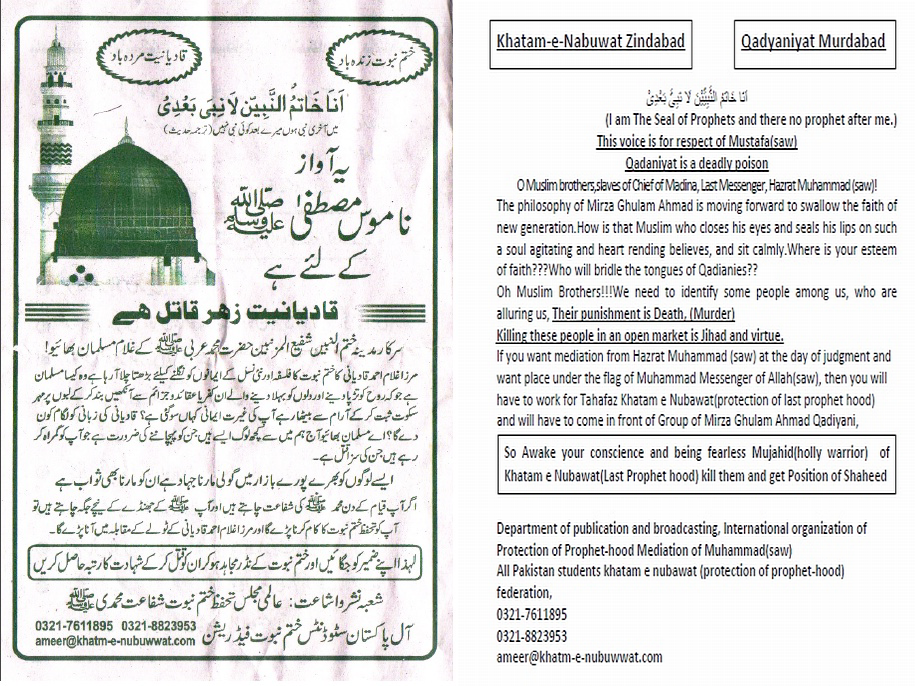
The daily Ausaf, Lahore of November 27, 2009 reported a statement by the minister’s spokesman as: “Qadiani lobby has launched a campaign of accusations and conspiracy against Dr Babar Awan, the Federal Minister of Parliamentary Affairs for his firm stand (seesa palai diwar ki tareh dat janey ki wajah se) against the proposals to change the name of the Islamic Republic of Pakistan and the repeal of the Blasphemy law. However, Dr Babar Awan, as a true lover of the Propeht (Aashiq rasul) and a Pakistani can sacrifice his life for the honour of the Prophet but will not let the plans of evil forces to bear fruit.”

The spokesman of the Ahmadiyya Jamaat denied the charge and called it an unwarranted accusation (Daily Express; Nov 27, 2009).

The daily Aajkal published an op-ed Turkish by Aasif Mahmud dated Nov 27, 2009 on this issue. Excerpts:

“If Babar Awan’s stand is correct, then the Ahmadi lobby is really busy in his character-assassination, or it might be that the Dr. wants to hide behind a holy visage so that he cannot be accused of corruption, and in case that happens, it can be dismissed as Qadiani propaganda.
“The Dr. has never mentioned in the past that Ahmadis are active against him. However, soon after an accused tells the Supreme Court of his corruption amounting to tens of millions, the Dr. remembers this Ahmadiyya conspiracy?
“Politics based on religion are not uncommon, but the present trend is very dangerous. It is only an attempt to hide from the corruption charge, behind the curtain of religion. This amounts to asking the people to defend a man without inquiry as a part of their religious sentiment. Political norm, however, dictates that if one is accused of corruption, he should not cover himself in the garb of sanctity, but should face the charge.”

The case of Mr. Bilour is of lessen consequence, although he too aroused religious prejudice to support his opinion regarding the day of Eid-ul-Fitr. He differed with the Ruet Hilal Committee’s decision on the sighting of the moon and stated in public that those who celebrated Eid on the day decided by the Committee were doing so “along with people of Rabwah.”

The minister was taken to task by the media and the mulla, for their own reasons and logic. The minister had to make a public apology and said that his remark was only a taunt (tanzia).

It is indeed surprising that these well-placed politicians should handle their serious political and personal problems by such questionable means.

Update on the Layyah five

After being incarcerated for approximately six months the four school-children and one adult Ahmadi of Layyah were set free by the Lahore High Court, Multan Bench on bail. The sword of prosecution still hovers over their heads. Their case was transferred to Multan due to the intensity of hostility in Layyah. Now they are appearing before the court on a regular basis. On November 3, 2009 the court examined the medical report of all the four children and declared them less than 18 years of age, non-adult, and asked the police to put up a new charge sheet on November 23. This was done. Now their case is ready for trial in the court – for how long, nobody knows.

Anti-Ahmadiyya conference

Digree Ghumnan, District Sialkot; November 10, 2009: Mullas held an anti-Ahmadiyya conference in Digree Ghumnan. Mulla Shafiq Dogar, who is a resident of Pasroor and an active opponent of the community, attended the gathering and spoke against Ahmadiyyat and its holy founder for an hour. These speeches were relayed by loudspeakers to the whole village. The event posed a threat to the local Ahmadis. They had to take appropriate precautions and remained vigilant in case anything happened.

A telltale story from the press

Tando Adam, Sindh: The daily Jang, Lahore of November 8, 2009 published the following story:

Tando Adam: The chief of Majlis Tahaffuz Khatme Nabuwwat (MTKN) Sindh’s gunman’s rifle stolen
Tando Adam (PR): The rifle of the official guard of Allama Ahmad Mian Hamadi was stolen from the guard room. Hearing this, all the office bearers and followers of the Majlis arrived at the office of the MTKN. They said that they had repeatedly warned the authorities that the security provided to Allama Hamadi was nominal and inadequate; it should be increased, but the administration failed to co-operate, and the tragedy happened. The leaders warned the administration that it will be held responsible if Allama Hamadi suffers any harm to his person or property. They demanded that the conspiring elements who have requested that the Allama’s security guard may be withdrawn, should be required to appear for the investigation in the loss of the gun.

In view of the fact that Hamadi, an extremist mulla, is known to have been active in sectarian strife for years, the following is apparent from the press release of the MTKN:
  • He is provided a regular armed guard at the public’s expense.
  • He even has a guardroom for security personnel.
  • His office has asked for more security personnel (although it is he who promotes murder in the name of religion).
  • Some people have suggested that he needs hardly any security.
  • The loss of the official rifle certainly calls for a thorough investigation; Hamadi and his staff should be interrogated, as it is they who stand to benefit from the theft.
The authorities continued regard for the extremist and sectarian mullas is noteworthy and incomprehensible.

Restoration of an Ahmadiyya mosque

Chak 5, District Badin, Sindh: In May of last year, a magistrate ordered the sealing of an Ahmadiyya mosque in this village in pursuance of a demand from sectarian mullas of the Majlis Tahaffuz Khatme Nabuwwat. The magistrate apparently acted as an agent of the clerics rather than an official of a state that is signatory to international covenants on human rights. His action was most unjust.

Three months ago the Ilaqa Magistrate told Ahmadis that if they cover up the minaret and the niche, he will allow the mosque to be opened.

Accordingly, the magistrate ordered the opening of the mosque on November 19, 2009. Ahmadis offered their congregational Friday prayers in that mosque the next day.

This mosque remained sealed for one year, five months and 22 days. All this time the Ahmadis of the village were denied their place of worship. Is it why Pakistan was created? The founding father is reported to have said on August 11, 1947:

“You are free, free to go to your temples; you are free to go to your mosques or to any other places of worship in this state of Pakistan…”

The question is, if the mosque can be open now, why was it sealed in the first instance — why could it not be opened within one week of the decision? The administration and the government of Sindh should think about this. No one, more so in Pakistan, has ever missed being accountable; history takes its own course and its roller-coaster flattens repeatedly all the pitfalls of wrongdoings.

It should be placed on record that the magistrate’s revised decision is also arbitrary and unjust in that the law does not specify that Ahmadiyya places of worship should not have a minaret and a niche. All over the country there are hundreds of Ahmadiyya mosques that have minarets and niches.

Appropriate action by a federal bureau

Islamabad: Jamaat Ahmadiyya’s director of public affairs, sent a News Report for the month of October 2009 to the federal Ministry of Interior. The ministry took note of its contents and sent a copy to the Home Secretaries of the Punjab, Sindh, Balochistan and AJ&K with a covering letter no. F. No. 2/1/2009-Poll.I (2) dated November 25, 2009 – a very appropriate follow-up indeed.

The covering letter urged the provinces: “It is requested that the contents of the enclosed News Report for the Month of October 2009 may be looked into and necessary action taken against the miscreants who are involved in the act of persecution of Ahmadis in your territorial jurisdictions and justice ensured to the aggrieved party (Ahmadis) and report furnished to this Ministry on priority basis.” The letter is signed by Mr. Abdul Rahman, the Section Officer. Its title is: Atrocities Against Jamaat-e-Ahmadiyya. It was marked IMMEDIATE.

It will be fit and material to see the response from the provinces. Human Rights these days are an international obligation, and the trust and obligation to ensure their observation is primarily in the power of provincial authorities in Pakistan. Provinces in Pakistan never tire of asking for more autonomy from the federation; they should therefore do more to fulfill their human rights obligations. Jamaat Ahmadiyya will also report any visible improvement in the cases referred to in the federal letter. In the past, such letters have generally resulted in superficial action or none at all. How can Pakistan function satisfactorily if the provinces do not pay heed to federal co-ordination in maters of joint interest and responsibility?

Press report on civic problems in Rabwah

The Daily Express, Faisalabad published the following story on November 4, 2009 highlighting the local government’s neglect of problems faced by citizens of Rabwah:

Excess of stray dogs in the streets of Chenab Nagar. A threat to citizens.
* Small school-going children have stopped going to school due to fear of dogs. Several men visit hospital due to dog-bites.
Chenab Nagar (Special Correspondent): Packs of stray dogs in the streets of Chenab Nagar are posing a great threat to the public. Small school-going children have stopped going to schools on foot due to the fear of these dogs; this is a big problem for parents. Affected people blame the municipality for this problem. Repeated pleas to the municipality have proved futile. The hospital administration has confirmed more than a dozen cases of dog-bites recently. The post of chief officer has been vacant at the municipality for the last three months. His functions are performed by the sub-engineer or by an accountant on an ad-hoc basis. The affected people question how those who cannot even perform their own duties well, can undertake additional duties? The president of the Human Rights Committee of Chenab Nagar, Mr. Ghulam Mustafa Khan has demanded from the DCO Chiniot that a competent officer should be posted in the municipality of Chenab Nagar. At present solving the long-outstanding public problems is a far cry; none is at hand to pay heed to the day-to-day problems of the residents.

Ahmadis behind bars

  1. Mr. Muhammad Iqbal was imprisoned for life in a fabricated case of blasphemy. He was arrested in November 2004, and is now incarcerated in the Central Jail, Faisalabad. An appeal lies with the Lahore High Court against the decision of the Sessions Court. It is registered as Criminal Appeal No. 89/2005. He is now in the sixth year of his imprisonment.
  2. Three Ahmadis namely Mr. Basharat, Mr. Nasir Ahmad and Mr. Muhammad Idrees along with 7 others of Chak Sikandar were arrested in November 2003 on a false charge of murder of a cleric, alleged by opponents of the Jamaat. The police, after due investigation found no evidence against the accused. Yet these men still faced ‘complaint trial’ for a crime they did not commit. Based on the unreliable testimony of the two alleged eye-witnesses (who were proven false in the court) the court acquitted seven of the accused, but on the evidence of the same two liars the court sentenced these three innocent Ahmadis to death. They are being held in a death row at a prison in Jehlum, while their appeal lies with the Lahore High Court. They are now in the seventh year of their incarceration. Their appeal to the Lahore High Court is registered as Criminal Appeal No. 616/2005 dated 26 April 2005.
  3. Dr. Muhammad Asghar was arrested on a fabricated charge of blasphemy in June 2008. The judge rejected his plea for bail. The police investigation found him innocent. Subsequently his plea for bail has been rejected by the High Court — and the Supreme Court. The Supreme Court has directed his expeditious trial which is now in progress.

From the Press

Attempt to build illegal Qadiani place of worship in Bhuwana aborted. Qadianis had attempted to build their place of worship and an office in the name of the service to humanity.
Great agitation among ulama and Muslims. Police acted to stop the construction.
The daily Ausaf; Lahore, November 05, 2009

Qadiani principal is promoting dissatisfaction. Thousand of students and teachers protest and boycott classes, in Polytechnic at Sialkot.
The daily Nawai Waqt; Lahore, November 20, 2009

Musharraf accused of letting terrorism wound fester: former French investigating judge Jean-Louis Bruguiere, in Paris on the ‘Danger nowadays in Pakistan’, said, describing the country as a ‘cauldron’ of extremism that was allowed to fester under Musharraf’s rule.
The daily Dawn; Lahore, November 7, 2009

ANP has suggested ‘Peoples Democratic Pakistan’ new name for country.
MQM will support it. — Farooq Sattar
It is wrong. — Haji Adeel.
The daily Khabrain; Lahore, November 20, 2009

Taliban under fire at Raiwind congregation. Participants say Taliban straying off from right path by ‘butchering Muslims’.
The Daily Times; Lahore, November 16, 2009

Blackwater buys house near Dr Qadeer’s residence. American intervention should be stopped. Jamiat (IJT of JI)
India has opened up 1000 consulates in Afghanistan to destabilize Pakistan.
The US uses the education system (here) to promote its own interests. Press conference by Atiq-ur-Rehman, the Nazim Aala Pakistan.
The daily Ausaf; Lahore, November 6, 2009

Taliban acceptable if they renounce Qaeda: — Holbrooke (US special Envoy)
The Daily Times; Lahore, November 25, 2009

There is no place for women who wear the Hijab in France — Sarkozi
The daily Ausaf; Lahore, November 14, 2009

Muslims have right to pray but not to azan, says Swiss president
The Daily Times; Lahore, November 18, 2009

Woman stoned to death for adultery by Somali Islamic militia: “Al Shahab”. Lover was inflicted 100 lashes.
The Daily Express; Lahore, November 20, 2009

America is the leader of terrorism; India and Israel are its followers. — Munawwar Hasan (of JI)
The daily Pakistan; Lahore, November 14, 2009

Swiss govt under fire over minaret referendum
The daily Dawn; Lahore, December 1, 2009

Qadianis are the greatest enemies of Islam and Pakistan. — Tufail Qadri
The daily Waqt; Lahore, November 11, 2009

Chenab Nagar: By disallowing a stop (here) of the Millat Express, the railway administration has displayed its spite.
  • The town is of special worldwide importance for being centre of a religious sect.
  • The Federal Minister should allow a two-minute stop here.
The daily Ausaf; Lahore, November 25, 2009

Wild dogs abound in Chenab Nagar. Citizens at risk. Children stop going to school for fear. Many hospitalized for dog bits.
The Daily Express; Lahore, November 4, 2009

JI will organize Jihadis: Munwar (of JI)
The Daily Times; Lahore, November 3, 2009

35 killed in Rawalpindi attack
The Daily Times; Lahore, November 3, 2009

Two women teachers shot dead in Bajour
The daily Dawn; Lahore, November 5, 2009

Suicide car bombs kills 32 in Charsadda
The Daily Times; Lahore, November 11, 2009

19 Killed in Peshawar court suicide attack.
The daily News; Lahore, November 20, 2009

Imam Masjid killed over prayer-leading issue.
The daily Nation; Lahore, November 4, 2009

IJT holds PU guards hostage
The daily Dawn; Lahore, November 24, 2009

NRO is not linked with the blasphemy law; Fauzi Wahab’s statement is shameful. — Shahid Sakka
Faisalabad (City reporter): Khawja Shahid Razzaq Sakka, president of Traders Assocation City (Registered) Faisalabad said that all traders in the city have strongly protested against Fauzia Wahab the Information Secretary of the Peoples Party for comparing the NRO with the blasphemy law which she called a black law. … President Zardari and PM Gilani should themselves take note and action on her shameful statement; otherwise the slaves of Muhammad Arabi (PBUH), who are flushed with religious motivation, will pull her tongue out.
The daily Aman; Faisalabad, November 5, 2009

Blasphemer gets death sentence (in Gojra)
The daily Dawn; Lahore, November 12, 2009

Poll massively rigged (in Gilgit-Baltistan), allege MQM, PML(Q)
The daily Dawn; Lahore, November 16, 2009

154 missing persons still untraced, AG informs SC
The daily Dawn; Lahore, November 24, 2009

Bhagwandas appointed FPSC chief
The daily Dawn; Lahore, November 26, 2009

CM (Punjab) pledges support to Sikh pilgrims
The daily Dawn; Lahore, November 7, 2009

Excerpt from President Obama’s speech:
…And we must make it clear to every man, woman and child around the world who lives under the dark clouds of tyranny that America will speak out on behalf of their human rights, and tend to the light of freedom and justice and opportunity and respect for the dignity of all peoples. That is who we are. That is the source, the moral source, of America’s authority.
www.nytimes.com/2009/12/02

Op-eds

Pampering the mulla
Unfortunately, it is this obsequiousness of our rulers toward the mullah since the creation of Pakistan that has emboldened the extremists over the last six decades…
Be it the Objectives Resolution or the timing of the Anti-Ahmadiyya movement in the 50s that facilitated the first martial law, the ban on alcohol and declaration of Friday as a weekly holiday by Zulfikar Ali Bhutto,
Naseerullah Babar’s Taliban idea during Benazir’s government, or Nawaz Sharif’s Shariah Bill of the 90s, staying on the right side of Maulana Fazl ur Rahman by successive governments or the on-going pampering of Wafaq-ul-Madaris by the incumbent administration, the political players of Pakistan have always put their own narrow interests before the interests of the nation. Religion is a strong social phenomenon and has been employed by many in human history to serve political ends. Muslim history is no exception. The mullahs of Pakistan have employed the same dispensation since 1947 to gain political power. This has eventually led to the rise of a ferocious militant element never known in Muslim history. Not even the hashashins of Hassan Sabah killed with such merry abandon. It is high time for the state to check the spread of unbridled hatred. It is time to stop pampering the mulla.
Talat Farooq in the daily The News; Lahore, November 06, 2009

Corrigendum
The story regarding the Ramadan timetables in our Annual report for 2008 and in the Monthly News Report for September 2008 contain three errors on account of faulty entries and vague punctuation in the vernacular FIR, that should be corrected:
  1. For ‘Qaisar jewelers’ read ‘Qamar Jewelers’.
  2. Mr. Mudassar Ahmad, proprietor of Nayab Advertisers (not ‘Enterprises’ as given in the FIR) and Printers was also arrested and put behind bars for weeks, while he was not mentioned by name in the FIR.
  3. For ‘Munir Ahmad Qaisar’, read ‘Munir Ahmad’.
 
^ Top of Page