Wednesday, April 22, 2009

Four Ahmadi school children and an adult remain incarcerated twelve weeks after arrest on a faux charge of blasphemy

--- Ahmadiyya Foreign Missions Office, Vikalat Tabshir

Urgent
Human Rights update
Fax
April 22, 2009

Four Ahmadi school children and an adult remain incarcerated twelve weeks after arrest on a faux charge of blasphemy
The applied penal clause carries death penalty.
Authorities decide to persecute the innocent rather than confront the bullying mulla
This case symbolizes the current non-governance by the provincial and federal governments


The police registered an FIR against four school-going Ahmadi children and an adult on a false accusation of blasphemy and arrested them in the last week of January this year in District Layyah, the Punjab. They were accused of writing the name ‘Muhammad’ on the toilet walls of the local mosque. Despite the fact that no incriminating evidence is available the accused are still behind bars more than 12 weeks after their arrest. They are being detained on ‘judicial remand’. On every court appearance the remand is extended by the judge on request of the police. It is not known when these innocent will be set free. In the meantime, those who seriously threatened law and order and disturbed communal peace remain free and content gloating at their easy victory over the authorities in forcing them to incarcerate Ahmadi children sans evidence. This case was earlier reported in our dispatch dated February 2, 2009. Update in essential detail of this important case is presented for necessary action.

This ‘blasphemy’ case is a serious one in that it carries death as penalty, and also because boys of tender age have been implicated this time. These accused were arrested in district Layyah and later transported to a prison in the distant city of DG Khan. That has made it very difficult for the parents to see the children for the much needed parental support. The school administration, rather callously, discharged one boy, Muhammad Irfan from the school. The others were due to appear in their important Matriculation examination on which depends the educational and professional career of the youth. They had to prepare for it and take the test (in) the prison. Last month it was learnt that the four children were kept in one cell and the adult Mr. Mobashir Ahmad who could have been a source of support to them was incarcerated in another cell. Apart from the fortnightly meeting, they were not allowed to meet and none of them was allowed to come out of the cell for daily respite as a routine facility. There are no fans. Living conditions are very unhygienic. Mr. Mobashir Ahmad’s health is fragile; he is asthmatic. None of the accused has any previous experience of being involved in a police case. The children are at risk of long-term damage to their mental and physical health. The state is keeping them in prison simply because it finds that more convenient.

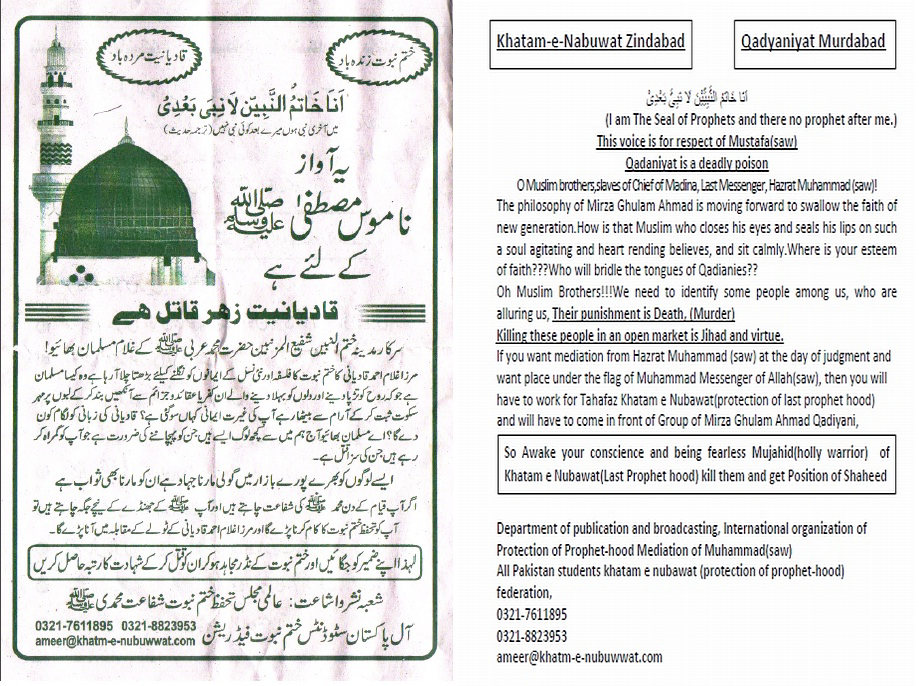
It is noteworthy that the two men who were the prime-movers of the false accusation belong to the extremist religious body, Jamaat ud Da’wa (JD) banned by the UN for promoting terrorism. The Aalami Majlis Tahaffuz Khatme Nabuwwat, the cover organization of mullas who promote their national and international political agenda these days in the garb of End of Prophethood, strove hard to raise communal tensions in the weeks following the incident. Saqlain Shah, the local MNA (PML-N) provided the political support to the agitation. Sarwat Nadeem, a provincial minister of Baluchistan, came all the way from Quetta to share the political spoils of a tense communal situation. It is material to the case that the local leadership who were aware of the reality did not support the charge. These included the Imam of the concerned mosque, the village head (Numberdar) and the Naib Nazim. As such rabble-rousers, self-styled Ghulaman-e-Rasul Punjab issued a leaflet with the following demand: “… The arrested Qadianis should be given death sentence forthwith. The Imam of the local mosque of Chak No. 172 should be immediately arrested and those who are in favor of disregarding the incident and dropping the case should be interrogated. If the local administration, the DPO and senior officials do not take action against the Imam, the people, motivated by religious zeal, will have to take action by themselves against the Imam”. One may ask: Who is ruling – the authorities or the mob?

Various human rights organizations, national as well as international took due notice of this important case and demanded that the accused should be set free. The Asian Human Rights Commission (AHRC), as early as January 30, 2009 issued a statement and titled it: Pakistan: Four children and one man have been arbitrarily arrested and charged with blasphemy at the request of Muslim radicals. It ended: The AHRC urges the government of President Asif Zardari to immediately release the illegally detained prisoners. Instead they should turn their attention to the dependence of Punjab Police on fundamentalist Islamic groups and the implementation of the rule of law in the province, including the amendment in the blasphemy law made by the parliament.

The Human Rights Commission of Pakistan sent its own fact-finding mission to District Layyah and rendered its report. Excerpts;
The local Ahmadiyya community is facing a social boycott since the incident, especially some members of the defund Sipah-e-Sahaba Pakistan (SSP), recently banned Jamaat ud Da’wa (JD), and Majlis Tahaffuz Khatme Nabuwwat. ... The police remain mum on these protests because those waging them enjoy the support of Iqbal Hussain Shah, uncle of Pir Saqlain Shah, MNA of the constituency. …The Imam of the local mosque Maulvi Saeed told TNS that writing graffiti on toilet walls is a norm here. … Maulvi Saeed believes there is no eye witness of the incident. … Maulvi Saeed alleges he was forced by Shahbaz and his aids to remain absent from the scene when police was visiting the mosque where the incident took place. … According to him (the police SHO), Maulvi Kalachi (of JD) was the first person on whose complaint the FIR was registered. To the question why police was unable to handle the protestors, he expressed his helplessness. … District President PPP and Naib Nazim of the concerned Union Council Abdul Majeed Bhutta affirmed that the complainants are making a hill out of molehill. “In my personal view, it is overplayed.” … In 2004, an amendment was made in Criminal Procedural Code (Cr PC) Section 295-C of the constitution according to which the police is bound to thoroughly investigate blasphemy accusations before leveling criminal charges. The aim of the amendment was to reduce the scope of the blasphemy laws which are still widely and frequently abused and often result in death penalties. But this did not happen in this case. … He (Dr Khalid Ranjha, former federal law minister) said people settle personal scores and give false testimony on these sensitive matters. He said if the state and police submit itself before propaganda, and allows mob to provoke the matter then there is no writ of the state and protection of citizens.
In a press release on February 12, 2009, Ms Asma Jahangir, Chairperson of the HRCP demanded of the government: “The Commission demands a transparent and fair inquiry in this incident so that innocent persons do not become targets of injustice. The Commission further demands that the government must ensure the members of the Ahmadiyya faith do not feel insecure in that area and they are not harassed. The Commission appeals to the government to take appropriate steps to stop misuse of the blasphemy law.”

This incident sent a wave of concern in many capitals of the world. For instance, a number of members of the US Congress wrote to the US State Department on the subject. In Europe, a question regarding this incident was tabled in European Union Council and Commission by a Swedish MEP. The Canadian High Commission carried out its own inquiry of the case and the High Commissioner wrote a letter to the Governor of Punjab conveying his concern. The Hong Kong-based AHRC put the question bluntly: “At this juncture the AHRC would like to question who Pakistan police are meant to serve: a few civilian religious groups with little regard for the law, and an agenda of violent persecution? Or do they serve the rule of law and the people of Pakistan? Their actions and admissions in this case point to the former.” The accused are considering making an appeal to the relevant office of the United Nations.

On April 8, 2009 Mr. Masood Ahmad, Advocate sent a Fax message to the President of Pakistan (Mr. Asif Zardari) with a copy to the Prime Minister of Pakistan, Chief Minister Punjab (Mian Shahbaz Sharif) and other concerned federal and provincial authorities requesting the release of the accused. Nothing has happened – as yet.

The prestigious daily Dawn got it right when it editorialized on March 4, 2009:
“The obscurantists must be tackled head on if we are to entertain any hope of redemption. If the state resorts to negotiating with militants from a position of weakness, what we will get is a disaster, across the board. The politicians need to wakeup, burry the hatchet in the national good and rout the real enemy.”
In Layyah, the government of the Punjab is unwittingly breading and nourishing its mullas Fazalullah. Will the consequences be any different than in Swat? No; there is indeed urgent need to wake-up.

Ref: The police registered the case with FIR No 46/09 at Police Station Kot Sultan District Layyah, on 28 Jan 09 under PPC 295C.

Thursday, April 16, 2009

Pakistan: USSD Country Reports on Human Rights Practices - 2008

Excerpts from
U.S. Department of State
Country Reports on Human Rights Practices - 2008
Released by the Bureau of Democracy, Human Rights, and Labor, February 25, 2009

Pakistan

……
Despite some improvements after the state of emergency at the end of the previous year, the human rights situation remained poor. Major problems included extrajudicial killings, torture, and disappearances. There were also instances in which local police acted independently of government authority. Collective punishment was a problem particularly in the Federally Administered Tribal Areas (FATA), which falls under the legal framework of the Frontier Crimes Regulation (FCR). Lengthy trial delays and failures to discipline and prosecute those responsible for abuses consistently contributed to a culture of impunity. Poor prison conditions, arbitrary arrest, and lengthy pretrial detention remained problems, as did a lack of judicial independence. Corruption was widespread within the government and police forces, and the government made few attempts to combat the problem. Although implementation of the 2006 Women’s Protection Act somewhat improved women’s rights, rape, domestic violence, and abuse against women remained serious problems. Honor crimes and discriminatory legislation affected women and religious minorities respectively. Religious freedom violations and inter-sectarian religious conflict continued. Widespread trafficking in persons, child labor, and exploitation of indentured and bonded children were ongoing problems. Child abuse, commercial sexual exploitation of children, discrimination against persons with disabilities, and worker rights remained concerns.
……

RESPECT FOR HUMAN RIGHTS

Section 1 Respect for the Integrity of the Person, Including Freedom From:

a. Arbitrary or Unlawful Deprivation of Life

Attacks on houses of worship, religious gatherings, and religious leaders linked to sectarian, religious extremist, and terrorist groups outside FATA resulted in hundreds of deaths during the year. Examples of these cases include the following:

……
On September 7, the local anchor of a religious affairs program on Geo Television, Amir Liaquat Hussain, declared that Islamic teachings necessitated the killing of members of the Ahmadi sect and prompted two religious scholars who were guests on the program to affirm the injunction. Amir, a former minister of religious affairs in the Musharraf government, repeated the statement the next day. Within days, two local Ahmadi leaders were killed in Sindh. Two gunmen killed Dr Abdul Mannan Siddiqui, an Ahmadi doctor and local leader known for his charity work, in a Mirpurkhas hospital on September 8. The gunmen also shot an Ahmadi guard and two patients. A day later, gunmen killed another local Ahmadi leader, Seth Muhammad Yousuf, in the bazaar in Nawab Shah. The Pakistan Medical Association called for official investigations into the case, but as of year’s end, the government continued to stall investigation into the deaths. Local media and human rights organizations condemned the Geo program for inciting sectarian violence.

c. Torture and Other Cruel, Inhuman, or Degrading Treatment or Punishment

The law prohibits torture and other cruel, inhuman, or degrading treatment; there were reports, however, that security forces, including intelligence services, tortured and abused individuals in custody. Under provisions of the Anti-Terrorism Act, coerced confessions are admissible in antiterrorism courts. The NGO SHARP reported 1,013 cases of torture by police between January and June, including approximately 500 cases by the Punjab police and nearly 350 cases by the Sindh police.……

Prison and Detention Center Conditions

Prison conditions were extremely poor and failed to meet international standards. Overcrowding was widespread, except for cells of wealthy or influential prisoners. According to SHARP, nearly 90,000 prisoners occupied 87 jails originally built to hold a maximum of 36,075 persons.

Inadequate food and medical care in prisons led to chronic health problems and malnutrition for those unable to supplement their diet with help from family or friends. Foreign prisoners often remained in prison long after completion of their sentences because they were unable to pay for deportation to their home countries.

Police reportedly tortured and mistreated those in custody and at times engaged in extrajudicial killings. Christian and Ahmadi communities claimed their members were more likely to be abused. Non-Muslim prisoners generally were afforded poorer facilities than Muslim inmates and often suffered violence at the hands of fellow inmates.
………

d. Arbitrary Arrest or Detention

Role of the Police and Security Apparatus

Police often failed to protect members of religious minorities from societal attacks, including Christians, Ahmadis, and Shias.

Arrest and Detention

………
The law stipulates detainees must be brought to trial within 30 days of their arrest. Under both the Hudood and standard criminal codes, there are bailable and nonbailable offenses. Bail pending trial is required for bailable offenses and permitted at a court's discretion for nonbailable offenses with sentences of less than 10 years. In practice judges denied bail at the request of police, the community, or on payment of bribes. In many cases trials did not start until six months after the filing of charges, and in some cases individuals remained in pretrial detention for periods longer than the maximum sentence for the crime for which they were charged. Human rights NGOs estimated that approximately 50 percent of the prison population was awaiting trial.

e. Denial of Fair Public Trial

Lower courts remained corrupt, inefficient, and subject to pressure from prominent wealthy, religious, and political figures. The politicized nature of judicial promotions increased the government's control over the court system. Unfilled judgeships and inefficient court procedures resulted in severe backlogs at both trial and appellate levels.

Trial Procedures

………
Courts routinely failed to protect the rights of religious minorities. Judges were pressured to take strong action against any perceived offense to Sunni orthodoxy. The judiciary rarely heard discrimination cases dealing with religious minorities.

Laws prohibiting blasphemy continued to be used against Christians, Ahmadis, and members of other religious groups, including Muslims. Lower courts often did not require adequate evidence in blasphemy cases, which led to some accused and convicted persons spending years in jail before higher courts eventually overturned their convictions or ordered them freed.

Original trial courts usually denied bail in blasphemy cases, claiming that since defendants faced the death penalty, they were likely to flee. Many defendants appealed the denial of bail, but bail was often not granted in advance of the trial. Lower courts frequently delayed decisions, were intimidated, and refused bail for fear of reprisal from extremist elements.
………

f. Arbitrary Interference with Privacy, Family, Home, or Correspondence

………
In accordance with the Anti-Terrorism Act of 1997, the government banned the activities of and membership in several religious extremist and terrorist groups. Some of the banned groups changed their names and remained active, including: Jaish e Muhammad (new name: Tehrikul Furqan & Al Rehmat Trust); Tehrik e Ja’afria Pakistan (new name: Tehrik e Islami Pakistan); and Sipah e Sihaba Pakistan (new name: Millat e Islamia Pakistan). Lashkar e Taiba regrouped under the new name Jamaat ud-Dawa but was again banned in December in response to its designation as a Foreign Terrorist Organization under UN Security Council resolution 1267. On August 25, the government labeled Tehrik-e-Taliban Pakistan (TTP) a terrorist organization and ordered the State Bank to freeze all the organization’s accounts. The TTP is a militant umbrella organization formed in December 2007 by Baitullah Mehsud.
………

Section 2 Respect for Civil Liberties, Including:

a. Freedom of Speech and Press

………
On September 7, the local anchor of a religious affairs program on Geo TV, Amir Liaquat Hussain, declared that Islamic teachings necessitated the killing of members of the Ahmadi sect. Within days, two local Ahmadi leaders were killed in Sindh (See section 1.a.).
………

b. Freedom of Peaceful Assembly and Association

The law provides for freedom of assembly and freedom of association, subject to restrictions imposed by law.

Freedom of Assembly


Although the constitution provides for this right, in practice the government placed selective restrictions on the right to assemble. By law, district authorities can prevent gatherings of more than four people without police authorization. Separately, Ahmadis have been prohibited from holding conferences or gatherings since 1984.

c. Freedom of Religion

The constitution states that adequate provisions shall be made for minorities to profess and practice their religions freely, [Word freely which appeared in the original Objective Resolution, passed by the Constituent Assembly of Pakistan in March, 1949, was omitted when it was made a substantive part of the Constitution of Pakistan by P.O. (Presidential Order) No.14 of 1985, Art.2 and Sch.item 2 (with effect from March 2, 1985).] but the government limited freedom of religion in practice. Islam is the state religion, and the constitution requires that laws be consistent with Islam. According to the constitution, Shari’a can be applied to a situation deemed to be in contradiction to the Koran, and therefore citizens who are normally governed by secular law can be subject to Shari’a. Shari’a also was applied in some tribal areas. In the PATA of NWFP, religious advisors assisted judges. All citizens were subject to certain provisions of Shari’a and the blasphemy laws. Freedom of speech is constitutionally subject to “any reasonable restrictions imposed by law in the interest of the glory of Islam.”

Reprisals and threats of reprisals against suspected converts from Islam occurred. Members of religious minorities were subject to violence and harassment, and at times police refused to prevent such actions or charge persons who committed them, leading to an atmosphere of impunity. The constitution stipulates the president and the prime minister must be Muslim. The prime minister, federal ministers, and ministers of state, as well as elected members of the Senate and National Assembly (including non-Muslims), must take an oath to “strive to preserve the Islamic ideology,” the basis for the creation of the country.

The law declares the Ahmadi community, which considers itself a Muslim sect, to be a non-Muslim minority. The law prohibits Ahmadis, who numbered more than two million, from engaging in any Muslim practices, including use of Muslim greetings, referring to their places of worship as mosques, reciting Islamic prayers, using specific Islamic terms, and participating in the Hajj or Ramadan fast. Ahmadis were prohibited from proselytizing, holding gatherings, or distributing literature. Government forms, including passport applications and voter registration documents, require anyone wishing to be listed as a Muslim to denounce the founder of the Ahmadi faith. The Ahmadi community claimed that during the year, 31 Ahmadis faced criminal charges under religious laws or because of their faith. As of November, there had been four targeted killings of Ahmadis during the year, according to the AHRC.

The penal code calls for the death sentence or life imprisonment for anyone who blasphemes the Prophet Muhammad. The law provides for life imprisonment for desecrating the Koran and as long as 10 years in prison for insulting another’s religious beliefs with the intent to offend religious feelings. The latter was used only against those who allegedly insulted the Prophet Muhammad. Groups such as the Khateme Nabuwwat Movement, which considered anyone who questioned the finality of Prophet Muhammad to be a heretic, were reported to insult Ahmadi beliefs, but authorities did not prosecute these cases.

On June 8, police charged all the residents of Rabwah in Punjab under anti-Ahmadi laws and arrested Muhammad Yunus. The basis for the police charges against the thousands of Rabwah residents, according to the FIR, included lighting fireworks and lamps and greeting each other, which the government considered to be preaching their faith, a crime by law. The case was pending at year’s end.

In August communities near Multan warned Ahmadis in the area to close their places of worship. When they refused, the communities lodged a complaint with local police, alleging the Ahmadis were attempting to proselytize. Police ordered the “temporary closure” of Ahmadi centers in the area. They remained closed at year’s end.

………
During the year, there were no developments in the January 2007 case in which an Intelligence Bureau district officer ordered the arrest of five Ahmadis, including two minors ages eight and 11, after a teacher discovered the minors carrying an Ahmadi children’s magazine, Tashhizul Azhan. The case received wide press coverage, following which the charges were dropped. The case was re-filed in February 2007 against two adults.

There were no developments in the trial of the March 2007 case of a retired assistant sub-inspector who shot and killed a recent Ahmadi convert in a restaurant in Seerah, near Mandi Bahauddin in Punjab. The retired officer, Riaz Gondal, later surrendered to police and admitted to the killing, claiming the act was justified under Islamic apostasy laws. At year’s end, he was incarcerated and the case was pending.

………
Complaints under the blasphemy laws were used in business or personal disputes to harass religious minorities or other Muslims, but most complaints were filed against the majority Sunni Muslim community. Many blasphemy complaints were lodged by Sunnis against fellow Sunnis. The appellate courts dismissed most blasphemy cases; the accused, however, often remained in jail for years awaiting the court’s decision. Trial courts were reluctant to release on bail or acquit blasphemy defendants for fear of violence from extremist religious groups. In 2005 the president signed a bill into law revising the complaint process and requiring senior police officials to review such cases in an effort to eliminate spurious charges. According to human rights and religious freedom groups, however, this process was not effective because senior police officers did not have the resources to review the cases. In 2007 courts convicted two individuals and acquitted two others under the blasphemy laws; 71 cases were ongoing at the end of the year.

Societal Abuses and Discrimination

Sectarian violence between Sunni and Shia extremists continued during the year. Shias, Christians, and Ahmadis were also the targets of religious violence across the country.

According to the National Commission for Justice and Peace (NCJP), one church, one Hindu temple, and five Ahmadi mosques were attacked and damaged in different parts of the country during the year; four of the seven attacks took place in the province of Punjab.

In the same period, the NCJP reported 53 Ahmadis and 93 Christians faced trials or were in prison on charges of desecrating the Koran.

Human rights lawyer and chairman of the NGO Legal Aid for Destitute and Settlement Parvez Aslam Chaudhry was forced to travel with police security during the year, following an attack on him in January 2006 for his work defending blasphemy cases. Although Punjabi authorities filed a case against an unknown assailant in 2007, no arrests were made during the year.

………
Ahmadi leaders charged that militant Sunni mullahs and their followers sometimes staged marches through the streets of Rabwah, a predominantly Ahmadi town and spiritual center in central Punjab. The Ahmadis claimed that police generally were present during these marches.

Ahmadi, Christian, Hindu, and Shia Muslim communities reported significant discrimination in employment and access to education, including at government institutions.

Shia, Christian, Hindu, and Ahmadi communities faced discrimination and societal violence. The government removed religiously sensitive material from new textbooks on religious differences and on how to worship. Other religions can opt out of these readings and read the more generic “Book of Ethics.”

Section 3 Respect for Political Rights: The Right of Citizens to Change Their Government

Elections and Political Participation

The government required voters to indicate their religion when registering to vote. The Ahmadi community boycotted the elections, according to the European Union Election Observation Mission, because they were required to register on a separate voter roll.

………
There were 10 religious minority members in reserved seats in the National Assembly and one served in the cabinet as the Federal Minister for Minorities. Such seats were apportioned to parties based on the percentage of seats each wins in the assembly. Under the law, minorities held 23 reserved seats in the provincial assemblies: eight in Punjab; nine in Sindh; three in NWFP; and three in Balochistan.

Section 5 Discrimination Based on Race, Sex, Disability, Language, or Social Status

The constitution provides for equality for all citizens and broadly prohibits discrimination based on race, religion, caste, residence, or place of birth; in practice, however, there was significant discrimination based on each of these factors.

URL: www.state.gov/g/drl/rls/hrrpt/2008/sca/119139.htm

Wednesday, April 15, 2009

Bangladesh: USSD Country Reports on Human Rights Practices - 2008

Excerpts from
U.S. Department of State
Country Reports on Human Rights Practices - 2008
Released by the Bureau of Democracy, Human Rights, and Labor, February 25, 2009

Bangladesh

………
Although levels of violence declined significantly and the caretaker government oversaw successful elections, the government’s human rights record remained a matter of serious concern, in part due to the state of emergency that remained in place for most of the year and the failure to fully investigate extrajudicial killings. The state of emergency, which was relaxed temporarily in advance of local elections in August and finally lifted on December 17, curtailed many fundamental rights, including freedom of expression, freedom of association, and the right to bail. The government promulgated the Emergency Powers Rules (EPR) 2007 and Emergency Powers Ordinance 2007 to enforce the state of emergency. The anticorruption drive that the government initiated, while greeted with popular support, gave rise to concerns about fairness and equity under the law. For most of the year the government banned political activities, although this policy was enforced unevenly. There was a decrease in the number of extrajudicial killings by security forces, but they committed serious abuses, including extrajudicial killings, custodial deaths, arbitrary arrest and detention, and harassment of journalists. Some members of security forces acted with impunity and committed acts of physical and psychological torture. Violence against women and children remained a serious problem, as did trafficking in persons.

RESPECT FOR HUMAN RIGHTS

Section 2 Respect for Civil Liberties, Including:

c. Freedom of Religion

The constitution establishes Islam as the state religion and also stipulates the right, subject to law, public order, and morality, to practice the religion of one's choice. The government generally respected this right in practice. Although the government was secular, religion shaped the platforms of certain political parties. Discrimination against members of religious minorities existed at both the governmental and societal levels, and religious minorities were disadvantaged in practice in such areas as access to government jobs, political office, and justice.
………

Government protection of Ahmadiyyas continued to improve, although social discrimination continued. The High Court continued to stay the government ban on publishing Ahmadiyya literature, effectively allowing Ahmadiyyas to publish.
………

Societal Abuses and Discrimination

Discrimination against Ahmadiyyas, Hindus, and Christians occurred during the year. However, there were no demonstrations by anti-Ahmadiyya groups during the year.

On March 15 and March 21, the Special Branch of police in Brahmanbaria prevented groups of Ahamadiyyas from holding a religious convention. Due to intervention by officials at senior levels of the home ministry, both conventions were held.
………

URL: www.state.gov/g/drl/rls/hrrpt/2008/sca/119132.htm

Indonesia: USSD Country Reports on Human Rights Practices - 2008

Excerpts from
U.S. Department of State
Country Reports on Human Rights Practices - 2008
Released by the Bureau of Democracy, Human Rights, and Labor, February 25, 2009

Indonesia

The government generally respected the human rights of its citizens and upheld civil liberties. Nonetheless, there were problems during the year in the following areas: killings by security forces; vigilantism; harsh prison conditions; impunity for prison authorities and some other officials; corruption in the judicial system; limitations on free speech; societal abuse and discrimination against religious groups and interference with freedom of religion, sometimes with the complicity of local officials; instances of violence and sexual abuse against women and children; trafficking in persons; child labor; and failure to enforce labor standards and worker rights.

RESPECT FOR HUMAN RIGHTS

Section 2 Respect for Civil Liberties, Including:

b. Freedom of Peaceful Assembly and Association

Freedom of Association

On April 19, approximately 350 members of the Islamic sect Ahmadiyya from 200 chapters across the country were forced to cancel their national conference in Bali when the Bali police would not issue them a permit (see section 2.c.).

c. Freedom of Religion

The constitution provides for “all persons the right to worship according to his or her own religion or belief” and states that “the nation is based upon belief in one supreme God.” The government generally respected the former provision. Six faiths Islam, Protestantism, Catholicism, Hinduism, Buddhism, and Confucianism—received official recognition in the form of representation at the Ministry of Religious Affairs.

On January 15, the government-appointed Coordinating Board for Monitoring Mystical Beliefs in Society recommended the government dissolve the Ahmaddiyah sect.

On June 9, the government issued a decree prohibiting the Ahmaddiyah from proselytizing and conducting religious activities, as well as prohibiting vigilantism against the sect. The decree warned Ahmaddiyah members against making their own interpretations of Islam and against spreading their beliefs. Vice President Jusuf Kalla said that the decree did not prohibit the Ahmadiyya from worshipping or continuing to practice within its own community.

On September 1, the South Sumatra governor banned Ahmadiyyah and any activities of the Indonesian Jamaah Ahmadiyyah organization in the province.

Persons whose religion was not one of the six officially recognized faiths had difficulty obtaining an identity card, which was necessary to register marriages, births, and divorces. Men and women of different religions experienced difficulties in marrying and in registering marriages. The government refused to register a marriage unless a religious marriage ceremony had taken place. However, very few religious officials were willing to take part in weddings involving couples of different faiths. For this reason, some brides and grooms converted to their partner’s religion. Others resorted to traveling overseas to wed.
………

Societal Abuses and Discrimination

Throughout the year numerous Ahmadiyya communities were attacked by vigilante groups, and over 20 mosques were forcibly shut down. A number of these incidents occurred after the release of the July decree that banned attacks on the religious group.

URL: www.state.gov/g/drl/rls/hrrpt/2008/eap/119040.htm

Tuesday, April 14, 2009

PERSECUTION IN PAKISTAN - MARCH 2009

---Ahmadiyya Muslim Jamaat International, UK

PERSECUTION IN PAKISTAN - MARCH 2009
REPORT
(Please note that information contained in this report is a summary only of selected
incidents that occurred in Pakistan during March 2009.)

CONTENTS
Murder of Two Ahmadi Doctors in Multan
District Layyah Update
15 Ahmadis charged in District Sargodha
Ahmadi charged for ‘preaching’
Female teacher charged
Threat to Ahmadi doctor
Abduction of Ahmadi in Sindh
Anti-Ahmadiyya inciteme
nt (various)

MURDER OF TWO AHMADI DOCTORS IN MULTAN – 14 MARCH 2009

Two Ahmadi doctors, Dr Shiraz Ahmad Bajwa and his wife Dr Noreen Bajwa, were martyred at their residence in Wapda Colony, Multan at around 3.30pm on 14 March 2009.

The body of Dr Shiraz Bajwa was found in the bedroom, hands tied behind his back, mouth gagged, blindfolded and with visible marks of strangulation.

The body of Dr Noreen Bajwa was found in the living room, hand tied behind her back, mouth gagged, blind folded and bleeding from the nose.

Multan is used as a headquarters by an anti-Ahmadiyya organisation and thus the area has become a hub of intense anti-Ahmadi propaganda and a number of documents have been published inciting hatred towards Ahmadiyyat. Prior to the aforementioned martyrdoms authorities had warned that sectarian elements within the local community had prepared a lengthy ‘hit list’ of both Ahmadi personalities and locations. All evidence points to the aforementioned murders forming part of this campaign.

Further information can be found in Press Releases issued by the Ahmadiyya Muslim Jamaat on 15 and 15 March 2009.

DISTRICT LAYYAH – UPDATE

On 28 January 2009 four Ahmadi children and one adult were falsely charged under section 295-C of the Pakistani Penal Code on spurious charges of blasphemy made by religious extremists in the area.

The five persons remain imprisoned and the education of the children continues to suffer. They are being detained in extremely poor conditions with little access to Ahmadiyya officials or their families.

Further information can be found in Press Releases issued by the Ahmadiyya Muslim Jamaat on 30 January 2009, 2 February 2009 and 6 February 2009.

15 AHMADIS CHARGED IN SILLANWALI, SARGODHA – 4 MARCH 2009

Police case (FIR 69/09) was registered on 4 March 2009 against 15 Ahmadis at Sillanwali Police Station at District Sargodha under the terms of section 295-C of the Pakistani Penal Code. They were accused of ‘posing’ as Muslims and praying in a building which they ‘call a Mosque’.

Three persons, Mr Abdul Aziz, Mr Muhammad Ashraf and Mr Khizar Hayat, were arrested and refused bail. Although at an initial hearing bail was refused the three detainees were released on bail on 28 March 2009. Since then others accused have been arrested and continue to be detained.

Further information can be found in Press Releases issued by the Ahmadiyya Muslim Jamaat on 15 and 13 March 2009.

AHMADI CHARGED FOR ‘PREACHING’ – 4 MARCH 2009

An FIR was registered by police against Muhammad Nawaz at the City Police Station, Chiniot on 4 March 2009 under the terms of section 295-B of the Pakistani Penal Code. Mr Nawaz is accused of ‘preaching’ Ahmadiyyat to a man named Mr Muhammad Latif. If convicted Mr Nawaz faces up to three years imprisonment.

FEMALE AHMADI TEACHER CHARGED – 5 MARCH 2009

Police case (FIR 71/09) was registered on 5 March 2009 against Bushra Naheed, a teacher at Government Girls High School, Jodhala, under the terms of section 295-A of the Pakistani Penal Code.

Ms Naheed is accused of inciting two labourers to attack Haleemam Bibi. This charge is absolutely denied by Ms Naheed. No such attack ever took place. However local Mullahs reported the matter to the police and school authorities. She was duly charged by the police and suspended by her school in the absence of any form of investigation. If convicted Ms Naheed could face up to ten years imprisonment.

THREAT TO AHMADI DOCTOR IN MIRPUR KHAS


An Ahmadi doctor is facing great threat to his life. He has recently received threats by phone urging him to either leave Ahmadiyyat or to flee the area. He has also received a number of letters addressed directly to him. A translated extract is produced:
“Take this small note seriously; do not take it as a hollow threat. We know everything about you. Your two sons are studying at... Cooperate with us otherwise we will abduct your children. Your house is in... Hurry to cooperate with us. Do not take this as a hollow threat.”
(Names and Addresses have been removed)

In September 2009 two Ahmadis (Dr Abdul Mannan Siddiqi and Saith Muhammad Yousuf) were murdered on consecutive days in Sindh. On the third day two of the murder suspects went to visit the doctor but he was away at the funeral of Dr Abdul Mannan Siddiqi. On the fourth day the two suspects again visited the doctor but he was away offering condolence to the family of Saith Muhammad Yousuf.

On 1st March 2009 a man approached the clinic of the doctor late at night. He demanded loudly that the door be opened and when this request was denied by staff he opened it forcibly. He subsequently engaged in foul language and insisted that the doctor be called. When staff resisted he pulled out a gun. Relatives of a patient admitted to the hospital observed this and as they were carrying their own arms managed to cause for the intruder to hurriedly depart alongside two associates who were waiting outside in the car park.

The threat level against this particular doctor is currently very high. Local authorities have been contacted but seem unwilling to cooperate to any significant degree.

ABDUCTION OF AHMADI IN DISTRICT UMAR KOT, SINDH – 16 MARCH 2009

Qamar Ahmad, age 26, was confronted by two men in the vicinity of his home at 9.30pm on 16 March 2009. He was forced into their vehicle, blindfolded and driven away. Upon arriving at an unknown location he was told to contact the local Ahmadiyya President because they said they had placed a bomb at the President’s home. Mr Ahmad said he did not have his number. He was then told to contact the local Head of the local Ahmadiyya Youth Association however again Mr Ahmad said he did not have the number. He was then told to phone his own brother and tell him to come immediately otherwise he would be killed.

Mr Ahmad phoned his brother and informed him of the threat. However nobody arrived and so the abductors tortured Mr Ahmad and tied his hands and feet. Eventually they left him stranded unconscious on the roadside. Sometime later four Ahmadi youths found Mr Ahmad unconscious and with rope tied around his neck and he was immediately taken to hospital.

Mr Ahmad is married and has a young daughter.

INCIDENTS IN RABWAH

On 6 March 2009, Ms Amatul Bari a visitor from Germany visited the local graveyard. Whilst at the graveyard she was struck by a brick and was injured. The incident was reported to police but no visible action has been noticed. This was not the first time that persons visiting the graveyard had been attacked.

Following three major anti-Ahmadi conferences held on 10 March 2009, the next day a van transporting 27 girls from Rabwah from their various colleges in Chiniot was attacked. Stones and bricks were pelted at the van. The incident was reported to police but no action was taken.


ANTI-AHMADIYYA INCITEMENT AT VARIOUS LOCATIONS

Faisalabad

Organised anti-Ahmadi protests and incitement has been occurring for a number of weeks at the National Textile University in Faisalabad. The protests are supervised by mullahs who use foul language and falsely attribute non-Islamic beliefs to Ahmadis. Edicts of death are routinely issued at these protests.

Chak No.5 District Nankana

A local mullah has made it his routine to come to the aforementioned Chak and lead anti-Ahmadi protests. His foul and aggressive language has caused for a serious deterioration in local society cohesion and he continues to urge his supporters to boycott all Ahmadis.

Okara City

Local extremists have targeted schools, colleges and business centres for the distribution of provocative literature and leaflets. Ahmadis are routinely receiving threats and indeed it has emerged that members of the Khatme-Nabuwwat organisation are keeping a collection of photos of prominent local Ahmadis.

District Umar Kot


A large open-air conference was held by mullahs in which the speakers used foul and threatening language in opposition to the Ahmadiyya Muslim Jamaat. As a result the situation in the District, which was already worrying, has deteriorated further.

Karachi

In celebration of Eid Milad (birth date of Prophet of Islampbuh) non-Ahmadi Muslims marched in a celebratory procession. When they arrived at the front of the local Ahmadiyya place of worship they indulged in filthy and provocative language and the front of the building was vandalised.

Sargodha

On 23 March 2009 Majlis Tahaffuz Khatme Nabuwwat organised a rally to ‘protect the honour of the Prophet’. The event continuously included anti-Ahmadiyya propaganda and attempts were made to inflame the large crowd with fiery speeches filled with lies about the Ahmadiyya Jamaat. The speakers promoted sectarian hatred and strife in the name of the Holy Prophetpbuh.

Khushab

Hostility against the Ahmadiyya Jamaat in Khushab has increased gravely in the recent past. Ahmadis have received threats and anti-Ahmadi conferences have been planned. On 15 March 2009 a Nabuwwat Conference was held in the main mosque of Mittha Tawana and mullahs from as far as Karachi came to participate. Hate filled speeches were given and anti-Ahmadi literature was distributed.

Khanewal

A three day Khatme-Nabuwwat Conference was held between 25 and 27 March 2009. Anti-Ahmadiyya banners were present and the speakers made hateful speeches against the Jamaat. Anti-Ahmadiyya literature was distributed amongst the crowds.

District Layyah and District Narowal

Anti-Ahmadiyya groups distributed literature aimed at inflaming tensions against Ahmadis.

Multan

Just days after the murders of Dr Shiraz Ahmad Bajwa and Dr Noreen Bajwa in Multan, a Tahaffuz Khatme Nabuwwat Conference was held in the city. Provocative speeches were made and anti-Ahmadiyya literature was distributed amongst the masses.

© Ahmadiyya Muslim Jamaat International, UK

Friday, April 3, 2009

Ahmadiyah Ploy By Islamic Parties

Ahmadiyah Ploy By Islamic Parties
---Jakarta Globe
April 03, 2009
Muninggar Sri Saraswati

Ahmadiyah Ploy By Islamic Parties

This week’s campaign sorties saw at least two Islamic parties try to boost their sagging popularity by calling for the government to outlaw Ahmadiyah, a controversial Islamic sect.

The Ahmadiyah, which has been in the country since 1920, has become a rallying point for Muslim hardliners since it was declared a deviant sect by the country’s highest authority on Islam, the Indonesian Council of Ulema, in 2008

Suryadharma Ali, the chairman of the United Development Party, or PPP, the country’s fourth largest party, addressing about 10,000 supporters at a party campaign rally here, called on the government to dissolve Ahmadiyah.

The call came as various l surveys showed that PPP’s popularity was on the wane and that Islamic political parties stood no chances against the secular nationalist ones in the April 9 legislative elections.

Another call for the dissolution of the group came from Yusril Ihza Mahendra, chairman of the supervisory council of the Crescent Star Party, or PBB, another party that had been singled out by surveys as facing a tough battle to win votes this year. Yusril, a former state secretary, told thousands of supporters during his party’s campaign rally in Padang, the capital of West Sumatra Province, that the president should disband Ahmadiyah and order it to form a new religion separate from Islam.

Komaruddin Hidayat, rector of the state-run Syarif Hidayatullah State Islamic University, said targeting Ahmadiyah as an enemy was not relevant to Indonesian voters at present.

“Campaigning for the elections is about offering ideas, not selling an issue to lure voters,” he said. Syamsuddin Haris, a political researcher for the Indonesian Institute of Sciences, or LIPI, said the use of Ahmadiyah in the parties’ campaigns was “stupid” and “unsuitable.”

“It will not be productive in attracting voters,” he said.

Copyright 2009 The Jakarta Globe
URL: www.thejakartaglobe.com/home/article/15184.html
 
^ Top of Page