Showing posts with label khatme nubuwat andolan. Show all posts

Tuesday, December 8, 2009

Bangladesh: Int’l Religious Freedom Report - 2009

Excerpts from
U.S. Department of State
International Religious Freedom Report 2009: Bangladesh
Released by the Bureau of Democracy, Human Rights, and Labor
October 26, 2009

The Constitution establishes Islam as the state religion. It provides for the right to profess, practice, or propagate all religions, subject to law, public order, and morality. It also states that every religious community or denomination has the right to establish, maintain, and manage its religious institutions. Although the Government publicly supported freedom of religion, attacks on religious and ethnic minorities continued to be a problem during the reporting period. There were no reported demonstrations or attempts to attack institutions of the Ahmadiyya Muslim Community, but there were isolated instances of harassment. Demands that Ahmadis be declared non-Muslims continued sporadically, but the Government generally acted in an effective manner to protect Ahmadis and their property. Religion exerted a significant influence on politics, and the Government was sensitive to the religious sentiments of most citizens.

There was no change in the status of respect for religious freedom by the Government during the reporting period. On December 29, 2008, the Awami League (AL), an avowedly secular party that enjoys broad support from religious minorities, won power in the first parliamentary elections since 2001. These elections were largely free of the violence and intimidation against religious minorities that had characterized earlier ones. The new Government appointed members of minority communities to several senior leadership positions. The Government initiated efforts to reform the curriculum of Islamic religious schools, known as madrassahs, to standardize education. Citizens generally were free to practice the religion of their choice. Government officials, including police, nonetheless often were ineffective in upholding law and order and sometimes were slow to assist religious minority victims of harassment and violence. The Government and many civil society leaders stated that violence against religious minorities normally had political or economic dimensions and could not be attributed solely to religious belief or affiliation.

There were reports of societal abuses and discrimination based on religious affiliation, belief, or practice during the period covered by this report, although figures suggested such incidents declined significantly in comparison to the previous reporting period. Hindu, Christian, and Buddhist minorities experienced discrimination and sometimes violence from the Muslim majority. Harassment of Ahmadis continued.

The U.S. Government discusses religious freedom with the Government as part of its overall policy to promote human rights. In meetings with officials and in public statements, U.S. Embassy officers encouraged the Government to protect the rights of minorities. Publicly and privately, the Embassy denounced acts of religious intolerance and called on the Government to ensure due process for all citizens. The Ambassador met with minority religious communities around the country, including a visit to the country's most prominent Hindu temple just days before the national election and a visit to a predominantly Hindu polling station during the election. The U.S. Government sponsored the highly successful visit of a prominent U.S. Muslim cleric who spoke to audiences about Qur’anic interpretations that support tolerance and gender equity.

Section I. Religious Demography

The country has an area of 55,126 square miles and a population of 154 million. According to the 2001 census, Sunni Muslims constitute 90 percent of the population and Hindus 9 percent. The rest of the population is mainly Christian, mostly Roman Catholic, and Theravada-Hinayana Buddhist. Ethnic and religious minority communities often overlap and are concentrated in the Chittagong Hill Tracts and northern regions. Buddhists are predominantly found among the indigenous (non-Bengali) populations of the Chittagong Hill Tracts. Bengali and ethnic minority Christians live in communities across the country, including Barisal City, Gournadi in Barisal District, Baniarchar in Gopalganj, Monipuripara in Dhaka, Christianpara in Mohakhal, Nagori in Gazipur, and Khulna City. There also are small populations of Shi’a Muslims, Sikhs, Baha’is, animists, and Ahmadis. Estimates of their numbers varied from a few thousand to 100,000 adherents per group. There is no indigenous Jewish community and no significant immigrant Jewish population. Religion is an important part of community and cultural identity for citizens, including those who did not participate actively in prayers or services.
………

Section II. Status of Religious Freedom

Legal/Policy Framework

The Constitution establishes Islam as the state religion but provides for the right to practice, profess, and propagate any religion, subject to law, public order, and morality. There are no laws against blasphemy, although religious political parties have pledged to enact such laws should they gain power. Since coming into power, the new Government has not publicly commented on this issue.

The Government publicly supported freedom of religion; however, attacks and discrimination against religious and ethnic minorities continued during the reporting period. In general, government institutions and the courts protected religious freedom.
………

In 2001 the High Court ruled all legal rulings based on Shari’a known as fatwas, to be illegal. However, the ban was not implemented because a group of Islamic clerics filed an appeal, which remained unresolved at the end of the reporting period.

Although Islamic tradition dictates that only muftis (religious scholars) who have expertise in Islamic law are authorized to declare a fatwa, village religious leaders at times made declarations in individual cases. Sometimes this resulted in extrajudicial punishments, often against women, for perceived moral transgressions.
………

Abuses of Religious Freedom

On March 15, 2008, the Special Branch of police in Brahmanbaria prevented the Ahmadiyya community from holding a religious convention. Following an intervention by higher authorities, the Special Branch lifted its objections and the event was held peacefully. A similar incident occurred at Shalshiri in Panchagarh district on March 21, 2008. There were no further developments in either of these cases or similar incidents during the reporting period.
………

Section III. Societal Attitudes

………
There were approximately 100,000 Ahmadis concentrated in Dhaka and several other locales. Although mainstream Muslims rejected some of the Ahmadiyya teachings, most of them supported Ahmadis’ right to practice without fear or persecution. As compared to the previous reporting period, harassment of Ahmadis by those who denounced their teachings declined.

Prothom Alo reported that on July 27, 2008, the Muslim religious extremist group Amra Dhakabashi resumed its campaign to declare the Ahmadiyya non-Muslim. The organization filed civil cases against the religious leaders of the Ahmadiyya in all 64 districts and launched a cell phone text message-based defamation campaign against Ahmadiyya leadership. By the end of the reporting period, these campaigns had been unsuccessful in provoking a widespread backlash against the Ahmadiyya community.

Section IV. U.S. Government Policy

The U.S. Government discusses religious freedom with officials at all levels of the Government as well as with political party leaders and representatives of religious and minority communities. During the reporting period, the Embassy emphasized the importance of free, fair, and credible national parliamentary elections in 2008 with full participation of all ethnic and religious communities. Following the election, the Embassy reiterated the need for an inclusive political process for all citizens regardless of religion. The Embassy continued to express concern about human rights, including the rights of religious and ethnic minorities. Embassy staff traveled to various regions investigating human rights cases, including some involving religious minorities, and met with civil society members, NGOs, local religious leaders, and other citizens to discuss concerns about pre and post-election violence. They also encouraged law enforcement to take proactive measures to protect the rights of religious minorities.

U.S. Embassy and visiting U.S. Government officials regularly visited members of minority communities to hear their concerns and demonstrate support. Prior to the elections, the Ambassador visited a prominent Hindu temple in Dhaka and met with leaders from the community to demonstrate the U.S. Government’s support for an electoral process that was inclusive and free of violence. On election day he observed voters in a predominantly Hindu polling center.

The Embassy assisted U.S. faith-based relief organizations in filing documents for approval of schools and other projects. The Government has been willing to discuss such subjects and has been helpful in resolving problems. The Embassy also has acted as an advocate in the Home Ministry for these organizations in resolving problems with visas.

The Embassy encouraged the Government, through the Ministry for Religious Affairs, to develop and expand its training program for Islamic religious leaders. After a pilot program, the U.S. Government provided orientation sessions for religious leaders on human rights and gender equality, among other topics. For the fourth year in a row, the U.S. Government sponsored the visit of a prominent U.S. Muslim cleric to tour the country and speak. The cleric visited the southeastern city of Chittagong and addressed several audiences in Dhaka about Qur’anic interpretations that support religious tolerance and freedom and promote gender equality.

During the reporting period, the U.S. Government continued to make religious freedom, especially the problems facing the population in the Chittagong Hill Tracts, a topic of discussion in meetings with government officials. Embassy officers, including the Ambassador, visited the Hill Tracts over the course of the reporting period and met with senior government officials to relay concerns about the treatment of minorities.

Democracy and governance projects supported by the U.S. Government included tolerance and minority rights components.

URL: www.state.gov/g/drl/rls/irf/2009/127363.htm

Friday, October 10, 2008

Int’l Religious Freedom Report - 2008: Bangladesh

Excerpts from
U.S. Department of State
International Religious Freedom Report 2008 : Bangladesh
Released by the Bureau of Democracy, Human Rights, and Labor
September 19, 2008
Bangladesh

The Constitution establishes Islam as the state religion. It provides for the right to profess, practice, or propagate all religions, subject to law, public order, and morality. It also states that every religious community or denomination has the right to establish, maintain, and manage its religious institutions. While the Government publicly supported freedom of religion, attacks on religious and ethnic minorities continued to be a problem during the reporting period. As opposed to previous reporting periods, there were no reported demonstrations or attempt to lay siege to Ahmadiyya institutions, but there were instances of harassment. Demands that Ahmadis be declared non-Muslims continued sporadically, but the Government generally acted in an effective manner to protect Ahmadis and their property. Religion exerted a significant influence on politics, and the Government was sensitive to the Islamic consciousness of most citizens.

There was no change in the status of respect for religious freedom by the Government during the reporting period. Citizens were generally free to practice the religion of their choice. Government officials, including the police, were nonetheless often ineffective in upholding law and order and were sometimes slow to assist religious minority victims of harassment and violence. The Government and many civil society leaders stated that violence against religious minorities normally had political or economic motivations and could not be attributed only to religious belief or affiliation.

There were reports of societal abuses and discrimination based on religious belief or practice during the period covered by this report. Hindu, Christian, and Buddhist minorities experienced discrimination and sometimes violence by the Muslim majority. Harassment of Ahmadis continued along with demands that Ahmadis be declared non-Muslims.

The U.S. Government discusses religious freedom with the Government as part of its overall policy to promote human rights. In meetings with officials and in public statements, U.S. embassy officers encouraged the Government to protect the rights of minorities. Publicly and privately, the Embassy denounced acts of religious intolerance and called on the Government to ensure due process for all citizens. The Ambassador and Charge d′Affairs made several visits to minority religious communities around the country. The U.S. Government sponsored the successful visit of a prominent U.S. Muslim cleric who spoke to audiences about Qur’anic interpretations that support tolerance and gender equity.

Section I. Religious Demography

The country has an area of 55,126 square miles, and its population is 154 million. According to the 2001 census, Sunni Muslims constitute 89.7 percent of the population and Hindus account for 9.2 percent. The rest of the population is mainly Christian (mostly Roman Catholic) and Theravada-Hinayana Buddhist. Ethnic and religious minority communities often overlapped and were concentrated in the Chittagong Hill Tracts and northern regions. Buddhists are found predominantly among the indigenous (non-Bengali) populations of the Chittagong Hill Tracts. Bengali and ethnic- minority Christians lived in many communities across the country; in cities such as Barisal City, Gournadi in Barisal District, Baniarchar in Gopalganj, Monipuripara in Dhaka, Christianpara in Mohakhal, Nagori in Gazipur, and Khulna City. There also are small populations of Shi’a Muslims, Sikhs, Baha’is, Animists, and Ahmadis. Estimates of their numbers varied from a few thousand to 100 thousand adherents per group. There was no indigenous Jewish community, nor a significant immigrant Jewish population. Religion was an important part of community identity for citizens, including those who did not participate actively in prayers or services.
………

Section II. Status of Religious Freedom

Legal/Policy Framework

The Constitution establishes Islam as the state religion but provides for the right to practice, profess, and propagate any religion, subject to law, public order, and morality.
………

While the Government publicly supported freedom of religion, attacks and discrimination against religious and ethnic minorities continued during the reporting period.

While the right to propagate the religion of one’s choice is guaranteed by the Constitution, local authorities and communities often objected to efforts to convert persons from Islam.

In general, government institutions and the courts protected religious freedom.………

Since 2001, the Government has routinely posted law enforcement personnel at religious festivals and events that are easy targets for extremists.
………

In 2001 the High Court ruled all legal rulings based on Shari’a known as fatwas to be illegal. However, the ban had not been implemented because of a pending appeal filed by a group of Islamic clerics, which remained unresolved at the end of the reporting period.

Abuses of Religious Freedom

………
On March 15, 2008, the Special Branch of police in Brahmanbaria prevented the Ahmadiyya from holding a religious convention. The convention ultimately was held peacefully after the Special Branch lifted its objections following intervention by higher authorities. A similar incident occurred at Shalshiri in Panchagarh district on March 21, 2008.

Section III. Societal Attitudes

There were approximately 100,000 Ahmadis concentrated in Dhaka and several other locales. While mainstream Muslims rejected some of the Ahmadiyya teachings, the majority supported Ahmadis′ right to practice without fear or persecution. However, Ahmadis continued to be subject to harassment from those who denounced their teachings.

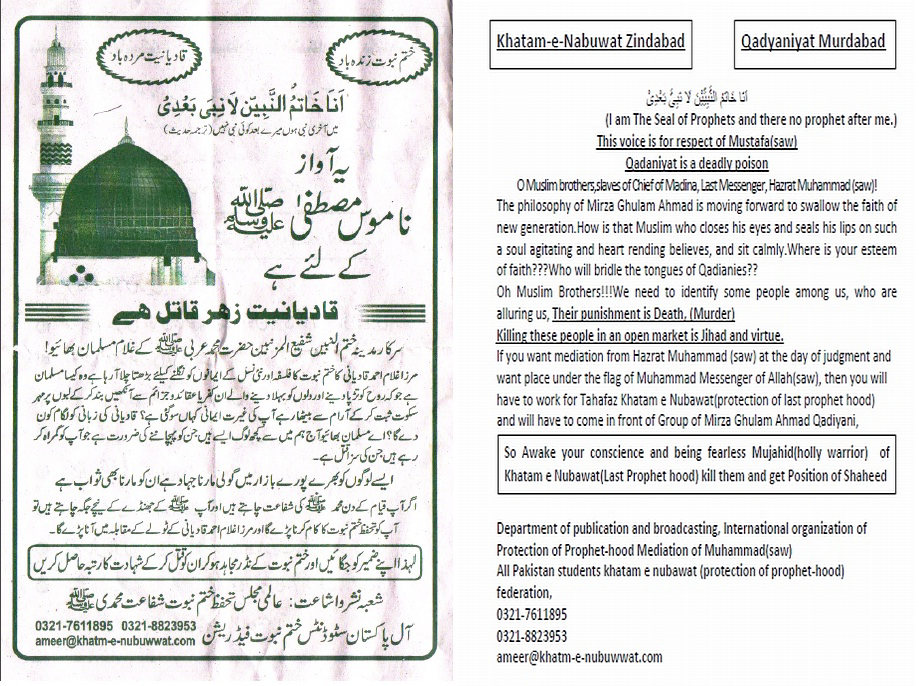
Since 2004 anti-Ahmadiyya extremists such as the International Khatme Nabuwat Movement Bangladesh and a splinter group, the Khatme Nabuwat Andolon Bangladesh (KNAB), have publicly demanded that the Government pass legislation declaring Ahmadis to be non-Muslims. The Government rejected the ultimatums and successfully kept protesters a safe distance from all Ahmadiyya buildings. Since the proclamation of a state of emergency in January 2007, the anti-Ahmadiyya groups have not held demonstrations. However, discrimination against Ahmadis continued. On August 24, 2007, local authorities in Kushtia stopped religious classes organized by the Ahmadiyya community inside their mosque.

In December 2006 the Awami League upset many of its minority and liberal supporters when it signed an electoral pact with the Bangladesh Khelafat Majlish, a splinter Islamist group tied to violent Islamist militants. The agreement committed a future Awami League-led government to recognizing some fatwas and an official declaration that the Prophet Mohammad is the last prophet, a direct challenge to the Ahmadiyya community. Ahmadis and liberal citizens criticized the agreement as politically expedient and inconsistent with core party principles. Following this criticism and open rebellion among senior party leaders, the Awami League quietly allowed the agreement to lapse after imposition of the state of emergency.

Section IV. U.S. Government Policy

The U.S. Government discusses religious freedom with officials at all levels of the Government as well as with political party leaders and representatives of religious and minority communities. During the period covered by this report, the Embassy emphasized the importance of free, fair, and credible national parliamentary elections by the end of 2008 with full participation of all ethnic and religious communities. The Embassy continued to express concern about human rights, including the rights of religious and ethnic minorities. Embassy staff traveled to various regions investigating human rights cases, including some involving religious minorities, and met with civil society members, NGOs, local religious leaders, and other citizens to discuss concerns about violence during the next election. They also encouraged law enforcement to take proactive measures to protect the rights of religious minorities.

Embassy and visiting U.S. government officials regularly visited members of minority communities to hear their concerns and demonstrate support.

The Embassy assisted U.S. faith-based relief organizations in guiding paperwork for approval of schools and other projects. The Government has been willing to discuss such subjects and has been helpful in resolving problems. The Embassy also has acted as an advocate in the Home Ministry for these organizations in resolving problems with visas.

The Embassy encouraged the Government through the Ministry for Religious Affairs to develop and expand its training program for Islamic religious leaders. After an initial pilot program, the U.S. Government provided, among other topics, orientation sessions for religious leaders on human rights and gender equality. For the third year in a row, the U.S. Government sponsored the visit of a prominent U.S. Muslim cleric to tour the country and speak. He visited the northwestern city of Rajshahi and also addressed groups in Dhaka about Qur’anic interpretations that support religious tolerance and freedom and that promote gender equality.

During the reporting period, the U.S. Government continued to make religious freedom, especially the problems facing the population in the Chittagong Hill Tracts, a topic of discussion in meetings with government officials. Embassy officers visited the Hill Tracts over the course of the reporting period and met with senior government officials to relay concerns over the treatment of minorities.

Democracy and governance projects supported by the United States included tolerance and minority rights components.

 
^ Top of Page