Showing posts with label anti-Ahmadi riots. Show all posts

Monday, June 21, 2010

Pakistan’s Medieval Constitution

   Monday, June 21, 2010
Wall Street Journal, USA
Pakistan’s Medieval Constitution
It is the only Muslim nation to explicitly define who is or is not a ‘Muslim.’

By MIRA SETHI

In the early hours of May 28, Khalid Solangi was shaken awake by his wife. She told him that she’d heard news of a bloody attack on two Ahmadi mosques in Pakistan. Khalid’s older brother, an Ahmadi Muslim American, had recently flown to Lahore for a wedding and they feared he was one of the victims. “My wife said to me, ‘Your brother has never missed the Friday prayer.’”

And so Khalid dialed his sister-in-law’s number. She confirmed the worst: Her husband had called from his cellphone minutes earlier, asking her to pray for him and the others trapped inside the mosque. “The next thing we heard was that my brother had been martyred,” said Khalid. “He had gone to Pakistan for a wedding. He didn’t even live there.”

When the dust from the bombs settled and the Taliban gunmen stopped their shooting, nearly 100 innocent Muslims lay dead inside the mosques where they had gathered for Friday prayer. This wasn’t the first act of terror committed against this minority Muslim sect.

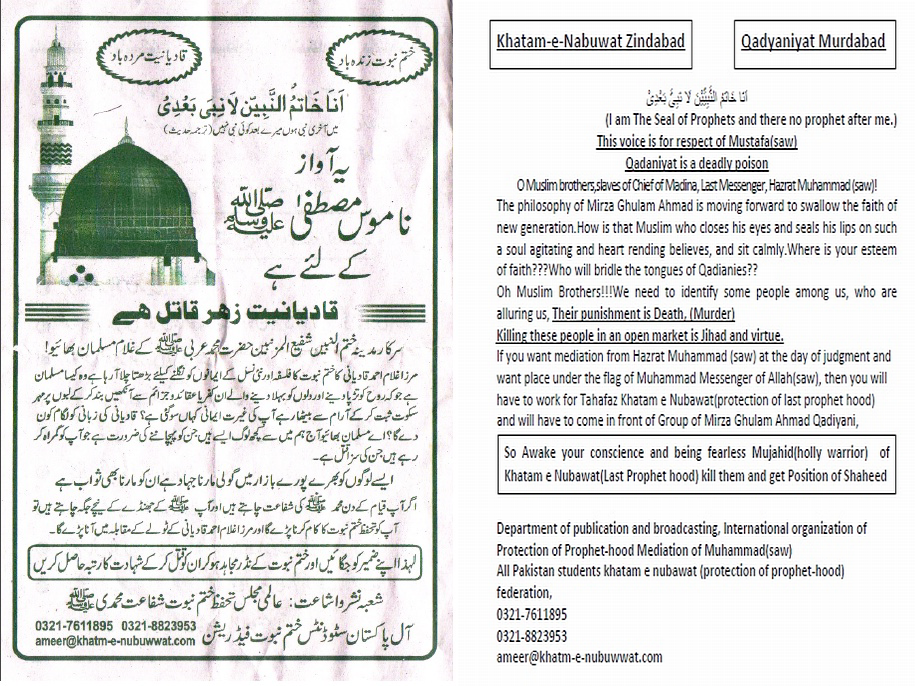
Since 1953, when the first anti-Ahmadi riots broke out in newly independent Pakistan, the Ahmadi community has lived under constant threat. In 1974, Pakistan amended its constitution to declare Ahmadis non-Muslims.

Ten years later, among a slew of anti-blasphemy laws—one of them famously known as “Ordinance XX”—the military dictator Zia ul-Haq made it a crime for Ahmadis to call themselves Muslims. They were forbidden from declaring their faith publicly, using the traditional Islamic greeting, and referring to their places of worship as mosques. In short, virtually any public act of worship or devotion by an Ahmadi can be treated as a criminal offense punishable by death.

Unsurprisingly, attacks on the Ahmadi community followed. In 2005 eight Ahmadis were gunned down in a mosque in a small town in Punjab, Pakistan’s most populous province. A year later a mob burned down Ahmadi homes and shops in a small village in the province, forcing more than a 100 Ahmadis to flee.

Last winter, while I was home in Lahore, I drove to a beige building near my house to get my passport renewed. The officer, in a small effort to assist me, made Xs next to the lines that needed my signature. First I signed the badly photocopied sheet, again and again. Then I found myself being asked to confirm that Mirza Ghulam Ahmad—a 19th century Punjabi reformer and founder of the Ahmadi movement—was an “imposter.”

This is standard. Every Pakistani Muslim applying for a passport must sign a statement deriding Ahmad, but I had forgotten about the procedure.

I asked the officer what would happen if I didn’t sign above the line. He looked at me blankly: “You don’t want passport?“

Later that day I went with my friends to a restaurant in Old Lahore—the city’s historic quarter—where cramped alleys lead to centuries-old Mughal mosques, forts and gateways. We ate kebabs and shared a hookah. On our way home, passing Lahore’s busiest road, I saw a banner on a building facing the Lahore High Court: “Jews, Christians and Ahmadis are enemies of Islam.” We passed a patch of grass where a bronze statue of Queen Victoria had once stood. It has been replaced by a tall glass box containing a Quran.

That the Ahmadi movement agrees with every tenet of Islam, save the additional belief that Mirza Ghulam Ahmad came to the Muslim community as a promised messiah, is irrelevant. The legal system has left minorities such as Christians and Hindus, and within Islam, Ahmadis and Shiites, socially and politically isolated.

Routinely, the graffiti along Lahore’s stylish boulevards will proclaim that Shiites are infidels. More than 100 Christian houses were burned in a town in central Pakistan last year over a claim that a Christian had defiled the Quran. That same year, 37 Ahmadis were charged under the blasphemy laws.

Pakistan is the only Muslim nation to explicitly define who is or is not a “Muslim” under its constitution. This serves only one purpose: to embolden groups like the Pakistani Taliban who use the laws as justification to declare Ahmadis as “wajib ul qatl” or “worthy of death.” As long as the state continues to decide who is and is not a Muslim—a personal, private question—we will continue to see attacks on minorities and medieval banners in the public square.

Ms. Sethi is a Robert L. Bartley Fellow at the Journal this summer.

Monday, May 10, 2010

Blasphemy laws: the root of Pakistani extremism

---The Baltimore Sun, USA

Home  >  News  >  Maryland Voices

Blasphemy laws: the root of Pakistani extremism
By Faheem Younus
May 10, 2010

The failed Times Square bombing raises important questions.


As a U.S. Muslim of Pakistani descent, I have wondered why so many plots against America continue to be hatched in Pakistan. At least nine people with some connection to Pakistan have been charged with terror plots against the United States in the past two years. What is it that accounts for this disturbing trend?

One can’t simply blame Islam. Were that true, Indonesia, the most populous Muslim country, would be the epicenter of terrorist plots against America. But it’s not. One can’t simply blame fiery rhetoric. Were that true, Iran, the most vocally anti-American of Islamic nations, would be breeding terrorists. But it’s not. One can’t simply blame illiteracy. Were that true, Ethiopia, ranked 170th in literacy, would be at the forefront of terrorist activities. But it’s not. One can’t simply blame poverty, either. Were that true, Bangladesh, the poorest of Islamic nations, would be leading the charge against America. But it’s not.

So, what makes Pakistan so uniquely conducive to extremism?

The answer, I believe, is rather simple. Pakistan proudly prosecutes its own people for a crime that exists in few countries: blasphemy. Section 295-C of Pakistan’s penal code, the so-called blasphemy law, states, “Whoever by words, either spoken or written or by visible representation, or by any imputation, innuendo, or insinuation, directly or indirectly, defiles the sacred name of the Holy Prophet Mohammed (PBUH) shall be punished with death, or imprisonment for life, and shall also be liable to fine.”

This law was passed in 1984, and six years later the stakes were raised when a federal Sharia Court ruled that “the penalty for contempt of the Holy prophet is death and nothing else.” A component was later added to target, by name, the Ahmadiyya Muslim Community, a minority Muslim group that believes Mirza Ghulam Ahmad to be the messiah of the latter days.

Blasphemy laws are to Pakistan’s extremists what Miracle Gro is to one’s home garden.

The alleged Time Square suspect, Faisal Shahzad, was a 5-year-old Pakistani citizen when these draconian laws were enacted. His generation knows only one way to deal with a difference of opinion in matters of religion: Shoot the opponent.

Here is Pakistan’s record: 650 Christians have been accused under the blasphemy law and more than 20 killed between 1988 and 2005, according to the Pakistan Catholic Bishops’ Conference’s National Commission for Justice and Peace. Since the promulgation of anti-Ahmadi laws in 1984, 101 Ahmadis have been killed on religious grounds. In June 2008, the entire population of Rabwah (the headquarters town of Ahmadiyya Muslim Community in Pakistan) — 60,000 people — was charged with committing blasphemy.

And while few Pakistanis actually terrorize minorities and non-Muslims, many others have cheered or remained silent.

Some in Faisal Shahzad’s generation seek a new challenge in United States. If drone attacks and back-door diplomacy are not working, what should be our strategy to deal with this threat?

Immediate attention is needed to repeal the blasphemy and anti-Ahmadi laws in Pakistan. Wasting more time in “bilateral talks” will be a godsend for countries such as Indonesia, where a court only last month upheld the constitutionality of that nation’s blasphemy code, which, while less punitive and restrictive than Pakistan’s law, still discriminates against minority religions. The U.S. State Department should make all future aid packages conditioned on Pakistan repealing these harmful laws. While it may be difficult for President Asif Ali Zardari to find Osama bin Laden, it sure isn’t difficult for him to locate a copy of his country’s Second Amendment, which strips the right of millions of Ahmadis to call themselves Muslims.

Once this root cause is removed, a long-term solution of strengthening religious freedom through legislation and establishing a robust educational infrastructure will have a chance to work. After Nigeria, Pakistan has the world’s largest number of out-of-school children and youth. School-age children need to be taught, from an early age, how to express a difference of religious opinion — and more importantly, how to respect one. This can be achieved through curriculum reform in both public and religious (madrassa) education systems.

For more than 200,000 peace-loving U.S. Muslims of Pakistani descent, staying quiet or cheering secretly is not an option anymore. We have to make a choice. Let’s not bite the hand that feeds us. If we are too weak to maintain our loyalty to the United States, then take the Holy Quran’s advice, “… Was not Allah’s earth vast enough for you to emigrate therein?“ (4:98).

Or, to quote a bumper sticker I once saw: America. Love it or leave it.

Dr. Faheem Younus is medical director for healthcare epidemiology and infection prevention at Upper Chesapeake Health in Bel Air and a clinical assistant professor at the University of Maryland, School of Medicine. His e-mail is dryounus@comcast.net

Copyright © 2010, The Baltimore Sun

URL: www.baltimoresun.com/news/opinion/bs-ed-bomb...6374355.story

Saturday, May 8, 2010

Terrorists grow where freedom does not

---OregonLive.com, USA
Hot Topic, International affairs, Terrorism, oped »
Terrorists grow where freedom does not
May 08, 2010, 4:23PM

By HARRIS ZAFAR

The alleged culprit in last weekend’s attempted terrorist attack in Times Square is a 30-year-old U.S. citizen of Pakistani descent who recently traveled back to Pakistan for bomb training. This is not the first time we have heard of a Muslim American of Pakistani descent attempting to kill fellow Americans.

Why does this keep happening? Is there something wrong with Pakistani people? I find myself asking this question so much because on paper, the description of Faisal Shahzad – the suspect in the attempted Times Square bombing – sounds a lot like me. Early 30s … American citizen … Pakistani ethnicity … American education … working a normal 9-to-5 job … from an educated family. How can two people with these similarities turn out so different? Why did he lean toward terrorist tendencies while I maintained my Islamic identity as a person who stands for peace, loyalty and freedom?

To understand this, one must understand the environment that Shahzad grew up in and how it formed a subtle but lasting impression on his mind. Whereas I was born and raised in the United States, Shahzad grew up in Pakistan and only came here 11 years ago. And it is there in Pakistan where Shahzad learned that it is OK to get rid of anyone who you disagree with. The mentality subconsciously instilled in young minds growing up in that society is that people with different views are bad and must be taken out.

Pakistan is one of the only countries in the world that prosecutes and persecutes its own citizens for what it calls “blasphemy.” Under the Pakistani Penal Code, any person found guilty of blasphemy is subject to either the death penalty or life imprisonment. The actual law states, “Whoever by words, either spoken or written or by visible representation, or by any imputation, innuendo, or insinuation, directly or indirectly, defiles the sacred name of the Holy Prophet Mohammed shall be punished with death, or imprisonment for life, and shall also be liable to fine.”

So how did this manifest itself in a way that would have a direct impact on a Pakistani citizen’s psyche? Well, this law has been used to prosecute more than 650 Christians in Pakistan for blasphemy. Even moderate Muslims in Pakistan – namely, the Ahmadiyya Muslim Community – have been charged under this law for blaspheming. Pakistan took it a step further in 1984 when it passed “Ordinance XX,” which prevented members of the Ahmadiyya Muslim Community from even calling themselves Muslims. If they do call themselves Muslims, they are subject to imprisonment and death.

Why such a bold law? Because Pakistani clerics disagreed with the Ahmadiyya Muslim Community’s belief that the promised messiah and reformer – the one Muslims have been waiting for – had come in the person of Mirza Ghulam Ahmad of Qadian. Pakistan passed laws to censor their thoughts and expressions and has exerted authority over minority religious groups to keep them quiet.

How ironic it is, then, that the Ahmadiyya Muslim Community USA was the first and foremost Muslim community in this country to speak out and condemn Shahzad’s actions. Its vice president and missionary-in-charge, Naseem Mahdi, made a bold statement Tuesday not only condemning the attempted terrorist plot but saying that any Muslim living in America who is not loyal to this country should go live in the land where they feel their loyalties belong. This is based on the Prophet Muhammad’s saying, “Love of one’s homeland (one’s place of residence) is a part of the Muslim’s faith.”

How such a community can be declared non-Muslim and punished by threats of imprisonment and death in Pakistan is beyond my comprehension. In order to avoid more Shahzads in the future, we need to set a precedent that differences in opinion or interpretation do not justify legal action. The average Pakistani citizen may not try to murder Americans himself or herself, but these people are vastly silent toward those who do. Their anti-blasphemy laws have desensitized them to the point where they have not the courage to speak out against morally repugnant actions and laws.

To save future generations from falling into the same pitfalls of subtle acceptance of extremism, or even full participation in terrorism like Shahzad, Pakistan must repeal these anti-blasphemy laws immediately. Pakistanis need to get to the root of the problem. Instead of hoping that our law enforcement officials can continue to heroically prevent future attacks from being successful, let’s put our efforts in preventing the idea of such attacks.

Harris Zafar is the national director of community service and local coordinator of faith outreach for a Muslim youth organization, and a freelance writer based in Portland.
Reach him at hrzafar@gmail.com.

© 2010 Oregon Live LLC. All Rights Reserved
URL : www.oregonlive.com/opinion/index.ssf/2010/05/terro...om.html

Sunday, May 2, 2010

Not the voice of the creator

---Dily Dawn, Pakistan
 
Not the voice of the creator
  By Ardeshir Cowasjee
  Sunday, 02 May, 2010

We inhabit a land where death no longer diminishes us, where those that hand it out do so with impunity, with no fear or trepidation.

Day after dreary day it goes on — a professor, a woman, shot and killed in a rickshaw in Quetta, four policemen blown up in Peshawar, five ‘activists’ shot dead in Karachi, and more, much more.

This land has a helmsman of little consequence and the sub-leadership is habitually frugal with the truth, always hoping that lies will sustain them. The future is hardly exhilarating, and we heedlessly plod on. We are not even told the truth when the latest political ‘triumph’ is bandied about, we are told about the 18th Amendment to the constitution, to many a non-event, to others an affront to democracy, and to those who brought it about a means to survive the parliamentary term extended to them.

The latest amendment has not restored the original 1973 constitution — those that claim that it has cannot be that ignorant, so they are resorting to mendacity in aid of expediency. The constitution is left, post-amendment, with vestiges of the 17th Amendment of military dictator Gen Pervez Musharraf, and with its greatest polluter, the 8th Amendment of military dictator Gen Ziaul Haq, littering its pages.

That being so, credit must be given where due — and due it is as far as one insertion is concerned, though the piece of legislation into which one word was restored should never have come into being. Part of the 8th Amendment was the inclusion into the constitution of the Objectives Resolution by Article 2(A) reproducing it in the annex and making it a substantive part of the constitution — and this notwithstanding the fact that the Objectives Resolution already formed its preamble.

There was one glaring difference in preamble and annex — why and how it came about has never been explained but it must be assumed that it was a mala fide exercise. One principle enunciated in the resolution pertains to the minorities: “Wherein adequate provisions shall be made for the minorities freely to profess and practise their religions and develop their cultures.” Such is recorded in the preamble. But in the annex the word ‘freely’ was omitted, thus altering the entire spirit of the provision. The missing word has now been re-inserted by the 18th Amendment — so on that score, well done!

The Objectives Resolution, legislation which would never have been permitted by the founder maker of this country, Mohammad Ali Jinnah, came into being in March 1949, a mere six months after his death when his loyal lieutenants succumbed to the pressures of the religious right which sought to impose its will on a country, the formation of which it had either opposed or stood by silently while the Muslim League struggled. It negated all that Jinnah had stood for, if we are to take as our guideline his famed address to the constituent assembly of Aug 11, 1947, when he declared that faith, caste or creed were to be put aside and all were to be equal citizens of one country, and, most importantly, that religion was not the business of the state.

The most ominous words spoken that March day when the resolution was passed by the constituent assembly were spoken by Hindu citizen of Pakistan, Sri Chattopadhyay, who represented 25 per cent of the then East Pakistan population.

“I do not consider myself as a member of the minority community. I consider myself as one of seven crores of Pakistanis. Let me retain that privilege.”

“I sadly remind myself of the great words of the Quaid-i-Azam that in state affairs the Hindu will cease to be a Hindu; the Muslim shall cease to be a Muslim. But alas, so soon after his demise what you do is that you virtually declare a state religion.”

“You could not get over the old world way of thinking. What I hear in this resolution is not the voice of the great creator of Pakistan — the Quaid-i-Azam, nor even that of the prime minister of Pakistan, the honourable Mr Liaquat Ali Khan but of the ulemas of the land.”

“This resolution in its present form epitomises that spirit of reaction. That spirit will not remain confined to the precincts of this house. It will send its waves to the countryside as well. I have been passing sleepless nights pondering what shall I now tell my people whom I have so long been advising to stick to the land of their birth.”

“And on the top of this all, by this resolution you condemn them to a perpetual state of inferiority. A thick curtain is drawn against all rays of hope, all prospects of an honourable life. After this what advice shall I tender? What heart can I have to persuade the people to maintain a stout heart?”

The waves indeed swept through the country, the first manifestations of intolerance, bigotry and their accompanying violence coming in 1953 with the anti-Ahmadi riots in Punjab. The rot grew and was given full impetus in 1977 when socialist democrat Zulfikar Ali Bhutto (who throughout his life showed few signs of fanatic zealotry) miserably surrendered to the mullah fraternity in the hope that he could cling on to a fast disappearing power seat. From then on, with the advent of Gen Ziaul Haq and his particular brand of religion, the descent has been swift.

Those who followed either exhibited little will to stem the rot or were hand in glove with the forces of darkness, the enemies of tolerance. Jinnah’s Pakistan has virtually ceased to exist, but there are still some who hope it has not yet been interred for ever.

arfc@cyber.net.pk

©2010 DAWN Media Group. All rights reserved
URL : www.dawn.com/wps/wcm/connect/...he-voice-of-the-creator-250-hh-05
 
^ Top of Page