Monday, February 7, 2011

Indonesia: Government must act now to protect rights of Ahmadis after mob butchers three

Amnesty International
Indonesia: Government must act now to protect rights of Ahmadis after mob butchers three
Posted: 7 February 2011

Amnesty International has urged the Indonesian government to investigate the killings of three members of a religious minority group by a mob on the island of Java this weekend.

The killings occurred when reportedly over 1,000 people wielding rocks, machetes, swords and spears stormed the house of a leader from the Ahmadiyya minority faith in the sub-district of Cikeusik, Banten province on 6 February 2011. Several more Ahmadis were wounded in the attack and two are reportedly missing.

Donna Guest, Asia-Pacific Deputy Director at Amnesty International, said: “This brutal attack on Ahmadiyya followers reflects the continued failure of the Indonesian government to protect religious minorities from harassment and attacks and to hold the perpetrators accountable.

“The Indonesian police must initiate a prompt, thorough and effective investigation into the violence and ensure that those suspected of involvement are prosecuted in fair trials.”

She added: “Indonesia must develop a concrete strategy to strengthen respect for freedom of religion and religious tolerance, which has clearly deteriorated in recent years.”

The Ahmadiyya are a religious group who consider themselves a part of Islam, although many mainstream Muslim groups say they do not adhere to the accepted belief system.

The mob surrounded a house where at least 18 Ahmadis were gathered, demanding that they disperse. They then charged inside the home, attacking and killing three Ahmadis identified as Roni, Tarno and Mulyadi.

The victims were found with multiple injuries including stab wounds and lacerations. At least five others were seriously injured and the whereabouts of two are said to be unknown. The mob also destroyed the house, as well as vehicles parked around it.

Background information:

Amnesty International has documented numerous cases of intimidation and violence against the Ahmadiyya community by radical Islamist groups in various parts of Indonesia.

These include attacks and burning of Ahmadiyya places of worship and homes, at times leading to their displacement.

In most cases, those who commit acts of violence against the Ahmadiyya are not punished and there is a tendency by the authorities to blame the minority for “deviant views” when attacks occur.

Harassment and attacks against the Ahmadiyya community are also fuelled by a 2008 joint ministerial decree forbidding the Ahmadiyya from promoting their activities. In September 2010, Indonesia’s Minister of Religion, Suryadharma Ali, called for the Ahmadiyya to be banned.

The government must repeal all laws and regulations that restrict the right to freedom of religion as guaranteed in Article 18 of the International Covenant on Civil and Political Rights (ICCPR) and initiate an independent and impartial inquiry into all cases of intimidation and violence against religious minorities in Indonesia.

Amnesty International has also called on the National Human Rights Commission (Komnas HAM) to investigate allegations that the police did not take adequate steps to protect the Ahmadiyya followers who were gathered, or to prevent Sunday’s attacks.

Indonesian authorities must investigate Ahmadiyya killings

Amnesty International
Indonesian authorities must investigate Ahmadiyya killings
7 February 2011

There have been attacks on Ahmadiyya places of worship and homes in Java (c) Private
There have been attacks on Ahmadiyya places of worship and homes in Java
© Private
Amnesty International has urged the Indonesian government to investigate the killings of three members of a religious minority group by a mob on the island of Java this weekend.

The killings occurred when reportedly over 1,000 people wielding rocks, machetes, swords and spears stormed the house of a leader from the Ahmadiyya minority faith in the sub-district of Cikeusik, Banten province on Sunday. Several more Ahmadis were wounded in the attack and two are said to be missing.

“This brutal attack on Ahmadiyya followers reflects the continued failure of the Indonesian government to protect religious minorities from harassment and attacks and to hold the perpetrators accountable,” said Donna Guest, Asia-Pacific Deputy Director at Amnesty International.

“The Indonesian police must initiate a prompt, thorough and effective investigation into the violence and ensure that those suspected of involvement are prosecuted in fair trials.”

The Ahmadiyya are a religious group who consider themselves a part of Islam, although many mainstream Muslim groups say they do not adhere to the accepted belief system.

The mob surrounded a house where at least 18 Ahmadis were gathered, demanding that they disperse. They then charged inside the home, attacking and killing three Ahmadis identified as Roni, Tarno and Mulyadi.

The victims were found with multiple injuries including stab wounds and lacerations. At least five others were seriously injured and the whereabouts of two are said to be unknown. The mob also destroyed the house, as well as vehicles parked around it.

Amnesty International has documented numerous cases of intimidation and violence against the Ahmadiyya community by radical Islamist groups in various parts of Indonesia.

These include attacks and burning of Ahmadiyya places of worship and homes, at times leading to their displacement.

In most cases, those who commit acts of violence against the Ahmadiyya are not punished and there is a tendency by the authorities to blame the minority for “deviant views” when attacks occur.

Harassment and attacks against the Ahmadiyya community are also fuelled by a 2008 joint ministerial decree forbidding the Ahmadiyya from promoting their activities. In September 2010, Indonesia’s Minister of Religion, Suryadharma Ali, called for the Ahmadiyya to be banned.

The government must repeal all laws and regulations that restrict the right to freedom of religion as guaranteed in Article 18 of the International Covenant on Civil and Political Rights (ICCPR) and initiate an independent and impartial inquiry into all cases of intimidation and violence against religious minorities in Indonesia.

Amnesty International has also called on the National Human Rights Commission (Komnas HAM) to investigate allegations that the police did not take adequate steps to protect the Ahmadiyya followers who were gathered, or to prevent Sunday’s attacks.

“Indonesia must develop a concrete strategy to strengthen respect for freedom of religion and religious tolerance, which has clearly deteriorated in recent years,” said Donna Guest.

Indonesia: Revoke Decree Against Religious Minority

Human Rights Watch
Indonesia: Revoke Decree Against Religious Minority
Prosecute Perpetrators of Attacks on Ahmadiyah Members
February 07, 2010

How many Ahmadiyah have to die at the hands of mobs before the police step in. The Indonesian government should end this wave of hate crimes and immediately revoke the 2008 anti-Ahmadiyah decree, which encourages these vicious attacks.
Elaine Pearson, deputy Asia director at Human Rights Watch
(New York) — The killing of three members of the Ahmadiyah religious minority underscores the need for Indonesian President Susilo Bambang Yudhoyono to immediately revoke a 2008 decree that bans the community’s religious activities, Human Rights Watch said today.

On February 6, 2011, a mob of at least several hundred people attacked about 25 Ahmadiyah members in Cikeusik village, Banten province in western Java, while about 30 police officers who were present made little effort to stop the attack. Senior government officials have condemned the attack and ordered a police investigation, but the government needs to ensure that those responsible are brought to justice and open an independent investigation into why the police did not prevent the attack, Human Rights Watch said.

“How many Ahmadiyah have to die at the hands of mobs before the police step in,” said Elaine Pearson, deputy Asia director at Human Rights Watch. “The Indonesian government should end this wave of hate crimes and immediately revoke the 2008 anti-Ahmadiyah decree, which encourages these vicious attacks.”

An amateur video obtained by Human Rights Watch shows hundreds of villagers encircling the house of an Ahmadiyah leader, Ismail Suparman, nicknamed Parman, at around 10 a.m. on February 6. A man in a black leather jacket and a skullcap leads the attackers, telling plainclothes police officers outside the house to move away.

The video shows two police trucks parked outside the house. One officer tries to persuade the mob’s leader not to attack, but he waves the police away. A man in military uniform also asks the villagers not to attack. In a matter of seconds, hundreds of the attackers wearing blue ribbons pinned to their chests - to distinguish themselves - enter the house, where at least 21 Ahmadiyah men are taking refugee. The group’s leader takes out a machete. The Ahmadis try to defend themselves with bamboo sticks and stones, but are in no position to stop the mob.

The assailants quickly take over the house and burn it, along with a van and a motorcycle. They order the Ahmadiyah men to strip naked, and the video footage shows gruesome beatings of the men with wooden sticks, hoes, and machetes. Three died and six were injured. Some of the Ahmadiyah in the house remain unaccounted for.

For years, Islamist militants have repeatedly attacked and burned Ahmadiyah homes and mosques elsewhere in Java, Sumatra, and Sulawesi. The February attack appears to have been led by militant Islamists who want the Ahmadiyah to leave Cikeusik village. Since last year about a dozen Muslim ulemas (preachers) had allegedly called for a broad campaign of harassment against the Ahmadiyah - ceasing to buy their products, bullying their children at schools, and preventing non-Ahmadiyah from working on their farms.

Senior government officials have called for a prompt police investigation into the violence. Yudhoyono said he regretted the killings and directed the national police chief, Gen. Timur Pradopo, and the minister of religious affairs, Suryadharma Ali, to go to Cikeusik to investigate. But since August 2010, Suryadharma has repeatedly called for banning the Ahmadiyah faith in Indonesia, saying if their activities are not banned, the potential for conflict would escalate.

Human Rights Watch said that an additional fully independent investigation is needed into the role of the police in the February 6 incident. Such an investigation should be credible, transparent, and impartial, Human Rights Watch said.

So far, police have questioned four people in the neighboring regency of Serang and five men in Pandeglang, but no one has been arrested. Suparman and his wife are currently being detained in Pandeglang police station.

“Police should be studying the video closely to identify and apprehend the attackers,” Pearson said. “And there needs to be a full investigation into why the police absolutely failed to prevent this mob from going on a violent rampage.”

Indonesian law facilitates discrimination against the Ahmadiyah. The June 2008 decree requires the Ahmadiyah to “stop spreading interpretations and activities that deviate from the principal teachings of Islam,” including “spreading the belief that there is another prophet with his own teachings after Prophet Muhammad.” Violations of the decree can result in prison sentences of up to five years. Human Rights Watch has repeatedly called for the government to rescind this decree, as it violates the fundamental right to freedom of religion.

At the time the decree was signed, officials said it was necessary to help stop further violence. Yet since the decree was issued, violence against the Ahmadiyah has increased dramatically from 3 incidents in 2006 to 50 in 2010, according to the Setara Institute, a nongovernmental group that monitors religious freedom.

“The Cikeusik attack is yet the latest example that banning Ahmadiyah religious practices does not deter violence against them,” Pearson said. “Revoking the 2008 anti-Ahmadiyah decree is a crucial first step to reversing this wave of violence, and it needs to happen immediately.”

The Ahmadiyah movement was founded in 1889 by Mirza Ghulam Ahmad. The Ahmadiyah identify themselves as Muslims but differ with other Muslims as to whether Muhammad was the “final” monotheist prophet; consequently, some other Muslims perceive the Ahmadiyah as “heretics.” Approximately 200,000 Indonesians follow the faith.

Prohibiting the Ahmadiyah from practicing their religion violates the International Covenant on Civil and Political Rights, ratified by Indonesia in 2006, which protects the right to freedom of religion and to engage in religious practice “either individually or in community with others and in public or private.” The treaty also protects the rights of minorities “to profess and practice their own religion.”

Indonesian president condemns mob killing of Ahmadiyah Muslims

Guardian, UK
News > World News > Indonesia
Indonesian president condemns mob killing of Ahmadiyah Muslims
Footage shows three members of vilified Muslim group beaten to death after 1,500 people storm house during prayers
Associated Press in Jakarta
guardian.co.uk, Monday 7 February 2011 18.03 GMT

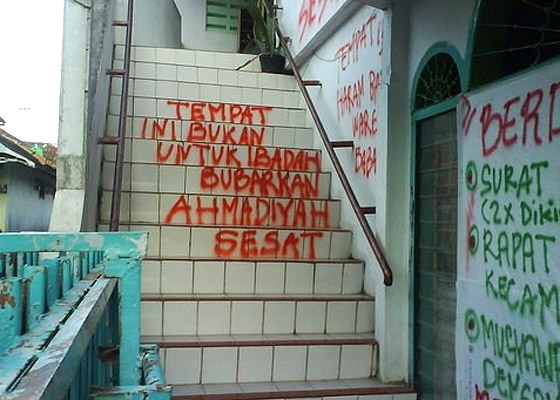
A policeman collects evidence from a house where Ahmadiyah members were attacked. The graffiti on the wall translates to 'Ahmadiyah is a devient teaching'. Photograph: Nurani Nuutong/AFP/Getty Images
A policeman collects evidence from a house where Ahmadiyah members were attacked. The graffiti on the wall translates to “Ahmadiyah is a devient teaching”. Photograph: Nurani Nuutong/AFP/Getty Images
Indonesia’s president today ordered an investigation into an attack on members of a minority Muslim sect after a gruesome video emerged of a mob beating several victims to death with machetes, sticks and rocks.

About 1,500 people stormed a house in Banten province on Sunday to stop 20 Ahmadiyah followers from worshipping. They killed three men and badly wounded six others, while destroying the house and setting fire to several cars and motorbikes.

Indonesia is a secular country and has a long history of religious tolerance, but in recent years a hard line fringe has grown louder and the government – which relies on the support of Islamic parties in parliament – has been accused of caving in to it.

The attacks – which drew rare condemnation from President Susilo Bambang Yudhoyono – were captured on video and circulated widely on national television and the internet.

The most disturbing clip, posted on YouTube, showed assailants repeatedly pounding two victims – who appeared to be dead – with heavy sticks.

A policeman came to the scene but his screams of “stop” were almost inaudible among dozens who shouted “Allahu Akbar” or “God is great”.

The Ahmadiyah, thought to have 200,000 followers in Indonesia, are considered deviant by many Muslims and are banned in many Islamic countries because they believe that Muhammad was not the final prophet.

“I have ordered a comprehensive investigation to find out the real cause of the incident so that those guilty, or violating the law, can be penalised,” Yudhoyono told a news conference.

He also called on security forces as well as local governments to be proactive in taking action against the instigators of such violence. “Don’t wait until the conflicts and clashes have already happened,” he said.

Many attacks on religious minorities in recent years have been carried out by members of the Islamic Defenders Front. The hardline group pressured local authorities late last year to shutter a Christian church located in a densely populated Muslim area, and assailants stabbed a Christian worshipper and beat a minister on the head with a wooden plank as they headed to prayers.

Thirteen members of the Islamic Defenders Front have gone on trial in the case, and state prosecutors today sought a six-month prison term for Murhali Barda, a local group leader, for instigating the attack in September.

The Setara Institute for Peace and Democracy, a human rights group, says attacks on religious freedom by hardliners are steadily increasing. It says in 2010 there were 64 incidents, ranging from physical abuse to preventing groups from performing prayers and burning houses of worship, up from 18 in 2009 and 17 in 2008.

© Guardian News and Media Limited 2011
URL: www.guardian.co.uk/world/2011/feb/07/...killed

Eight questioned over deadly Indonesia religious clash

MSN News, Indonesia
By Agence France-Presse, Updated: 2/7/2011
Eight questioned over deadly Indonesia religious clash
Indonesian police said Monday they are questioning eight people involved in a bloody religious clash which claimed three lives at the weekend.

The incident, involving more than 1,000 Muslims who stormed a house in West Java on Sunday to stop the minority Ahmadiyah Islamic sect from holding worship, has been condemned by the government and rights activists.

National police spokesman Boy Rafli Amar said eight people are being questioned and investigations are ongoing, but police are yet to lay charges.

President Susilo Bambang Yudhoyono has instructed police to take firm action against the perpetrators, “to capture them and haul them to court if need be,” his senior adviser Daniel Sparingga told AFP.

“The president is deeply concerned and condemned the violence and said that the country must be firm in defending the constitution, that would never allow small groups to use religion to attack groups of different faiths,” he said.

Indonesia’s constitution explicitly guarantees freedom of religion and the country of some 240 million people, 80 percent of whom are Muslim, has ratified the International Covenant on Civil and Political Rights.

But a government decree adopted in 2008 under pressure from Islamic conservatives bans the Ahmadiyah sect from spreading its faith, which includes the belief that its founder, Mirza Ghulam Ahmad, was the final Muslim prophet.

The group, which claims hundreds of thousands of members in Indonesia, has been repeatedly targeted with violence by members of hardline Islamic extremist organisations who operate with almost total impunity.

National Human Rights Commission chairman Ifdhal Kasim said Sunday’s incident was “embarrassing” as the police had made no effort to stop the mob.

“The police are biased and ignored their ultimate responsibility which is to protect the people,” he said.

“The government has no right to make judgments on whether a religion is heretical or not. Its job is to protect the people.”

Ahmadis Recount Morning of Terror

Jakarta Globe, Indonesia
HOME
Ahmadis Recount Morning of Terror
Nivell Rayda & Ulin Yusron | February 07, 2011

Bebi, 45, is one of the survivors of the Cikeusik attack that saw three people killed. He sustained severe injuries to his head and body. Other Ahmadiyah members say they're lucky to have escaped alive. (JG Photo/Nivell Rayda)
Bebi, 45, is one of the survivors of the Cikeusik attack that saw three people killed. He sustained severe injuries to his head and body. Other Ahmadiyah members say they’re lucky to have escaped alive. (JG Photo/Nivell Rayda)
Ahmad Masihudi has bruises on his right jaw, a swollen eye and cuts all over his body, but he considers himself a lucky man. A resident of Parung, West Java, Ahmad said he was grateful “just to be alive” after a lynch mob of over 1,500 people attacked members of the Ahmadiyah community in the Cikeusik village of Pandeglang on Sunday.

Ahmad said he was one of about 18 members of the Ahmadiyah, a minority Islamic sect, who went to Cikeusik to protest the detention of local Ahmadiyah cleric Ismail Suparman by Pandeglang Police. But a bloody clash ensued which left three Ahmadis dead and five badly injured. Ten other Ahmadis managed to escape.

Those killed were identified as Roni and Warsono from Jakarta and Chandra from Parung.

“I ran with all my might when the mob came in the thousands. We were clearly outnumbered. It was an outright attack,” 25-year-old Ahmad said.

“I ran to a nearby rice field. We all agreed to scatter in a bid to give some of us a chance at surviving the ordeal. I remember several people chasing me. I was hit in the back with bamboo a stick. I stumbled to the ground.”

Ahmad said he was saved by the fact that he had Rp 1 million ($110) in cash on him.

“They let me go just like that [after finding the money]. But that didn’t stop the others from trying to beat me up. I saw a police officer. I immediately held on to him and wouldn’t let go as the mob tried to pull me and continued to hit me,” Ahmad said.

“The other officers soon came and I was dragged to a police truck.” Ahmad was indeed one of the lucky ones.

One of the injured, Deden Sujana, remains in a coma with extensive injuries to his head and body. The 45-year-old was in critical condition and has been rushed to Pertamina Hospital in Jakarta. Deden’s right arm suffered a blow from a machete and was nearly severed.

In an emergency meeting convened by the central government over the attack, National Police Chief Gen. Timur Pradopo said on Sunday night that police on Thursday had been informed about Ahmadiyah members in Cikeusik being involved in “activities,” which locals deemed “unacceptable” and were preparing to take action.

“The FKUB [Interreligious Communication Forum of Banten] anticipated problems and took [Ahmadiyah cleric] Ismail Suparman to local police for his own safety on Saturday,” Timur said.

“But suddenly, on Sunday at around 7 a.m., a group of 15 Ahmadis, led by a man named Deden, who claimed to be from the Ahmadiyah central headquarters, arrived at Ismail’s empty home, saying that the house belonged to the Ahmadiyah community and they would guard it in case of any attack,” Timur said.

“We [the police] arrived and asked them to leave. They refused. At the same time, some 1,500 villagers came. This is when the incident occurred.”

Another resident of Parung, Ferdiaz, said he had been one of the Ahmadiyah members who had occupied Ismail’s house.

He confirmed that police had attempted to get them to leave the house for their own safety.

Ferdiaz told police they would not vacate and reminded officers that it was their job to protect them from harm. But soon afterwards, the mob started pelting the house with rocks and several people even drew machetes. Police did little but watch the show, Ferdiaz said.

“In the end, I ran, but a man slashed me with a machete in my back. They hit me with rocks and sticks. I was lucky police officers managed to stop them.”

In Jakarta, about 50 people gathered in front of the State Palace to protest against the violence. Yudhi Latief from the Reform Institute said police must protect all citizens. “Nobody should be killed just because they have different faiths,” he said.

Additional reporting by Farouk Arnaz

 
^ Top of Page