By: Husain Naqi
The massacres at two Ahmadiyya mosques in Lahore is the result of anti-Ahmadi sentiment fanned by religious extremists and allowed by a compromised state and the silent support of political parties.

The 28 May mayhem at two Ahmadiyya mosques in Lahore brought into sharp focus the agenda of extremist Islamic groups against Pakistan’s religious minorities. It also exposed the political opportunism of the government, especially in Punjab province. The civil administration’s complacency, despite being tipped off about the entry of extremists aligned with the Tehreek-e-Taliban Pakistan (TTP) into the province, also lays bare its failure to deal sternly with easily identifiable perpetrators and their patrons amongst banned sectarian outfits. In late May, this complacency resulted in the loss of 94 lives and over a hundred injured.
Unfortunately, the twin attacks targeting this religious minority were not unexpected, but merely constitute the latest in a century of Ahmadi discrimination by mainstream Muslims. Ahmadis were declared to be ‘non-Muslim’ through a constitutional amendment in 1974, under Zulfikar Ali Bhutto – despite the fact that, at that time, Bhutto’s left-of-centre Pakistan People’s Party (PPP) enjoyed a two-thirds majority in the national legislature. Ahmadis continue to be derogatorily called Qadianis, after the name of the village in Gurdaspur District, in Punjab state, where the sect’s founder, Mirza Ghulam Ahmad, lived and established his creed’s headquarters in 1901.
The differences between Ahmadis and other Muslims lie in three main areas: prophethood, the crucifixion and resurrection of Jesus, and jihad. The main difference is with regard to the common Muslim belief that the Prophet Muhammad was the last among 124,000 prophets, that there would be no prophet after him, and that anyone claiming otherwise was an apostate whose punishment is death. Ahmadis, on the other hand, believe that Mirza Ghulam Ahmad was the promised messiah. Interestingly, Ahmad had once even described himself as Maseel-i-Krishna (in the likeness of Krishna). While Ahmadiyya communities can today be found in India, Bangladesh and Indonesia (as well as in Europe), the largest, of three million, is in Pakistan, which also has the distinction of being the first country to have officially declared Ahmadis to be non-Muslim.
In the first decade of the 20th century, Mirza Ghulam Ahmad began to be targeted and branded as an apostate by the Ahraris, an ultra-orthodox segment of Deobandi/Wahhabi Islam. The history of the Ahrari community too is important in understanding the matter of Ahmadiyya persecution. Initially, the Ahraris’ political views were nationalistic, and they briefly joined the Congress party; even after they separated, they remained close to the Congress. They were bitter opponents of the Pakistani establishment, even referring to the new country as
palidistan (dirty place), and were also vociferous critics of Muhammad Ali Jinnah.
In contrast, the Ahmadis supported the creation of Pakistan and respected Jinnah. At his request, the head of the community at the time, Mirza Bashir-ud-din Mahmood, the son of Mirza Ghulam Ahmad, directed all Ahmadis to vote for the Muslim League in the crucial 1946 elections, even declaring that anyone who did not vote for the Muslim League candidate would be considered an outcast. Jinnah reciprocated this gesture when the Muslim League included Zafarullah Khan, a member of a leading Ahmadi family, as Pakistan’s first foreign minister.
At the same time, one of the leading scholars at the Deoband seminary, Maulana Shabbir Ahmad Usmani, a virulent critic of the Ahmadis, was also included in the central body of the All Indian Muslim League. It is important to note that Jinnah did not feel that Sharia law should be made supreme in Pakistan, nor even that Islam should be declared the state religion, despite what subsequently took place. Yet after Jinnah’s death, Maulana Usmani and other non-secular elements in the Muslim League hierarchy became dramatically stronger, eventually succeeding in getting the so-called Objectives Resolution (which was eventually made a substantive part of the Constitution by General Zia ul-Haq) passed by the Constituent Assembly, elected in 1946. This formally ensured that the new Constitution would not be based on secular policy lines, as spelled out by Jinnah, but rather stipulated that the country would essentially adopt an Islamic state structure.
For his part, Maulana Usmani assumed the title of Pakistan’s Sheikh-ul-Islam, the supreme Islamic divine. He also needs to be identified as perhaps the earliest exponent of Islamist extremism in Pakistan, as he, along with Maulana Zafar Ali Khan, the owner-editor of the sectarian Urdu daily
Zamindar, formed a militant organisation, Sarfaroshan-e-Islam. Throughout this period, Usmani lent considerable support to the anti-Ahmadi lobby, the Ahraris.
Ahrari’s punching bag
After remaining relatively quiet for a time on the establishment of Pakistan, the Ahraris decided to strongly take up an anti-Ahmadi campaign, despite their claims to have given up on their anti-Pakistan views and pledging support for the Muslim League. Doing so also allowed the Ahraris to be taken off the Muslim League’s list of nationalist groups that had opposed Partition (these included Khan Abdul Ghaffar Khan’s Khudai Khidmatgar and more than a dozen others). Yet the Ahraris (and other like-minded parties) stepped up their denunciations of Ahmadiyyat and of Ahmad himself, and called for the removal of Foreign Minister Zafarullah Khan and other senior civil and military officers from the Ahmadi community. In this, they were led by three individuals in particular – Maulana Mazhar Ali Azhar, Master Taj Din and Ataullah Shah Bukhari. In the meantime, with the support of the Punjab government, the Ahraris were able to gain a strong political foothold in Punjab province.
Historically, it was actually the Afghan government that first officially considered the Ahmadi community as heretical, with its adherents even given death penalties. The first to fall victim in Kabul, during the reign of Amir Abdur Rahman Khan in the 1920s, was an Ahmadi by the name of Abdur Raahman Khan, who was staked to the ground and stoned to death. Many more such deaths followed, the earliest defence of which came in a pamphlet written by Maulana Shabbir Ahmad Usmani himself. Some 20 years later, this pamphlet was reprinted and distributed in large numbers in Pakistan, especially in the Punjab, despite Jinnah’s fervent attempts at instituting secularism.
In the first decade after Pakistan’s creation, the role of Punjab province as a bastion of political power and bureaucratic control was already well understood by Islamist extremists – the same ones who had identified Ahmadis as a convenient punching bag. Identifying Ahmadis as people who undermined the Prophet’s exalted position as
khatam-un-nabiyyeen (the last of the prophets) was sure to give political dividends. This also provided the Ahraris – with their anti-Pakistan, anti-Jinnah background – a convenient way to legitimise themselves in a hostile environment. Having been laundered of their anti-Pakistan past, groups such as the Ahraris were brought into the political mainstream thanks to the feudal leadership of the Punjab Muslim League and the province’s bureaucratic apparatus. It was no wonder that, by May 1948, the first conference of All Pakistan Majlis-e-Ahrar was held in Punjab at Lyallpur (now renamed Faisalabad, after the late Saudi monarch). In the following year, the group held several conferences targeting Ahmadis, particularly demanding that they be declared non-Muslim. Jinnah was still alive but in bad health when the murder of an Ahmadi army doctor, one Major Mahmood, took place.
The anti-Ahmadi campaign succeeded in fanning public hatred against the community, particularly among clerics but also among Punjab’s Shia community. Verbal abuse developed into widespread violence, and there were more murders of Ahmadis and burning of their places of worship. In July 1952, the Ahrari leadership began to spearhead a series of high-level national umbrella meetings of Muslim parties, which sharpened the anti-Ahmadi campaign by passing a resolution to resort to direct action to require the fulfilment of their demands on the Ahmadis, and to form a central committee to that effect. An ultimatum was eventually given to Prime Minister Khwaja Nazimuddin in January 1953, calling on the government to accept the demands within a month. After heated meetings, the government rejected the ultimatum on 27 February, leading to the arrest of the action committee and the beginning of public agitation. In Punjab province alone, some 50,000 volunteers pledged to sacrifice their lives to ‘defend the honour’ of the Prophet Muhammad, while massive donations were collected. Eventually, the military had to be called into various parts of Punjab to restore order, at which point martial law was enforced and some of the top leaders of the anti-Ahmadi actions were sentenced to death (though these were never carried out). That was far from an end to the issue, however.
Wajibul qatl
Two decades after Prime Minister Nazimuddin’s rejection of the anti-Ahmadi lobby’s ultimatum, in 1974 Prime Minister Bhutto surrendered to the Islamists, agreeing to the passage of the Second Constitutional Amendment that officially declared Ahmadis to be non-Muslims. The military ruler who followed, Gen Zia ul-Haq, went even farther, introducing a new blasphemy law prohibiting Ahmadis from using Islamic symbols, from calling their places of prayer ‘mosques’, and using the Islamic greeting of
as-salaamu alaikum, etc. Gen Zia also amended the Constitution to make the provisions of the Objectives Resolution a substantive part of the Constitution.
While Pakistani civil society has since urged multiple amendments to annul the discriminatory laws and constitutional provisions, the legislators have been lethargic. It is not realistic to expect that the majority of the political parties in the Parliament would take such a step even today. With a political culture ascendant, especially in Punjab where any negative event is quickly branded a conspiracy of yahud-o-hunood (Jews and Hindus) who are not available as targets in the Punjab – the Ahmadis make a convenient target for the politics of hate, before which all the political parties are cowed down.
The vernacular press and Urdu television channels also inflame anti-Ahmadi sentiment. In the months and weeks leading up to the Lahore attacks, a programme on Geo TV, the country’s most popular channel, aired a number of clerics vociferously dubbing Ahmadis as apostates – and reminding viewers that the punishment for apostasy is death; the provincial ruling party in Punjab even sponsored a public meeting at which staunchly anti-Ahmadi clerics were prominent presenters. In days after the attacks, Ahmadis have been publicly described in the media as
wajibul qatl (worthy of being killed). Little wonder, then, that an incident such as the Lahore massacre took place – and that worse could yet follow.
Husain Naqi is a freelance columnist and human-rights activist in Lahore.



 VIEWS & OPINIONS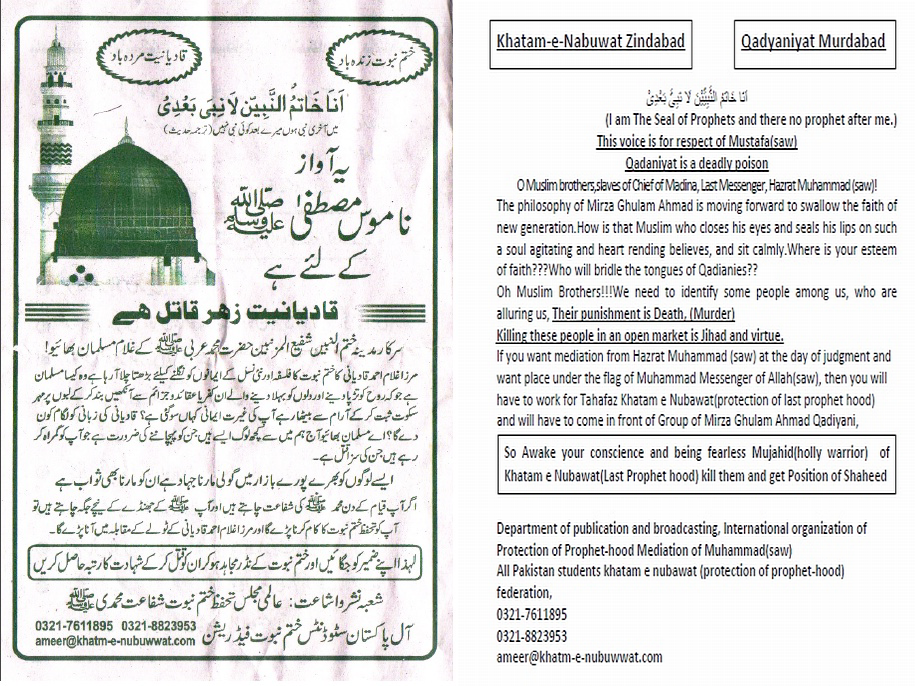




 Posts
Posts


