---Asian Human Rights Commission, Hong Kong
Asian Human Rights Commission — Statement
INDONESIA: Freedom of religion not protected
FOR IMMEDIATE RELEASE
AHRC-STM-032-2010
February 23, 2010
A Statement by the Asian Human Rights Commission
INDONESIA: Freedom of religion not protected
U.S. President Barack Obama is scheduled to visit Indonesia, the place of his childhood, in March. It is important that the President does not waste this opportunity and uses his good relations with Indonesian President Susilo Bambang Yudhoyono to raise the issue of religious tolerance in Indonesia.
Late last year Obama External Link - Opens new browser window stated that “Indonesia is important… as one of the world’s largest democracies, as one of the world’s largest Islamic nations… it has enormous influence and really is… a potential model for the kind of development strategies, democracy strategies, as well as interfaith strategies that are going to be so important moving forward.”
(Photo source: Carolincik, 2008, Yogyakarta, flickr)While his statement is no doubt true in some respects, the essence of Obama’s remark is at odds with the current situation in Indonesia.
In recent years the United Nations has expressed disquiet at religious discrimination and intolerance in the country. There is continuing concern at the distinctions made in legal documents between the six recognized religions of Islam, Protestantism, Catholicism, Hinduism, Buddhism and Confucianism, and the adverse impact on the freedom of thought, conscience and religion of people belonging to minorities, ethnic groups and indigenous peoples in Indonesia.
In 2007 the U.N. Committee on the Elimination of Racial Discrimination noted with concern that mixed-faith couples – in which the man and woman hold different recognized beliefs – faced difficulties in officially registering their marriages and that their children were not provided with birth certificates, as they were not the products of “lawful” marriage. Paradoxically, people that change their religion in order to marry their partner can face stigmatization.
Furthermore, there is no provision for individuals with no religious belief to enter into a civil marriage contract, and no legal documentation for those without such a belief. This results in people keeping their atheist beliefs secret and when the time comes to marry, they make the choice of either marrying in a religious ceremony that is devoid of meaning for them, or not marrying at all, which can leave their family and offspring without legal protection.
Moreover, under Indonesian Law No. 23 of 2006 on Civic Administration, individuals are required to record their faith on legal documents such as identity cards and birth certificates. Atheists who ascribe to no religion or those who wish to leave the column blank or to register under one of the “non-recognized” religions face discrimination and harassment - including refusal of employment.
Forcing an Indonesian to adopt a religion as part of her identity grossly undermines his right to freedom of thought and religion under article 18 of the International Covenant on Civil and Political Rights.
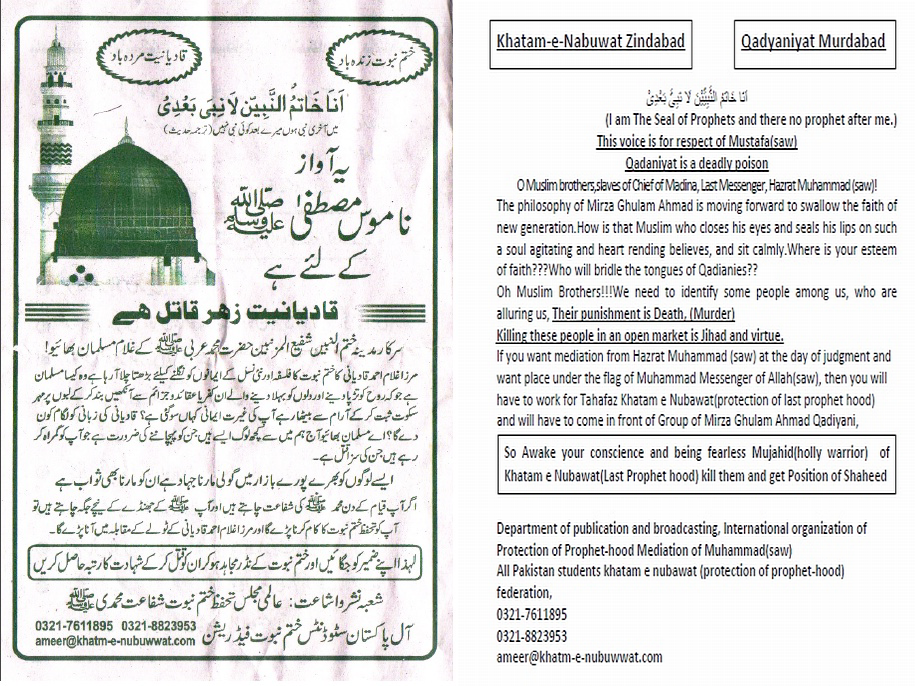
Concern has been expressed in Indonesia and internationally about religious minorities such as the Ahmadiya – followers of a disputed branch of Islam – being targeted by fundamentalists that have branded them members of heretical cults. The Asian Human Rights Commission External Link - Opens new browser window and other human rights organizations have highlighted violent attacks and intimidation against the Ahmadiya people and other religious groups, and their places of religious worship. But so far there has been no concerted effort to protect the rights of these groups.
To the contrary, religious intolerance and discrimination is effectively condoned under Law No.1/1965 on the Prevention of Religious Abuse and Blasphemy, which amends the Indonesian Penal Code (Article 156 (a)) to allow the state to prosecute people deemed to commit blasphemous acts which “principally have the character of being at enmity with, abusing or staining a religion adhered to in Indonesia”. The maximum penalty is five years imprisonment.
To combat this law and the issues of state-authorized religious intolerance within it, human rights groups have gone to the Constitutional Court to seek a judicial review of the law, in the hope that it will be struck down as incompatible with human rights and freedom of religion.
However, state officials have reacted against the review. They claim that if the court were to uphold freedom of religion and expression, as guaranteed in international and domestic law, as well as in the principles of Pancasila External Link - Opens new browser window, the official philosophical foundation of the Indonesian state, it would create “unlimited religious freedom.” They fear this could lead to social upheaval, with people worshiping in ways not authorized by the state. Such intolerance is clearly a breach of the Indonesian Constitution under Articles 28 and 29 External Link - Opens new browser window.
The state, by only recognising six religions and enforcing a blasphemy law which alienates and criminalises those that hold beliefs outside of those six, is in effect, giving Indonesians a choice between one of six religions. The right to choose between one religion or another is a false choice and only creates the illusion of freedom.
Both President Obama and President Yudhoyono should understand very well that tolerance and acceptance of varying beliefs, including atheist belief, are vital for a peaceful, democratic society. Practices and laws requiring people to adopt a faith that they do not actually hold is not in accordance with the principles of tolerance, equal rights and non-discrimination, which are the cornerstones of democracy and human rights.
Any blasphemy law should be struck down as unconstitutional. The religions that Indonesia’s blasphemy law seeks to protect can withstand criticism and do not need the full force of the criminal law to ensure adherence. No state should interfere in the practice of religion or belief other than to protect the rights of individuals to freedom of expression, assembly and thought including the right to be free from religious thought.
In a diverse democratic society that prides itself on being multicultural, multi-religious and multi-racial, the Indonesian government should welcome this judicial review and enforce laws to prohibit discrimination based on faith.
In a democratic Indonesia which seeks to adhere to the rule of law and the supreme law of its Constitution, the state should seek to protect the rights of religious minorities from the tyranny of those that wish to foster intolerance and discrimination.
# # #
About AHRC: The Asian Human Rights Commission is a regional non-governmental organisation monitoring and lobbying human rights issues in Asia. The Hong Kong-based group was founded in 1984.
URL: www.ahrchk.net/statements/mainfile.php/2009statements/2430/
Showing posts with label Prevention of Blasphemy. Show all posts
Showing posts with label Prevention of Blasphemy. Show all posts
Wednesday, February 24, 2010
Court Chief Refuses Blasphemy Law Petition From Muslim Schools, Leaders
--- Jakarta Globe, Indonesia
February 23, 2010
Camelia Pasandaran
Court Chief Refuses Blasphemy Law Petition From Muslim Schools, Leaders
Copyright 2010 The Jakarta Globe
URL: www.thejakartaglobe.com/news/court-chie...lim-schools-leaders/360410
February 23, 2010
Camelia Pasandaran
Court Chief Refuses Blasphemy Law Petition From Muslim Schools, Leaders
Constitutional Court chief Mahfud MD on Tuesday refused to accept a petition against annulling a blasphemy law because the petition’s organizers — several Islamic boarding schools and a forum of Muslim leaders from Madura — had not followed proper procedures.
“They arrived as a delegation,” Mahfud said. “I received them and spoke with them. However, such aspirations must be conveyed during court proceedings, inside a courtroom, and not directly to a judge,” he said.
The 1965 Law on the Prevention of Blasphemy and Abuse of Religion is currently the subject of a judicial review after it was challenged by the late President Abdurrahman Wahid last year on the grounds it was being misused to intimidate minority religions.
Mahfud told representatives of the schools and the Muslim leaders that their aspirations must be conveyed via organizations legally involved in the review.
“Please hand over your thoughts and aspirations to organizations involved in the case. If you are in favor of the law, hand it over to the government or official groups that are in favor of the law,” Mahfud said.
He also said the court would never invite expert witnesses to give testimony in regard to the review.
“We do not invite. It is requested by applicants and we oblige. If expert witnesses from Mecca are presented, we will accept them. Even if expert witnesses from hell are presented, we cannot refuse,” he said.
The review applicants have requested that the court hear testimony from W Cole Durham Jr, a human rights and religious freedom advocate from Brigham Young University in the United States, Mahfud said.
He said the petition organizers had argued the law should not be annulled because matters of religious blasphemy would fail to be legally regulated.
“The public would then resort to using their own version of the law [street justice], which would be chaotic. Actually, this opinion has been presented in previous hearings,” Mahfud said.
The judicial review was filed by several people and organizations, including Wahid.
According to Choirul Anam, a lawyer representing the applicants, the law is unconstitutional because it only recognizes six religions: Islam, Protestantism, Catholicism, Hinduism, Buddhism and Confucianism.
The law bans people from publicly espousing other religious views or following non-mainstream interpretations of one of the state-sanctioned religions, he said.
The Indonesian Conference on Religion and Peace recently expressed concern over the use of the law to justify violent acts against minority groups that interpret religious tenets differently, such as the Ahmadiyya Muslim minority sect.
Mahfud said the petition organizers had also asked him to hold a theological meeting to discuss the law.
“We are not theologians. The conclusions taken in court are about law and will be based on legal conclusions, not theological ones,” he said. “We hold on to the truth, based on the law.”
Copyright 2010 The Jakarta Globe
URL: www.thejakartaglobe.com/news/court-chie...lim-schools-leaders/360410

FPI Hard-Liners Heckle Scholar Over Religion Law
--- Jakarta Globe, Indonesia
February 17, 2010
Ulma Haryanto
FPI Hard-Liners Heckle Scholar Over Religion Law
Copyright 2010 The Jakarta Globe
URL: www.thejakartaglobe.com/news/fpi-h...er-religion-law/359299
February 17, 2010
Ulma Haryanto
FPI Hard-Liners Heckle Scholar Over Religion Law
An Islamic scholar and lecturer from Jakarta’s Paramadina University was jeered by members of a hard-line Islamic group at the Constitutional Court on Wednesday when he dared to draw a comparison between the Prophet Muhammad and the leader of a sect who claimed to be the bride of the Archangel Gabriel.
Luthfi Assyaukanie, who is also cofounder of the Jakarta-based Liberal Islam Network, told the court, which is reviewing the controversial blasphemy law, that the Prophet had initially been persecuted when he first started preaching his faith.
He then compared this to the treatment of Lia Aminuddin, the leader of the Kingdom of Eden sect who was jailed last year for blasphemy. “Some people think she is crazy and even persecute her, just like the Prophet Muhammad in the beginning,” Luthfi said.
His statement immediately provoked vocal protest and abuse from members of the Islamic Defenders Front (FPI), who had filled up more than half of the courtroom.
The court hearing comes during the fifth phase of the judicial review into the 1965 Law on the Prevention of Blasphemy and Abuse of Religion. Dating back to the last years of President Sukarno, the law was challenged by the late President Abdurrahman “Gus Dur” Wahid last year for being misused to intimidate minority religions.
Undeterred by the jeers, Luthfi said the state should never side with a particular religion or criminalize worshipers who held different beliefs.
“What if the majority of the country’s population followed Ahmadiyah?” he asked, once again inviting shouts of anger from the crowd. He was referring to the controversial minority Islamic sect that for years has suffered from discrimination and had their mosques burned down by hard-line Islamic groups.
“I’m sure that both Sunni and Shia followers each believe that they are the most correct and true,” Luthfi added, referring to the two main branches of Islam.
“The problem with our Constitution is that it allows the religious majority power to do anything in the name of defending their religious rights. We have seen, during violent attacks, it’s usually started by the majority who think they have the right to do it.”
Toward the end of Luthfi’s testimony, presiding judge Mahfud MD had to reprimand the court spectators for their continuous shouting.
Ifdhal Kasim, chairman of the National Commission for Human Rights (Komnas HAM), who also appeared as a witness at the hearing, said the state needed to limit itself from interfering in religious matters.
“The right to be religious and to practice one’s religion is a Constitutional right,” he said, adding that the government should draw the line only when it came to four issues: public safety, public order, morality and if human rights are threatened.
The government, Ifdhal said, was obligated to protect the rights of its citizens through the legal system.
“We argue that Article 1 of the 1965 Law crosses the line on the right to religious belief because it prohibits people from having their own interpretations of religion,” he said.
Lutfi Hakim, legal counsel for the Indonesian Council of Ulema (MUI), said Ifdhal’s testimony was unconvincing.
“And furthermore, the four things that you mentioned, were more or less the same with what is written in the judicial review request,” he added.
Copyright 2010 The Jakarta Globe
URL: www.thejakartaglobe.com/news/fpi-h...er-religion-law/359299
Subscribe to:
Posts (Atom)




 Posts
Posts


