This is a Backgrounder On Asia, National Security and Defense, Worldwide Freedom and Human Rights, South Asia, Southeast Asia and War Against Terrorism
Bangladesh: Checking Islamist Extremism in a Pivotal Democracy
Published on March 15, 2010 by Maneeza Hossain and Lisa Curtis
Abstract: Bangladesh , the world’s third largest Muslim-majority nation, is facing challenges from violent Islamist groups. The government is cracking down on radical groups and emphasizing the democratic principles of the country’s founding, but radical Islamism still threatens to undermine stability in Bangladesh. Radicalization and terrorism are directly linked to government corruption and a lack of trust in the representative political process. To build trust in the political process, Bangladesh needs to strengthen its democratic institutions and develop a culture of transparency in the government that fosters accountability and restrains corruption.
The restoration of democratic government in Bangladesh, the world’s third largest Muslim-majority nation, has helped to counter the immediate threat from Islamist extremists. Three years ago, when elections were postponed due to escalating political violence, observers warned that Bangladesh’s traditional culture of tolerance and moderation was threatened by the political clashes as well as by rising Islamist militancy. Since the December 2008 election, the new government led by Sheikh Hasina, leader of the Awami League, has taken steps to stem Islamist extremism in Bangladesh by cracking down on radical groups and emphasizing the democratic principles of the country’s founding.
However, like many nations in the “Muslim world,” Bangladesh continues to struggle to define the role of Islam in society and governance. A robust civil society, a vibrant community of nongovernmental organizations, an independent judiciary, and active participation of women in the social and economic sectors have thus far contributed to denying extremists a foothold in the country. Yet Washington needs to remain closely engaged with Dhaka and continue to encourage democratic trends and steady development of the country’s economy.
Until millions of Bangladeshis are raised out of poverty, governing institutions are strengthened further, and corruption is controlled, Bangladesh will face a threat from Islamist extremists seeking to undermine the country’s democratic institutions and tolerant traditions. Preventing Bangladesh–a nation with 140 million Muslims–from falling prey to a volatile mix of radicalization and political unrest should be a top priority for Western policymakers. The U.S. should seek new ways to partner with the Bangladeshi government to stem the influence of Islamists so that they do not become an urgent threat to the country.
A Return to Democracy
More than a year has passed since the elections that put Bangladesh back on the democratic path. On January 11, 2007, the Bangladeshi military intervened in a precarious democratic process, effectively removing Bangladesh from the list of recognized democracies. One more Muslim-majority nation seemed to be heading toward prolonged autocratic rule. In December 2008, however, Bangladeshi democracy received another lease on life with elections that international observers deemed credible.
The return of democracy to Bangladesh is a welcome development, but the country continues to face challenges from groups that support Islamist ideologies as well as from groups that violently oppose the state. Without concerted action by government authorities and increased awareness among the Bangladeshi public about the agendas of these groups, the political center of gravity in Bangladesh could shift increasingly toward Islamism.[1]
While moderation and religious tolerance continue to be defining features of Bangladeshi politics, the secular discourse and ideals upon which Bangladesh was founded in 1971 have been diluted. Arguably, the process of integrating Islam more fully into the political sphere began as early as 1975, after General Ziaur Rahman assumed the presidency. He removed the reference to “secularism,” a fundamental principle of Bangladeshi nationhood, from the preamble of the Bangladeshi constitution and replaced it with a new clause asserting that “absolute trust and faith in the Almighty Allah” should be “the basis of all actions.” Zia also lifted the ban on religious political parties, thus allowing Islamists a role within the political realm. Furthermore, to prove his own Islamic credentials, General Hussain Ershad, Zia’s successor, declared Islam the state religion in 1988.[2] These military regimes, which took power through coups in 1975 and 1982, respectively, generally pursued policies of Islamization to gain political legitimacy.[3]
Islamist ideas have thus become more prevalent in the country’s political discourse, a process spurred by the rising fortunes of the Jamaat-e-Islami (JI), the predominant Islamist political party. The two major political parties, the Bangladesh National Party (BNP) and the Awami League, have found it politically expedient to create space for political Islam in their own campaign rhetoric and to form short-term and long-term alliances with Islamist political parties. When the BNP ruled the country from 2001 to 2006, it formed an alliance with the JI, allowing JI members to hold cabinet positions for the first time. Although the JI has captured only about 6 percent to 8 percent of the vote in the past four elections, it is considered a kingmaker in Bangladeshi politics. Just before the 2007 election, the Awami League, which trumpets its secular credentials, found it politically expedient to reach out to the Islami Okiyo Jote, a smaller and more radical Islamist party.
The emergence of violent Islamist groups in Bangladesh over the past decade is another worrisome trend, although the Bangladeshi authorities have demonstrated a willingness to deal firmly with the threat. A handful of transnational terrorist groups, some with connections to Pakistan-based groups, stepped up attacks against the state in 2004-2005. On August 17, 2005, Jamaat-ul-Mujahideen Bangladesh (JMB) conducted the most spectacular of these attacks, a coordinated series of bombings throughout the country. On November 29, 2005, at least nine people were killed in another series of attacks on Bangladeshi courts, which further demonstrated that Islamist groups were seeking to weaken the state.[4] The bombings served as a wake-up call to the Bangladeshi government about the need to control Islamist terrorist groups. In March 2007, the military-backed caretaker government tried and executed six JMB leaders for their involvement in the August 2005 bombings.
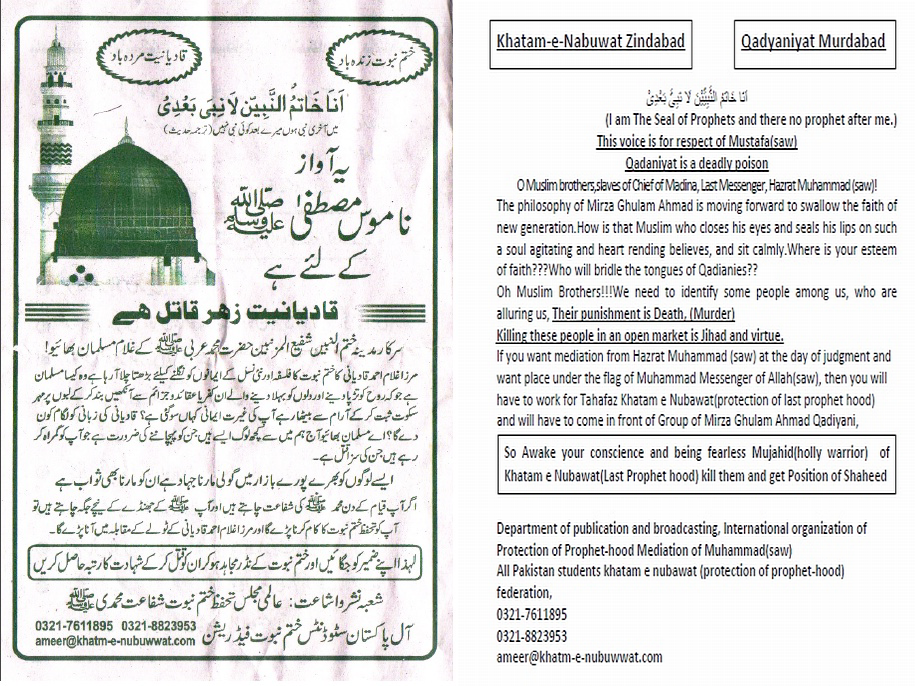
While violent groups increased their attacks against the state, Islamist political parties initiated a campaign against the Ahmadiyya community in Bangladesh and demanded that the government declare them non-Muslims.[5] In 2004, the Bangladeshi government, then led by the BNP, banned the publication, sale, distribution, and preservation of all books and booklets on Islam published by the Ahmadiyya in Bangladesh. In June 2005, Islamists set fire to an Ahmadiyya mosque in Brahmanbaria and detonated more than two dozen bombs, injuring two people.[6] As Bangladesh scholar Dr. Ali Riaz noted in 2004, “The accommodation of political Islam [in Bangladesh]…has created a context within which political radicalism and social intolerance are increasing and soon may become the mainstay of politics.”[7]
However, the U.S. State Department reported in its 2008 Country Reports on Human Rights Practices that the Bangladesh government has improved its protection of religious minorities, including the Ahmadiyyas. The report also noted that the Bangladesh High Court stayed the government ban on publishing Ahmadiyya literature, effectively allowing Ahmadiyyas to publish.[8]
The current Awami League government led by Prime Minister Sheikh Hasina has demonstrated its determination to deal firmly with violent Islamist groups and to roll back Islamist trends within the country’s politics.[9] The Hasina government’s October 23rd banning of the Islamist extremist group Hizbut Tahrir is one indicator that the Bangladesh government is taking a tough stance toward extremism and is committed to ensuring the country remains on a democratic and peaceful path. The Appellate Division of Bangladesh’s Supreme Court also recently upheld the 2005 High Court decision to reinstate the ban on religious political parties, which was lifted in 1979 by the Fifth Amendment to the Constitution. The Appellate Division dismissed two petitions challenging the High Court ruling, which had found the Fifth Amendment “illegal and unconstitutional.” It is unclear whether the decision will lead to the official banning of religion-based parties.
Evolution of Bangladeshi Identity
Bangladesh (previously East Pakistan) was born in 1971 as a reaction to perceived exploitation and repression by the country’s leaders located in West Pakistan (now Pakistan). Two main elements of identity have shaped the people in this land: the Islamic faith and Bengali culture. The cultural element gained prominence immediately after the War of Liberation. Both the United States and the Soviet Union viewed this local conflict as another manifestation of their proxy confrontation, and Bangladesh became a battlefield for competing regional and international interests, with Pakistan supporting local forces to counter India’s influence. An ally of India and the Soviet Union, Sheikh Mujibur Rahman, the charismatic figure at the founding of the Bangladesh nation, incorporated secularism and socialism as national ideals enshrined in the Constitution. However, in its early years, the Bangladesh government failed in its nation-building tasks, and Sheikh Mujib even resorted to the one-party rule.
Bangladesh became a sustained democratic system only in 1991, with the election of Begum Khaleda Zia of the Bangladesh National Party (BNP). The two subsequent elections were bitterly contested, but the results were still accepted. Regrettably, democratic government further amplified corruption, which was an endemic problem that predated the democratic era. The economic opportunities of the globalizing world of the 1990s also brought a modest prosperity to some Bangladeshis. The democratic era thus became a breeding ground for the vicious circle of corruption, patronage, and popular resentment.
In the context of democracy’s eroding credibility, support for Islamist ideas began to grow in Bangladesh. The fading memory of the War of Liberation diluted the importance of nationalism in the political identity of Bangladesh and allowed the Islamic element of this identity to gain ascendancy. Globalization also enhanced Middle Eastern influences, both through the influx of funds from Islamic charitable organizations seeking to foster new Islamic learning and social services institutions and through migrant workers who returned from Gulf states with new ideas about the relationship between state and religion.[10]
Impact of the Caretaker Government (2007-2008)
The army takeover of January 11, 2007, was carried out in the name of cleansing the political process of both corruption and terrorism. Most Bangladeshis initially supported the Bangladesh Army’s action as the only option to save the country from political disaster and a potential bloodbath. Three years later, however, the army appears to have failed to root out corruption. Indeed, Bangladeshi media has reported some cases of corruption by the military-backed civilian rulers.[11]
On the issue of terrorism, the military-backed government of 2007-2008 made notable progress, arresting and executing Islamist activists involved in terrorism. The military-backed government also commissioned a report on effective ways to address the terrorism issue. As such, the government’s main thrust in handling the terrorism problem was to view it as a criminal phenomenon. This tendency has influenced the approach subsequently adopted by the Hasina government.
A less helpful legacy of the military-backed government is the precedent that it set by suspending the democratic process. This plays into one of the ideological underpinnings of extremism and terrorism, the political proposition that questions the validity of democracy and the legitimacy of popular sovereignty. Although the Bangladeshi people initially viewed the state of emergency as necessary given the rising political tensions in the country, they nevertheless welcomed the 2008 elections and the return to democracy.
The imposition of military-backed rule for 18 months has increased doubts of many Bangladeshis about civilian authority over the army. Rumors of an impending coup flourish in the country, and faith in Hasina’s leadership fluctuates accordingly.
Mutiny Challenges Hasina Government
Sheikh Hasina faced the most severe challenge to her leadership in February 2009 when a mutiny in the Bangladesh Rifles (BDR), one corps of the armed forces, degenerated into a massacre. The government’s handling of events had the potential to create a confrontation with the military. However, it managed the crisis deftly and averted a catastrophe.
The exact circumstances that led to the mutiny on February 25-26, 2009, have not yet been fully uncovered. The BDR is a border guard force of about 67,000, led by Bangladeshi army officers. While government and military investigations have explored the events at length, many questions remain unanswered, and competing narratives are circulating in different segments of the Bangladeshi political spectrum. What is known is that BDR elements took over a portion of the Dhaka Cantonment, the main concentration of military offices and residences in the country, and made public demands for parity with the Army on benefits and promotions. By the second day, the unrest had spread to at least 12 other towns. The mutiny ended with the mutineers surrendering their arms and releasing their hostages after negotiations with the government.
No solid evidence yet indicates exactly who instigated the mutiny or whether the purpose of the mutiny went beyond the stated demands of the mutineers for higher pay and better employment benefits. The intensity of the atrocities–including the massacre of dozens of high-ranking military officers, disfiguration and dismemberment of army personnel, and rape of female family members of the officers–was clearly disproportionate to the mutineers’ demands.
Several questions remain: Were the atrocities the results of miscalculations and uncontrollable excesses, or were they part of a deliberate attempt to weaken the army? If it was an attempt to weaken the army, who is behind the conspiracy? One member of Hasina’s cabinet has called the mutiny a “deep-rooted conspiracy” by people intent on destabilizing the country.[12]
Islamism as an Existential Threat
The largely socialist and secular background of today’s Bangladeshi cultural elite contrasts with broader society, which is growing more conservative in religious practices and mores. The reasons behind this trend are numerous. Locally, the emergence of distinct social classes and the identification of some segments of the elite with a Western way of life have triggered a reaction toward a more conservative outlook. Contributing factors include the abundance of satellite television channels that preach more dogmatic forms of the religion and the large number of Bangladeshi migrant workers returning home from Gulf states where they acquired different values. Islamists have injected themselves into this environment of greater religious conservatism, adding components of activism and intolerance.
This sociocultural dynamic is significant and needs to be monitored. Islamists do not generally state a political vision at the outset, but the socioeconomic needs of the people provide the Islamists with an opening to begin influencing the grassroots of society. Islamists engage in a bait-and-switch process, entering through a social question and then eventually promoting a political formula. In reality, their political formula is negation of the existing system. They argue that the current order is illegitimate and needs to be changed and that Islam is the solution, but leave the specifics of this solution unexplained. Still, in their relentless rejection of the current order, Islamists capitalize on and amplify the resentment toward the ruling elite. They also undermine the legitimacy of the state and question the foundations of democracy.
Bangladesh is grounded in a tradition of pluralism and its aspiration for sound democratic governance. Furthermore, indications are that Bangladeshis have become increasingly devout in their religious practices, but are uncomfortable with any notion of increased state engagement in religious affairs. However, there are some signs that Bangladeshi confidence in democratic values has receded. Islamists are actively seeking to uproot these values further, and the trend may be toward losing the pluralistic values of liberal society, unless proactive steps are taken. Radical Islamism should be treated as an existential threat to the country.
Three Types of Islamism
Islamism as a political ideology, which aims at redefining sovereignty in Islamic terms, has coalesced into three main approaches globally.[13] These approaches can be described as evolutionary, revolutionary, and opportunistic.
Evolutionary Islamism. The evolutionary model is represented in Bangladesh and the rest of South Asia by the Jamaat-e-Islami. The JI seeks to turn Bangladesh into an Islamic state, in which the people and the parliament no longer have sovereignty, but JI seeks to achieve this goal by working within the existing laws and conventions of the country.[14] The JI Islamist project proceeds incrementally from individual to family to society to state through a process of Islamization that seeks to reshape everyday life according to the Islamists’ understanding of Islam.
Evolutionary Islamism is accommodating of existing systems and institutions, but operates with the underlying belief that these structures will naturally dissolve as the project moves forward. JI is willing to contest elections and assume responsibilities of government–behaving as any other political party–with the implicit conviction that this is merely a temporary framework until the Islamist ideal is realized. The Muslim Brotherhood in Egypt is another evolutionary Islamist group.
Revolutionary Islamism. In the revolutionary model, Islamists reject the temporary compromise on principal or simply make no space to accommodate it. Instead, they choose to openly confront the existing system. The Jamaat-ul-Mujahideen Bangladesh follows this model.
Opportunistic Islamism. The opportunistic model, which is less prominent in global Islamism, also rejects any legitimacy outside the Islamic framework. Opportunistic Islamists do not seek an immediate open confrontation with the existing order, but instead are inclined to seed state institutions, particularly the military, with their own activists to usher in a momentous transformation when the time is right.
The Hizbut Tahrir can be called opportunistic Islamists. Any effort to counter the effects of these groups in Bangladesh needs to be informed by their global ideological context, but the idiosyncratic histories of these groups in Bangladesh may also be important in devising ways to contain them.
Jamaat-e-Islami
Jamaat-e-Islami is by far the oldest, largest, and most deeply rooted Islamist organization in Bangladesh. It has maintained a constant presence in the Bangladeshi National Parliament since the restoration of democracy in 1991, although it secured only two seats in parliament in the December 2008 elections. Its youth organization has branches nationwide and is an effective recruitment arm for the political party. Its network of social services offers impoverished constituents basic health and an invitation to political patronage. The JI has faced two main handicaps in the past few years: the revival of political interest in reexamining its role in the 1971 War of Liberation and its long-term association with the Bangladesh National Party (BNP), a political party that faced a serious setback in the most recent elections.
While it can be argued that any liberation war is also a civil war, the cultural consensus in Bangladesh is to draw a clear line between those who sought independence and those who supported the Pakistani Army’s repression of the independence movement. In 1971, supporters of Pakistan as the Muslim state of the Indian subcontinent argued that the independence movement in East Pakistan was a secessionist action instigated by India to undermine the integrity and power of the Islamic state. The JI’s role in supporting West Pakistan and the repressive measures of its army has since been recast by political opponents as collaboration in genocide. The JI leadership, largely due to political circumstances and military rule, has so far largely escaped being stigmatized by this accepted version of history. However, the constant threat of being tarred by these accusations indirectly helps to prevent the JI from overtly undermining democracy in Bangladesh.
From the point of view of the Awami League and its allies, the JI’s active participation in the BNP government from 2001-2006 justified the invocation of the anti-JI weapon of raising the issue of the 1971 war crimes. In an attempt to court the Awami League and the left-leaning part of the political spectrum, the 2007-2008 military-backed government reintroduced the question of a special tribunal for the war criminals of 1971. Over the past few decades, the military’s apparent oscillation on questions relating to the JI and the targeting of Islamists likely reflects internal divergences within the military. On the other hand, the interactions between the military and JI demonstrate the army leadership’s ability to balance and manipulate the political system. During two years of military-backed rule, the army leadership seemed to explore various approaches in managing the diverse political forces, finally choosing to endorse much of the Awami League’s program.
Today, having inherited the war crimes issue from the military-backed caretaker government, the Awami League finds it advantageous to raise the issue in its quest to dismantle the BNP, its opposition. Prosecution of the 1971 war crimes has limited support in some segments of Bangladeshi society, but it is widely seen as a political issue aimed primarily at discrediting the JI, rather than as a societal issue to be resolved in the interest of national reconciliation.
Supporters of holding trials view them as a means to curtail the JI’s influence and as a potentially fatal blow to the organization. However, seeking to counter the JI only through the courts would be misguided. The JI, as an evolutionary Islamist group, is engaged in a generational quest to change Bangladeshi society and government. Court actions may distract it, but they are unlikely to derail its long-term project. It is noteworthy that JI’s leaders consider the December 2008 elections a victory, even though its representation in parliament dwindled to just two seats. Jamaat-e-Islami representatives instead highlight the fact that JI candidates received more votes in 2008 than they did in 2001. These votes may not have translated into parliamentary seats, but they demonstrate that the party is making incremental gains in the electorate.
Jamaat-ul-Mujahideen Bangladesh
On August 17, 2005, the Jamaat-ul-Mujahideen Bangladesh staged a spectacular series of coordinated bombings across the nation, detonating approximately 400 devices within the space of 45 minutes in 63 of the country’s 64 districts, but killing only three people. The JMB apparently believed that this dramatic action would usher in the rise of a revolutionary Islamist insurgency. Sporadic terrorist operations followed the August bombings, further demonstrating the JMB’s goals in the country. The language that the JMB used to justify its attacks was sharp, unyielding, and consistent with global jihadist discourse. The JMB argued that the Bangladesh government was corrupt and that its democratic system should be rejected.[15]
The military-backed government of 2007-2008 tried the JMB ringleaders in court and eventually executed them without taking special legal measures. Vigorous enforcement against the JMB seems to have largely curtailed the group’s operations, although Bangladeshi authorities discovered a JMB-connected bomb factory in an Islamic school in the Bhola district in the spring of 2009. Local villagers had noticed suspicious activity at the school and alerted the authorities.[16] The JMB has thus far shown little ability to penetrate social environments in Bangladesh that could be tapped to sustain an insurgency. Yet the JMB’s possible revival into a renewed threat to the Bangladeshi state and society cannot be ruled out, especially with international players seeking a foothold in murky Bangladeshi politics. The spectacular character of the JMB’s “baptism of fire,” the series of coordinated bombings, seems also to have created a well-known brand name for the group among international extremist networks, as evidenced by the group’s technologically savvy presence on the Internet.
Sources in the Bangladesh government have indicated that many operational aspects of the synchronized bombings were outsourced to other insurgent groups, such as a hard-line communist insurgency that operates in Bangladeshi rural areas. However, this should be viewed as a strength, not a weakness, of the JMB. In fact, the JMB has demonstrated sophistication in its Web presence, elusive networks, and associations with unlikely partners.
Harakat-ul-Jihad-i-Islami/Bangladesh
The Harakat-ul-Jihad-i-Islami/Bangladesh (HuJI-B) is an offshoot of the Pakistan-based Harakat-ul-Jihad-i-Islami (HuJI), a pan-Islamist terrorist group that has the stated goal of combating worldwide oppression of Muslims. The HuJI originally formed to fight the Soviets in Afghanistan in the 1980s. It then focused its militant activities against India in Jammu and Kashmir throughout the 1990s, and it now fights alongside the Taliban and al-Qaeda against coalition forces in Afghanistan. Pakistan-based HuJI leader Ilyas Kashmiri has been targeted by U.S. drone missile strikes in Pakistan’s tribal areas and was recently named by the FBI as co-conspirator in plots to attack India and Denmark.
The HuJI-B was formed under the leadership of Shafiqur Rehman in 1992 by Bangladeshi veterans of the 1980s war in Afghanistan, and it likely maintains close connections with the Pakistan-based HuJI.[17] The U.S. State Department designated HuJI-B as a foreign terrorist organization in March 2008. In late January 2010, Indian authorities reportedly arrested a HuJI-B operative who had planned to attack Hyderabad, India, on Indian Republic Day.[18]
Hizbut Tahrir
Between JI’s temporary acceptance of the democratic process and the JMB and HuJI-B’s unequivocal rejection is qualified coexistence with the system, as practiced by the Hizbut Tahrir (HUT). This group presents itself globally as the party of the restoration of the Caliphate, the universal Islamic state that transcends nationalities and political borders.[19] Hizbut Tahrir seeks to achieve its goal through de facto acceptance of established order in Muslim majority societies, while aggressively questioning the legitimacy of any system other than the universal Islamic state.
Globally, Hizbut Tahrir has only rarely been implicated in violent or terrorist actions, but it has been banned in Germany, Russia, Kazakhstan, and a handful of other countries. The Bangladesh government banned HUT’s Bangladesh chapter after an unidentified group bombed a ruling party parliamentarian on October 21, 2009. The government said it would not punish HUT activists for past offenses, but warned them not to continue “anti-state” activities. Mohiuddin Ahmed, the HUT chief coordinator in Bangladesh and a professor at Dhaka University, was put on “forced leave indefinitely.”[20]
HUT is the fifth militant organization to be outlawed in Bangladesh since 2001.[21] Previously, it was suggested that leaders in the Bangladeshi Armed Forces viewed HUT in its discipline and professional outlook as a counterproposition to the revolutionary Islamism of the JMB and similar groups.[22] However, this view ignored the potent radicalization effect of HUT. As described by former HUT members in the United Kingdom, the organization instills in its youthful recruits a sense of alienation and isolation from the wider society.[23] HUT leads its members on a path to radicalization and rejection of the established order. It is unclear whether HUT engaged directly in terrorism in Bangladesh, but it has staged intimidating demonstrations that apparently provoked people to violence.[24]
HUT originally drew the attention of the Bangladeshi authorities after a grenade attack on British High Commissioner to Bangladesh Anwar Choudhury in May 2004. Bangladeshi press reported that, two days before the incident, HUT supporters had posted anti-British and anti-U.S. posters at the shrine where Choudhury was later attacked. Although HUT may not be a force of insurgency, it is a major driver of radicalization.
Until millions of Bangladeshis are raised out of poverty, governing institutions are strengthened further, and corruption is controlled, Bangladesh will face a threat from Islamist extremists seeking to undermine the country’s democratic institutions and tolerant traditions. Preventing Bangladesh–a nation with 140 million Muslims–from falling prey to a volatile mix of radicalization and political unrest should be a top priority for Western policymakers. The U.S. should seek new ways to partner with the Bangladeshi government to stem the influence of Islamists so that they do not become an urgent threat to the country.
A Return to Democracy
More than a year has passed since the elections that put Bangladesh back on the democratic path. On January 11, 2007, the Bangladeshi military intervened in a precarious democratic process, effectively removing Bangladesh from the list of recognized democracies. One more Muslim-majority nation seemed to be heading toward prolonged autocratic rule. In December 2008, however, Bangladeshi democracy received another lease on life with elections that international observers deemed credible.
The return of democracy to Bangladesh is a welcome development, but the country continues to face challenges from groups that support Islamist ideologies as well as from groups that violently oppose the state. Without concerted action by government authorities and increased awareness among the Bangladeshi public about the agendas of these groups, the political center of gravity in Bangladesh could shift increasingly toward Islamism.[1]
While moderation and religious tolerance continue to be defining features of Bangladeshi politics, the secular discourse and ideals upon which Bangladesh was founded in 1971 have been diluted. Arguably, the process of integrating Islam more fully into the political sphere began as early as 1975, after General Ziaur Rahman assumed the presidency. He removed the reference to “secularism,” a fundamental principle of Bangladeshi nationhood, from the preamble of the Bangladeshi constitution and replaced it with a new clause asserting that “absolute trust and faith in the Almighty Allah” should be “the basis of all actions.” Zia also lifted the ban on religious political parties, thus allowing Islamists a role within the political realm. Furthermore, to prove his own Islamic credentials, General Hussain Ershad, Zia’s successor, declared Islam the state religion in 1988.[2] These military regimes, which took power through coups in 1975 and 1982, respectively, generally pursued policies of Islamization to gain political legitimacy.[3]
Islamist ideas have thus become more prevalent in the country’s political discourse, a process spurred by the rising fortunes of the Jamaat-e-Islami (JI), the predominant Islamist political party. The two major political parties, the Bangladesh National Party (BNP) and the Awami League, have found it politically expedient to create space for political Islam in their own campaign rhetoric and to form short-term and long-term alliances with Islamist political parties. When the BNP ruled the country from 2001 to 2006, it formed an alliance with the JI, allowing JI members to hold cabinet positions for the first time. Although the JI has captured only about 6 percent to 8 percent of the vote in the past four elections, it is considered a kingmaker in Bangladeshi politics. Just before the 2007 election, the Awami League, which trumpets its secular credentials, found it politically expedient to reach out to the Islami Okiyo Jote, a smaller and more radical Islamist party.
The emergence of violent Islamist groups in Bangladesh over the past decade is another worrisome trend, although the Bangladeshi authorities have demonstrated a willingness to deal firmly with the threat. A handful of transnational terrorist groups, some with connections to Pakistan-based groups, stepped up attacks against the state in 2004-2005. On August 17, 2005, Jamaat-ul-Mujahideen Bangladesh (JMB) conducted the most spectacular of these attacks, a coordinated series of bombings throughout the country. On November 29, 2005, at least nine people were killed in another series of attacks on Bangladeshi courts, which further demonstrated that Islamist groups were seeking to weaken the state.[4] The bombings served as a wake-up call to the Bangladeshi government about the need to control Islamist terrorist groups. In March 2007, the military-backed caretaker government tried and executed six JMB leaders for their involvement in the August 2005 bombings.
While violent groups increased their attacks against the state, Islamist political parties initiated a campaign against the Ahmadiyya community in Bangladesh and demanded that the government declare them non-Muslims.[5] In 2004, the Bangladeshi government, then led by the BNP, banned the publication, sale, distribution, and preservation of all books and booklets on Islam published by the Ahmadiyya in Bangladesh. In June 2005, Islamists set fire to an Ahmadiyya mosque in Brahmanbaria and detonated more than two dozen bombs, injuring two people.[6] As Bangladesh scholar Dr. Ali Riaz noted in 2004, “The accommodation of political Islam [in Bangladesh]…has created a context within which political radicalism and social intolerance are increasing and soon may become the mainstay of politics.”[7]
However, the U.S. State Department reported in its 2008 Country Reports on Human Rights Practices that the Bangladesh government has improved its protection of religious minorities, including the Ahmadiyyas. The report also noted that the Bangladesh High Court stayed the government ban on publishing Ahmadiyya literature, effectively allowing Ahmadiyyas to publish.[8]
The current Awami League government led by Prime Minister Sheikh Hasina has demonstrated its determination to deal firmly with violent Islamist groups and to roll back Islamist trends within the country’s politics.[9] The Hasina government’s October 23rd banning of the Islamist extremist group Hizbut Tahrir is one indicator that the Bangladesh government is taking a tough stance toward extremism and is committed to ensuring the country remains on a democratic and peaceful path. The Appellate Division of Bangladesh’s Supreme Court also recently upheld the 2005 High Court decision to reinstate the ban on religious political parties, which was lifted in 1979 by the Fifth Amendment to the Constitution. The Appellate Division dismissed two petitions challenging the High Court ruling, which had found the Fifth Amendment “illegal and unconstitutional.” It is unclear whether the decision will lead to the official banning of religion-based parties.
Evolution of Bangladeshi Identity
Bangladesh (previously East Pakistan) was born in 1971 as a reaction to perceived exploitation and repression by the country’s leaders located in West Pakistan (now Pakistan). Two main elements of identity have shaped the people in this land: the Islamic faith and Bengali culture. The cultural element gained prominence immediately after the War of Liberation. Both the United States and the Soviet Union viewed this local conflict as another manifestation of their proxy confrontation, and Bangladesh became a battlefield for competing regional and international interests, with Pakistan supporting local forces to counter India’s influence. An ally of India and the Soviet Union, Sheikh Mujibur Rahman, the charismatic figure at the founding of the Bangladesh nation, incorporated secularism and socialism as national ideals enshrined in the Constitution. However, in its early years, the Bangladesh government failed in its nation-building tasks, and Sheikh Mujib even resorted to the one-party rule.
Bangladesh became a sustained democratic system only in 1991, with the election of Begum Khaleda Zia of the Bangladesh National Party (BNP). The two subsequent elections were bitterly contested, but the results were still accepted. Regrettably, democratic government further amplified corruption, which was an endemic problem that predated the democratic era. The economic opportunities of the globalizing world of the 1990s also brought a modest prosperity to some Bangladeshis. The democratic era thus became a breeding ground for the vicious circle of corruption, patronage, and popular resentment.
In the context of democracy’s eroding credibility, support for Islamist ideas began to grow in Bangladesh. The fading memory of the War of Liberation diluted the importance of nationalism in the political identity of Bangladesh and allowed the Islamic element of this identity to gain ascendancy. Globalization also enhanced Middle Eastern influences, both through the influx of funds from Islamic charitable organizations seeking to foster new Islamic learning and social services institutions and through migrant workers who returned from Gulf states with new ideas about the relationship between state and religion.[10]
Impact of the Caretaker Government (2007-2008)
The army takeover of January 11, 2007, was carried out in the name of cleansing the political process of both corruption and terrorism. Most Bangladeshis initially supported the Bangladesh Army’s action as the only option to save the country from political disaster and a potential bloodbath. Three years later, however, the army appears to have failed to root out corruption. Indeed, Bangladeshi media has reported some cases of corruption by the military-backed civilian rulers.[11]
On the issue of terrorism, the military-backed government of 2007-2008 made notable progress, arresting and executing Islamist activists involved in terrorism. The military-backed government also commissioned a report on effective ways to address the terrorism issue. As such, the government’s main thrust in handling the terrorism problem was to view it as a criminal phenomenon. This tendency has influenced the approach subsequently adopted by the Hasina government.
A less helpful legacy of the military-backed government is the precedent that it set by suspending the democratic process. This plays into one of the ideological underpinnings of extremism and terrorism, the political proposition that questions the validity of democracy and the legitimacy of popular sovereignty. Although the Bangladeshi people initially viewed the state of emergency as necessary given the rising political tensions in the country, they nevertheless welcomed the 2008 elections and the return to democracy.
The imposition of military-backed rule for 18 months has increased doubts of many Bangladeshis about civilian authority over the army. Rumors of an impending coup flourish in the country, and faith in Hasina’s leadership fluctuates accordingly.
Mutiny Challenges Hasina Government
Sheikh Hasina faced the most severe challenge to her leadership in February 2009 when a mutiny in the Bangladesh Rifles (BDR), one corps of the armed forces, degenerated into a massacre. The government’s handling of events had the potential to create a confrontation with the military. However, it managed the crisis deftly and averted a catastrophe.
The exact circumstances that led to the mutiny on February 25-26, 2009, have not yet been fully uncovered. The BDR is a border guard force of about 67,000, led by Bangladeshi army officers. While government and military investigations have explored the events at length, many questions remain unanswered, and competing narratives are circulating in different segments of the Bangladeshi political spectrum. What is known is that BDR elements took over a portion of the Dhaka Cantonment, the main concentration of military offices and residences in the country, and made public demands for parity with the Army on benefits and promotions. By the second day, the unrest had spread to at least 12 other towns. The mutiny ended with the mutineers surrendering their arms and releasing their hostages after negotiations with the government.
No solid evidence yet indicates exactly who instigated the mutiny or whether the purpose of the mutiny went beyond the stated demands of the mutineers for higher pay and better employment benefits. The intensity of the atrocities–including the massacre of dozens of high-ranking military officers, disfiguration and dismemberment of army personnel, and rape of female family members of the officers–was clearly disproportionate to the mutineers’ demands.
Several questions remain: Were the atrocities the results of miscalculations and uncontrollable excesses, or were they part of a deliberate attempt to weaken the army? If it was an attempt to weaken the army, who is behind the conspiracy? One member of Hasina’s cabinet has called the mutiny a “deep-rooted conspiracy” by people intent on destabilizing the country.[12]
Islamism as an Existential Threat
The largely socialist and secular background of today’s Bangladeshi cultural elite contrasts with broader society, which is growing more conservative in religious practices and mores. The reasons behind this trend are numerous. Locally, the emergence of distinct social classes and the identification of some segments of the elite with a Western way of life have triggered a reaction toward a more conservative outlook. Contributing factors include the abundance of satellite television channels that preach more dogmatic forms of the religion and the large number of Bangladeshi migrant workers returning home from Gulf states where they acquired different values. Islamists have injected themselves into this environment of greater religious conservatism, adding components of activism and intolerance.
This sociocultural dynamic is significant and needs to be monitored. Islamists do not generally state a political vision at the outset, but the socioeconomic needs of the people provide the Islamists with an opening to begin influencing the grassroots of society. Islamists engage in a bait-and-switch process, entering through a social question and then eventually promoting a political formula. In reality, their political formula is negation of the existing system. They argue that the current order is illegitimate and needs to be changed and that Islam is the solution, but leave the specifics of this solution unexplained. Still, in their relentless rejection of the current order, Islamists capitalize on and amplify the resentment toward the ruling elite. They also undermine the legitimacy of the state and question the foundations of democracy.
Bangladesh is grounded in a tradition of pluralism and its aspiration for sound democratic governance. Furthermore, indications are that Bangladeshis have become increasingly devout in their religious practices, but are uncomfortable with any notion of increased state engagement in religious affairs. However, there are some signs that Bangladeshi confidence in democratic values has receded. Islamists are actively seeking to uproot these values further, and the trend may be toward losing the pluralistic values of liberal society, unless proactive steps are taken. Radical Islamism should be treated as an existential threat to the country.
Three Types of Islamism
Islamism as a political ideology, which aims at redefining sovereignty in Islamic terms, has coalesced into three main approaches globally.[13] These approaches can be described as evolutionary, revolutionary, and opportunistic.
Evolutionary Islamism. The evolutionary model is represented in Bangladesh and the rest of South Asia by the Jamaat-e-Islami. The JI seeks to turn Bangladesh into an Islamic state, in which the people and the parliament no longer have sovereignty, but JI seeks to achieve this goal by working within the existing laws and conventions of the country.[14] The JI Islamist project proceeds incrementally from individual to family to society to state through a process of Islamization that seeks to reshape everyday life according to the Islamists’ understanding of Islam.
Evolutionary Islamism is accommodating of existing systems and institutions, but operates with the underlying belief that these structures will naturally dissolve as the project moves forward. JI is willing to contest elections and assume responsibilities of government–behaving as any other political party–with the implicit conviction that this is merely a temporary framework until the Islamist ideal is realized. The Muslim Brotherhood in Egypt is another evolutionary Islamist group.
Revolutionary Islamism. In the revolutionary model, Islamists reject the temporary compromise on principal or simply make no space to accommodate it. Instead, they choose to openly confront the existing system. The Jamaat-ul-Mujahideen Bangladesh follows this model.
Opportunistic Islamism. The opportunistic model, which is less prominent in global Islamism, also rejects any legitimacy outside the Islamic framework. Opportunistic Islamists do not seek an immediate open confrontation with the existing order, but instead are inclined to seed state institutions, particularly the military, with their own activists to usher in a momentous transformation when the time is right.
The Hizbut Tahrir can be called opportunistic Islamists. Any effort to counter the effects of these groups in Bangladesh needs to be informed by their global ideological context, but the idiosyncratic histories of these groups in Bangladesh may also be important in devising ways to contain them.
Jamaat-e-Islami
Jamaat-e-Islami is by far the oldest, largest, and most deeply rooted Islamist organization in Bangladesh. It has maintained a constant presence in the Bangladeshi National Parliament since the restoration of democracy in 1991, although it secured only two seats in parliament in the December 2008 elections. Its youth organization has branches nationwide and is an effective recruitment arm for the political party. Its network of social services offers impoverished constituents basic health and an invitation to political patronage. The JI has faced two main handicaps in the past few years: the revival of political interest in reexamining its role in the 1971 War of Liberation and its long-term association with the Bangladesh National Party (BNP), a political party that faced a serious setback in the most recent elections.
While it can be argued that any liberation war is also a civil war, the cultural consensus in Bangladesh is to draw a clear line between those who sought independence and those who supported the Pakistani Army’s repression of the independence movement. In 1971, supporters of Pakistan as the Muslim state of the Indian subcontinent argued that the independence movement in East Pakistan was a secessionist action instigated by India to undermine the integrity and power of the Islamic state. The JI’s role in supporting West Pakistan and the repressive measures of its army has since been recast by political opponents as collaboration in genocide. The JI leadership, largely due to political circumstances and military rule, has so far largely escaped being stigmatized by this accepted version of history. However, the constant threat of being tarred by these accusations indirectly helps to prevent the JI from overtly undermining democracy in Bangladesh.
From the point of view of the Awami League and its allies, the JI’s active participation in the BNP government from 2001-2006 justified the invocation of the anti-JI weapon of raising the issue of the 1971 war crimes. In an attempt to court the Awami League and the left-leaning part of the political spectrum, the 2007-2008 military-backed government reintroduced the question of a special tribunal for the war criminals of 1971. Over the past few decades, the military’s apparent oscillation on questions relating to the JI and the targeting of Islamists likely reflects internal divergences within the military. On the other hand, the interactions between the military and JI demonstrate the army leadership’s ability to balance and manipulate the political system. During two years of military-backed rule, the army leadership seemed to explore various approaches in managing the diverse political forces, finally choosing to endorse much of the Awami League’s program.
Today, having inherited the war crimes issue from the military-backed caretaker government, the Awami League finds it advantageous to raise the issue in its quest to dismantle the BNP, its opposition. Prosecution of the 1971 war crimes has limited support in some segments of Bangladeshi society, but it is widely seen as a political issue aimed primarily at discrediting the JI, rather than as a societal issue to be resolved in the interest of national reconciliation.
Supporters of holding trials view them as a means to curtail the JI’s influence and as a potentially fatal blow to the organization. However, seeking to counter the JI only through the courts would be misguided. The JI, as an evolutionary Islamist group, is engaged in a generational quest to change Bangladeshi society and government. Court actions may distract it, but they are unlikely to derail its long-term project. It is noteworthy that JI’s leaders consider the December 2008 elections a victory, even though its representation in parliament dwindled to just two seats. Jamaat-e-Islami representatives instead highlight the fact that JI candidates received more votes in 2008 than they did in 2001. These votes may not have translated into parliamentary seats, but they demonstrate that the party is making incremental gains in the electorate.
Jamaat-ul-Mujahideen Bangladesh
On August 17, 2005, the Jamaat-ul-Mujahideen Bangladesh staged a spectacular series of coordinated bombings across the nation, detonating approximately 400 devices within the space of 45 minutes in 63 of the country’s 64 districts, but killing only three people. The JMB apparently believed that this dramatic action would usher in the rise of a revolutionary Islamist insurgency. Sporadic terrorist operations followed the August bombings, further demonstrating the JMB’s goals in the country. The language that the JMB used to justify its attacks was sharp, unyielding, and consistent with global jihadist discourse. The JMB argued that the Bangladesh government was corrupt and that its democratic system should be rejected.[15]
The military-backed government of 2007-2008 tried the JMB ringleaders in court and eventually executed them without taking special legal measures. Vigorous enforcement against the JMB seems to have largely curtailed the group’s operations, although Bangladeshi authorities discovered a JMB-connected bomb factory in an Islamic school in the Bhola district in the spring of 2009. Local villagers had noticed suspicious activity at the school and alerted the authorities.[16] The JMB has thus far shown little ability to penetrate social environments in Bangladesh that could be tapped to sustain an insurgency. Yet the JMB’s possible revival into a renewed threat to the Bangladeshi state and society cannot be ruled out, especially with international players seeking a foothold in murky Bangladeshi politics. The spectacular character of the JMB’s “baptism of fire,” the series of coordinated bombings, seems also to have created a well-known brand name for the group among international extremist networks, as evidenced by the group’s technologically savvy presence on the Internet.
Sources in the Bangladesh government have indicated that many operational aspects of the synchronized bombings were outsourced to other insurgent groups, such as a hard-line communist insurgency that operates in Bangladeshi rural areas. However, this should be viewed as a strength, not a weakness, of the JMB. In fact, the JMB has demonstrated sophistication in its Web presence, elusive networks, and associations with unlikely partners.
Harakat-ul-Jihad-i-Islami/Bangladesh
The Harakat-ul-Jihad-i-Islami/Bangladesh (HuJI-B) is an offshoot of the Pakistan-based Harakat-ul-Jihad-i-Islami (HuJI), a pan-Islamist terrorist group that has the stated goal of combating worldwide oppression of Muslims. The HuJI originally formed to fight the Soviets in Afghanistan in the 1980s. It then focused its militant activities against India in Jammu and Kashmir throughout the 1990s, and it now fights alongside the Taliban and al-Qaeda against coalition forces in Afghanistan. Pakistan-based HuJI leader Ilyas Kashmiri has been targeted by U.S. drone missile strikes in Pakistan’s tribal areas and was recently named by the FBI as co-conspirator in plots to attack India and Denmark.
The HuJI-B was formed under the leadership of Shafiqur Rehman in 1992 by Bangladeshi veterans of the 1980s war in Afghanistan, and it likely maintains close connections with the Pakistan-based HuJI.[17] The U.S. State Department designated HuJI-B as a foreign terrorist organization in March 2008. In late January 2010, Indian authorities reportedly arrested a HuJI-B operative who had planned to attack Hyderabad, India, on Indian Republic Day.[18]
Hizbut Tahrir
Between JI’s temporary acceptance of the democratic process and the JMB and HuJI-B’s unequivocal rejection is qualified coexistence with the system, as practiced by the Hizbut Tahrir (HUT). This group presents itself globally as the party of the restoration of the Caliphate, the universal Islamic state that transcends nationalities and political borders.[19] Hizbut Tahrir seeks to achieve its goal through de facto acceptance of established order in Muslim majority societies, while aggressively questioning the legitimacy of any system other than the universal Islamic state.
Globally, Hizbut Tahrir has only rarely been implicated in violent or terrorist actions, but it has been banned in Germany, Russia, Kazakhstan, and a handful of other countries. The Bangladesh government banned HUT’s Bangladesh chapter after an unidentified group bombed a ruling party parliamentarian on October 21, 2009. The government said it would not punish HUT activists for past offenses, but warned them not to continue “anti-state” activities. Mohiuddin Ahmed, the HUT chief coordinator in Bangladesh and a professor at Dhaka University, was put on “forced leave indefinitely.”[20]
HUT is the fifth militant organization to be outlawed in Bangladesh since 2001.[21] Previously, it was suggested that leaders in the Bangladeshi Armed Forces viewed HUT in its discipline and professional outlook as a counterproposition to the revolutionary Islamism of the JMB and similar groups.[22] However, this view ignored the potent radicalization effect of HUT. As described by former HUT members in the United Kingdom, the organization instills in its youthful recruits a sense of alienation and isolation from the wider society.[23] HUT leads its members on a path to radicalization and rejection of the established order. It is unclear whether HUT engaged directly in terrorism in Bangladesh, but it has staged intimidating demonstrations that apparently provoked people to violence.[24]
HUT originally drew the attention of the Bangladeshi authorities after a grenade attack on British High Commissioner to Bangladesh Anwar Choudhury in May 2004. Bangladeshi press reported that, two days before the incident, HUT supporters had posted anti-British and anti-U.S. posters at the shrine where Choudhury was later attacked. Although HUT may not be a force of insurgency, it is a major driver of radicalization.

What the U.S. Should Do
As Bangladesh seeks to limit the influence of radical Islamists and to prevent extremist ideologies from taking root in the country, the U.S. should:
As Bangladesh seeks to limit the influence of radical Islamists and to prevent extremist ideologies from taking root in the country, the U.S. should:
- Assist Bangladesh in improving its democratic process. Bangladesh is an imperfect democracy. Radicalization and terrorism are directly linked to corruption and a lack of trust in the representative political process. Thus, it is important for the U.S. to help Bangladesh to engage in a long-term reform of its democratic practices and to address endemic problems, such as strong-arm politics and the perpetual rejection of electoral defeat. The Hasina government can help this process by focusing on developing a common civic sense that places nation and state ahead of party and dynastic politics.
- Urge the Bangladesh government to develop a culture of transparency that fosters accountability and restrains corruption. One way to encourage greater transparency is to require all government agencies and departments to issue periodic reports detailing their activities and disbursements of funds. Disclosure should become the norm, and withholding information should require justification. The current administrative culture of Bangladesh remains afflicted by both secrecy and ad hoc reporting. Transitioning to a more predictable, more transparent relationship with the citizenry is essential to establishing good governance.
- Support Bangladesh in strengthening and streamlining its judicial system. In Bangladesh there is a critical vacuum in the law and order system. Even secular liberal democrats do not trust the legal system. The legitimacy of the political process has largely relied on charismatic leadership, rather than strong and enduring institutions. The evolution of Bangladeshi democracy into a reliable system based on consistent laws and individual accountability remains a major challenge.
- Support Bangladesh in developing a comprehensive approach to countering extremism and terrorism. Dhaka needs to resist the temptation to view terrorism as solely a criminal issue or an imported ideology. It is a combination of the two. Bangladesh needs to recognize the importance of addressing the radicalization as more than a criminal issue.[25] For example, the main leaders of the JMB were prosecuted and executed, but the organization continues to exist and evolve. In addition to decapitating the organization, the government needs to pursue the JMB’s ideological links to other organizations and individuals and work to prevent the spread of extremist ideas. The Hasina government is starting to grasp the complexity of the terrorism issue. Washington should support the Bangladesh government in adopting a comprehensive approach to dealing with the challenges posed by extremist ideologies.
- Support Bangladesh in working with other Muslim states and societies that are countering radicalism. Initiatives to counter radicalism are best conceived and implemented at the nongovernmental level, with local civil society actors assuming the primary role. While radical Islam has a global narrative, the most efficient responses to it are formulated at the local level, with regional and international counterradicalism networks providing support and sharing ideas. Bangladesh can also contribute to building up international networks to counter radicalism by sharing its own experiences of fusing local culture with Islam in a way that upholds democratic values, supports religious tolerance and pluralism, and serves as a bulwark against violent groups seeking to weaken the state.
- Support the Bangladesh government in developing a reintegration program for migrant workers returning to Bangladeshi society. Bangladeshi religious leaders should take a role in ensuring that Bangladeshi laborers returning from the Gulf region understand that there is no dichotomy between Bengali culture and the religion of Islam. Returning migrant workers from the Gulf have often been exposed to new ideas about the relationship between state and religion and/or have been influenced into thinking that Islam as practiced in Saudi Arabia is somehow superior to Islam as traditionally practiced in Bangladesh. Insistence on the validity of Bengali Islam can counter the destructive impulse of reductionist Islamist ideas, the seeds of which can be planted in Bangladeshi laborers during extended stays in the Gulf.
- Encourage Bangladesh to build on the strength of its culture to offer women relative freedom and choice in both the public and the private spheres. Since independence, women, regardless of social class, have assumed important roles in Bangladeshi society and have been active participants in socioeconomic life. Confronting Islamism in the social sphere should focus on the empowerment of women as individual, productive, and full members of society, not on the type of clothing they wear. The success of microfinance programs in Bangladesh that primarily lend to women demonstrates the benefits of women’s active involvement in economic life. Bangladesh should build on this success.
- Support the depoliticization of the debate surrounding radical Islam. The issue of radicalization should not be politicized for short-term gains against political opponents. Trials of the 1971 war crimes, in particular, could easily be misused for narrow political purposes, undermining a process of recovery and national reconciliation that is still lagging. The U.S. government should encourage Bangladesh to openly debate issues of national import, but discourage the parties from exploiting such issues for narrow political purposes.
While Bangladesh has so far met the challenges from creeping Islamist radicalization, the situation inside the country remains somewhat precarious. The local challenges in Bangladesh have been amplified by the injection of an internationally minded radicalization process. However, the assets that Bangladesh has accumulated over the past four decades remain a solid base for a potential recovery and reversal of Islamist radicalization.
The U.S. should stand ready to support local Bangladeshi actors, while recognizing that a free Bangladeshi society and democratic government must take the lead role and responsibility in meeting these challenges.
Maneeza Hossain is a Senior Fellow at the Hudson Institute. Lisa Curtis is Senior Research Fellow for South Asia in the Asian Studies Center at The Heritage Foundation.
APPENDIX
SOURCES FOR TABLE 1: TEN KEY ISLAMIST GROUPS IN BANGLADESH
Islamist Political Groups
Bangladesh Jamaat-e-Islami: Jamaat-e-Islami, “Maulana Motiur Rahman Nizami,” at http://jamaat-e-islami.org/index.php?option=com_popup_org&Sub_Menu=PR&Info_Id=12 (February 5, 2010); Bangla2000, “Jamaat-e-Islami Bangladesh,” at http://www.bangla2000.com/Election_2001/Manifesto_Jamaat-e-Islami.shtm (February 9, 2010); and Anis Ahmed, “Former PM Hasina Wins Landslide in Bangladesh Poll,” Reuters, December 30, 2008, at http://www.reuters.com/article/idUSTRE4BR0KL20081230 (February 24, 2010).
Islami Oikyo Jote: “Salauddin Qader on PM’s India Visit: People Want to See Positive Outcome,” The New Nation, January 8, 2010, at http://nation.ittefaq.com/issues/2010/01/09/news0687.htm (February 9, 2010); Ali Riaz, Faithful Education: Madrassahs in South Asia (New Brunswick, N.J.: Rutgers University Press, 2008), p. 159; and Swati Parashar, “Engage Bangladesh Before It Is Too Late,” Asia Times, April 4, 2006, at http://www.atimes.com/atimes/South _Asia/HD04Df01.html (February 24, 2010).
Islamic Democratic Party: Joyeeta Bahattacharjee, “Understanding 12 Extremist Groups of Bangladesh,” Observer Research Foundation, June 7, 2009, at http://www.observerindia.com/cms/export/orfonline/modules/analysis/attachments/Bangladesh-Militant-Groups_1246945884723.pdf (January 6, 2010); Islamic Democratic Party, Dhaka City Branch, Web site, at http://www.islamicdemocraticpartydhakacitybranch.blogspot.com (February 5, 2010); U.S. Department of State, Office of the Coordinator for Counterterrorism, Country Reports on Terrorism 2008, April 2009, pp. 297-298, at http://www.state.gov/documents/organization/122599.pdf (December 30, 2009); and Indo-Asian News Service, “12 Militant Outfits Active in Bangladesh: Home Ministry,” Thaindian News, March 17, 2009, at http://www.thaindian.com/newsportal/wrld-news/12-militant-outfits-active-in-bangladesh-home-ministry_100167313.html (February 8, 2009).
Islamist Grassroots Organizations
Hizbut Tahrir: Khilafat.org, “About Us,” at http://www.khilafat.org/newPages/Contact/contact.php (February 9, 2010); Hizb ut-Tahrir, “Hizb ut-Tahrir,” at http://www.hizb-ut-tahrir.org/index.php/EN/def (February 9, 2010); BBC News, “Bangladesh Islamist Group Banned,” October 23, 2009, at http://news.bbc.co.uk/2/hi/south _asia/8321329.stm (February 8, 2010); and South Asia Terrorism Portal, “Bangladesh Timeline Year 2008,” at http://www.satp.org/satporgtp/countries/bangladesh/timeline/2008.htm (February 9, 2010).
Islami Chhatra Shibir: “24 Key Shibir Leaders ‘Quit’ over RU Violence,” The Daily Star (Dhaka, Bangladesh), February 23, 2010; Bangladesh Islami Chhatra Shibir, “Central President’s Profile,” at http://shibir.org.bd/indexeng.php/organization/presidentbiography (February 24, 2010); “Rampage at RU,” The Daily Star, February 10, 2010 at http://www.thedailystar.net/newDesign/news-details.php?nid=125635 (March 2, 2010); and “Shibir, BCL Trade Gunfire on RU Campus,” bdnews24.com, February 9, 2010, at http://bdnews24.com/details/php?id=153204 (February 10, 2010).
Islamist Militant Groups
Jamaatul Mujahedin Bangladesh: Animesh Roul, “Islam-O-Muslim and the Resilience of Terrorism in Bangladesh,” Jamestown Foundation Terrorism Monitor, July 27, 2009, at http://www.jamestown.org/single/?no_cache=1&tx_ttnews[tt_news]=35326 (February 9, 2010); National Consortium for the Study of Terrorism and Responses to Terrorism, “Jamaatul Mujahedin Bangladesh,” at http://www.start.umd.edu/start/data/tops/terrorist_organization_profile.asp?id=4497 (January 6, 2010); and DAWN, “Six Militants Executed in Bangladesh,” March 31, 2007, at http://www.dawn.com/2007/03/31/top14.htm (February 9, 2010).
Jagrata Muslim Janata Bangladesh: South Asia Terrorism Portal, “Jangrata Muslim Janata Bangladesh,” at http://www.satp.org/satporgtp/countries/bangladesh/terroristoutfits/JMJB.htm (February 9, 2010); National Consortium for the Study of Terrorism and Responses to Terrorism, “Jagrata Muslim Janata Bangladesh,” at http://www.start.umd.edu/start/data/tops/terrorist_organization_profile.asp?id=4587 (December 30, 2009); and Paul Cochrane, “The Funding Methods of Bangladeshi Terrorist Groups,” CTC Sentinel, Vol. 2, Issue 5 (May 2009), pp. 17-23, at http://www.ctc.usma.edu/sentinel/CTCSentinel-Vol2Iss5.pdf (February 9, 2010).
Harakat-ul-Jihad-i-Islami/Bangladesh: Chaitanya Chandra Halder and Kailash Sarkar, “Huji Founder Makes Startling Confession,” The Daily Star, December 4, 2009, at http://www.thedailystar.net/story.php?nid=116253 (February 9, 2010), and U.S. Department of State, Office of the Coordinator for Counterterrorism, Country Reports on Terrorism 2008, April 2009, pp. 297-298, at http://www.state.gov/documents/organization/122599.pdf (December 30, 2009)
Shahadat-e al Hikma: Joyeeta Bahattacharjee, “Understanding 12 Extremist Groups of Bangladesh,” Observer Research Foundation, June 7, 2009, at http://www.observerindia.com/cms/export/orfonline/modules/analysis/attachments/Bangladesh-Militant-Groups_1246945884723.pdf (January 6, 2010); Joyeeta Bahattacharjee, “Understanding 12 Extremist Groups of Bangladesh,” Observer Research Foundation, June 7, 2009, at http://www.observerindia.com/cms/export/orfonline/modules/analysis/attachments/Bangladesh-Militant-Groups_1246945884723.pdf (January 6, 2010); and Indo-Asian News Service, “12 Militant Outfits Active in Bangladesh: Home Ministry,” Thaindian News, March 17, 2009, at http://www.thaindian.com/newsportal/wrld-news/12-militant-outfits-active-in-bangladesh-home-ministry_100167313.html (February 8, 2009).
Hizbut Touhid: Salah Uddin Shoaib Choudhury, “Islamist Militancy Group Hizbut Towhid in Action in Bangladesh,” American Chronicle, October 3, 2009, at http://www.americanchronicle.com/articles/view/120840 (March 2, 2010); Joyeeta Bahattacharjee, “Understanding 12 Extremist Groups of Bangladesh,” Observer Research Foundation, June 7, 2009, at http://www.observerindia.com/cms/export/orfonline/ modules/analysis/attachments/Bangladesh-Militant-Groups_1246945884723.pdf (January 6, 2010); Amanur Aman, “31 Hizb-ut Towhid Men Arrested in Kushtia,” The Daily Star, April 18, 2009, at http://www.thedailystar.net/story.php?nid=84464 (February 9, 2010); South Asia Terrorism Portal, “Bangladesh Timeline Year 2009,” at http://www.satp.org/satporgtp/countries/bangladesh/timeline/2009.htm (February 10, 2010); and Indo-Asian News Service, “12 Militant Outfits Active in Bangladesh: Home Ministry,” Thaindian News, March 17, 2009, at http://www.thaindian.com/newsportal/wrld-news/12-militant-outfits-active-in-bangladesh-home-ministry_100167313.html (February 8, 2009).
- For further details on this process, see Maneeza Hossain, Broken Pendulum: Bangladesh’s Swing to Radicalism (Washington, D.C.: Hudson Institute, 2008).
- Ali Riaz, “‘God Willing’: The Politics and Ideology of Islamism in Bangladesh,” Comparative Studies of South Asia, Africa and the Middle East , Vol. 23, Nos. 1-2 (2003), pp. 310-312, at http://www.cssaame.com/issues/23/34.pdf (March 1, 2010).
- Ali Riaz, Faithful Education: Madrassahs in South Asia (New Brunswick, N.J.: Rutgers University Press, 2008), p. 139.
- Ali Riaz, “Bangladesh in 2005: Standing at a Crossroads,” Asian Survey, Vol. 46, Issue 1 (January/February 2006), p. 107, at http://my.ilstu.edu/~ariaz/as.2006.46.1.pdf (March 1, 2010).
- The Ahmadiyya Jamaat has approximately 10 million followers in the world, but only about 100,000 are in Bangladesh. Toward the end of the 19th century, Mirza Ghulam Ahmad (1835-1908), founder of the Ahmadiyya Jamaat, broke with centuries-old Islamic dogma by claiming to be an Islamic prophet. (Mainstream Muslims believe that the Prophet Mohammad was the last prophet.) In the 1950s, Syed Abul Ala Mawdudi, founder of the Jamaat-i-Islami, published the controversial pamphlet “The Qadiani [Ahmadi] Question and the Finality of Prophethood,” which argued that Ahmadiyya was an entirely new religion that should not be associated with Islam. The Ahmadis have been declared non-Muslims in Pakistan.
- Riaz, “Bangladesh in 2005,” p. 110.
- Ali Riaz, God Willing: The Politics of Islamism in Bangladesh (Landam, Md.: Rowman & Littlefield Publishers, Inc., 2004), p. 143.
- U.S. Department of State, 2008 Country Reports on Human Rights Practices , s.v. “Bangladesh,” February 25, 2009, at http://www.state.gov/g/drl/rls/hrrpt/2008/sca/119132.htm (March 1, 2010).
- Such recent actions include the banning of Hizbut Tahrir and Harakat-ul-Jihadi Islami and the arrest of the leadership of the latter. See BBC News, “Bangladesh Islamist Group Banned,” October 23, 2009, at http://news.bbc.co.uk/2/hi/8321329.stm (March 1, 2010).
- Riaz, Faithful Education, pp. 142-143.
- Rashidul Hasan, “Ministry to Sue Matin for Container Deal: Accused of Graft, Violation of Constitution,” The Daily Star (Dhaka, Bangladesh), August 14, 2009.
- Julhas Alam, “Bangladesh Mutiny: 1,000 Guards Charged over Massacre,” The Huffington Post, March 1, 2009, at http://www.huffingtonpost.com/2009/03/01/bangladesh-mutiny-1000-gu_n_170864.html (January 5, 2010).
- In this paper, Islamism, or political Islam, refers to an ideology that supports the goal of establishing an Islamic state or government. While different Islamist groups vary as to which tactics they support to reach their goals, they share common beliefs, including opposition to political and/or religious pluralism and rejection of democracy as un-Islamic. Hassan Mneimneh, “Convergence? The Homogenization of Islamist Doctrines in Gaza,” Hudson Institute, Current Trends, December 16, 2009, at http://www.currenttrends.org/research/detail/convergence-the-homogenization-of-islamist-doctrines-in-gaza (March 1, 2010).
- Riaz, God Willing , p. 15.
- Hassan Mneimneh, “Seven Years Later: The Jihadist International,” American Enterprise Institute Middle Eastern Outlook No. 6, September 2008, at http://www.aei.org/outlook/28598 (October 28, 2009).
- “Out of Action: Bangladesh Cracks Down on Terrorists,” Asia Pacific Defense Forum, Vol. 34, Issue 3 (3rd Quarter, 2009), p. 11.
- Ali Riaz, testimony before the U.S. Commission on International Religious Freedom on Bangladesh, December 4, 2008.
- Press Trust of India, “Huji Man’s Arrest Spares Another Terror Attack on Hyderabad,” Daily News and Analysis (India), January 19, 2010, at http://www.dnaindia.com/india/report_huji-man-s-arrest-spares-another-terror-attack-on-hyderabad_1336729 (March 1, 2010).
- Hizbut Tahrir, “About Us,” at http://www.hizbuttahrir.org/1-19-about-us.aspx (March 4, 2010).
- “2 Hizbut Offices Raided,” The Daily Star, October 26, 2009, at http://www.thedailystar.net/story.php?nid=111369 (March 4, 2010).
- The other four outlawed military organizations are HuJI-B, JMB, Jagrata Muslim Janata Bangladesh, and Shahadat-e-Al Hikma.
- Private conversation with confidential source, Dhaka, Bangladesh, August 21, 2009.
- Quilliam, “Quilliam Outreach and Training Unit,” at http://www.quilliamfoundation.org/quilliam-outreach-and-training-unit.html (March 4, 2010).
- When the Caretaker Government considered amending inheritance laws to institute equality between men and women in Bangladesh, HUT showed its ability to mobilize intimidating mobs. “Violent Clashes with Cops Leave 200 Hurt,” The Daily Star , April 12, 2008, at http://thedailystar.net/story.php?nid=31858 (March 1, 2010).
- Sharier Khan and Abul Kalam Azad, “Government Takes on Terror Socially, Politically,” The Daily Star , August 25, 2009, at http://www.thedailystar.net/story.php?nid=102755 (March 1, 2010).
URL : www.heritage.org/Research/Reports/2010..mocracy





 Posts
Posts


