  | Sun, Nov 20, 2011, Zilhaj 22, 1432 A.H |
Opinion | |
| |
Minority report | |
| |
Sana Bucha
Sunday, November 20, 2011
Blood, meat and hides marked the first day of Eid-ul-Azha in Pakistan. While most Muslims celebrated their holy festival by sacrificing animals, some decided to achieve new levels of faith by targeting Hindus in Shikarpur. Three doctors were shot dead in broad daylight in Chak Town, allegedly, after a conflict arose between the Bhayo tribe and the Hindu community over a dancing girl.
Prior to the murders, the issue had already captured the attention of the local elders and a jirga was to be convened after Eid. Threats were issued to the Hindu community and reported to the local police but to no avail. Why is it that the government machinery only comes into motion after a tragedy has unfolded? The president and prime minister have both condemned the murders and ordered an inquiry. The police have since been prompt in arresting many from the Bhayo tribe. As anybody in Pakistan will tell you, arrests don’t necessarily mean justice. This is not the only case of Hindus being discriminated against in Pakistan – Sindh, long known for the wisdom of renowned Sufis and saints, is now home to a whole new brand of faith.
This ghastly incident takes me back to another instance in Lahore last year, when two shrines of the minority Ahmadi sect were attacked, leaving more than 90 people dead. Threats to Ahmadis were ignored then too, and calls for greater government protection in the future fell on deaf ears.
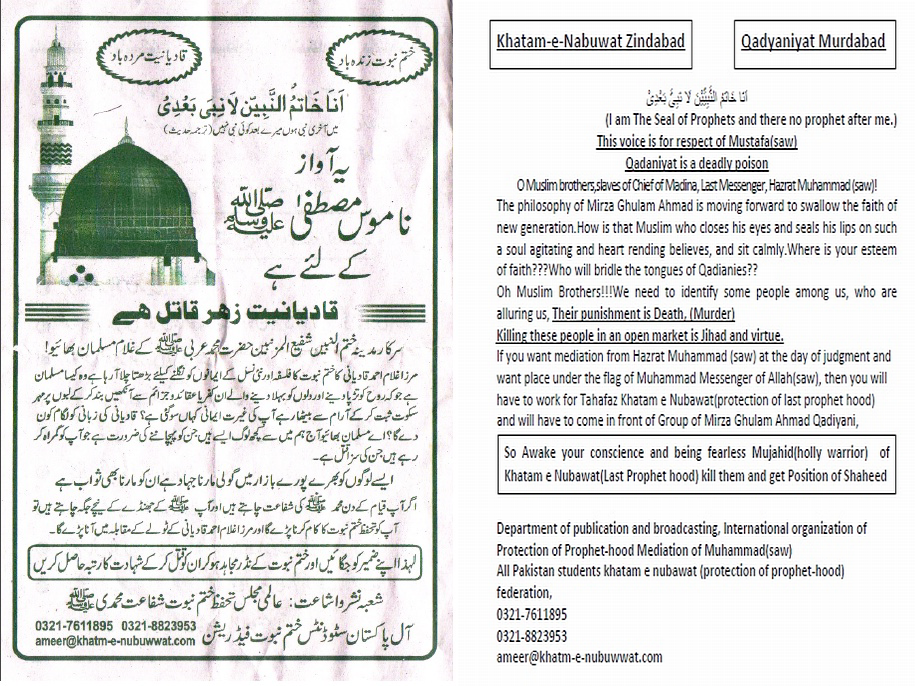
A few months ago, Faisalabad was witness to brazen warnings on Ahmadis; pamphlets labelling members of the Ahmadi community “wajib-ul-qatal” were distributed comprising names and identities of Ahmadi industrialists, doctors and businessmen. Most recently, Ahmadi residents in Lahore’s Satellite Town have been asked to leave or face dire consequences. This because they have established their place of worship which is deemed ‘unconstitutional’ by some.
It surprises me that we have forgotten those very people who helped draft the resolution that gave us Pakistan. Mohammad Zafarullah Khan was an Ahmadi but it was he who drafted the Pakistan Resolution and represented the Muslim League’s view when it came to deciding the future boundaries between India and Pakistan. He also served as Pakistan’s first minister for foreign affairs. Jinnah with his liberal views chose men to represent his country on merit, not religion, caste or creed. Pakistan’s first law minister was a Hindu who had more faith in Jinnah’s liberal views than the Congress’ secular ones; hence he decided to stay in Pakistan. Mandal was supposed to draft the first constitution of Pakistan; however he never got around to staying here long enough to see that to fruition. He resigned from the cabinet due to the consistent persecution of Hindus in Pakistan and moved back to India shortly after Jinnah’s death.
Encouraging persecution of minorities in Pakistan allows intolerance to flourish and has created precisely the kind of second-class citizenry in Pakistan – with uncertain rights and prejudiced values – that the country’s democratic principles were expected to avoid. For 64 years the whole point has been to come to some sort of conclusion as to whether this Islamic Republic of Pakistan can accommodate minorities without threatening their person, faith and livelihood. The idea has been to remove ambiguities and knock off a predominant holier-than-thou attitude towards Christians, Hindus, Ahmadis and Parsis. That clarity was in part, intended for the welfare of the existing minorities, so they could break free from their trap of uncertainty and insecurity. With a secular party at the helm, was this too much to ask for?
As religious historian Karen Armstrong stated recently: “like art, religion is difficult to do well and is often done badly.” The way to experiencing art is through an artist’s eyes. Similarly, religion is usually judged by how it is followed. The secular Pakistan Peoples Party distanced its views from those of Maulvi Nawaz Sharif’s – the alleged closet Taliban. However, it was “Maulvi Sahib” who made his way to Chak town and personally conveyed his condolences to the bereaved Hindu families. It was Sharif who pleaded to the Hindu community not to leave Pakistan, not our “secular” ruling party or its equally “secular” allies, the ANP or the MQM.
Pakistan’s minority dilemma is complex because secularism and conservatism don’t go their separate ways, but come together. Zulfikar Ali Bhutto was considered Pakistan’s most secular and liberal leader, however by adopting the Objectives Resolution in the 1973 constitution, he ended up empowering conservative forces.
Similarly, the man who promised Pakistan “enlightened moderation” also gave way to the Muttahida Majlis-e-Amal. General (r) Pervez Musharraf’s regime gave more power to the maulvis than any other government in Pakistan. Claiming to be Pakistan’s ray of hope, Imran Khan too has disappointed his secular voters (and some party workers). In an interview with Indian journalist Karan Thapar, Khan said he realised the need to ban militant organisations however, when asked to take names, he refused. Khan said he knew the threat that looms large since the Governor of Punjab, Salmaan Taseer, was murdered and hence would not endanger his own life by taking names. And his motto is? You guessed it! Change.
However, it seems the most conservative leader has turned out to be the most secular. From his proposed policy of looking inward for a solution to the war on terror, to envisioning an open trade and better relations with India, Nawaz Sharif has ended up doing what the PPP has long promised. But there are still question marks on some of his party’s leaders harbouring relations with banned outfits and participating in their rallies. His own brother and chief minister of Punjab had previously pleaded with the Taliban not to attack Punjab because of their anti-US policy. As if the other three provinces are in complete disagreement with the views of the TTP and therefore deserve to die.
Persecution of minorities in Pakistan is on a steady rise. It’s not only non-Muslims who are under threat; the minority Muslim sects are also bearing its brunt. In the last two years, almost every important day in the Shiite calendar has been witness to attacks. There have also been attacks on religious shrines of Data Darbar, Abdullah Shah Ghazi and Baba Farid. Scholars who disavowed this form of brutal violence as un-Islamic were either martyred like Maulana Sarfaraz Naeemi and Maulana Hasan Jaan, or they had to flee the country.
Come to think of it, one way or the other, we are all minorities – Punjabis in Balochistan, Mohajirs in Punjab, Pashtuns in Sindh, Baloch in Khyber Pakhtunkhwa – we are all victims of this prejudice. Will we realise, in time, what we don’t condemn today for others could very well be our fate tomorrow.
The writer works for Geo TV.
Sunday, November 20, 2011
Blood, meat and hides marked the first day of Eid-ul-Azha in Pakistan. While most Muslims celebrated their holy festival by sacrificing animals, some decided to achieve new levels of faith by targeting Hindus in Shikarpur. Three doctors were shot dead in broad daylight in Chak Town, allegedly, after a conflict arose between the Bhayo tribe and the Hindu community over a dancing girl.
Prior to the murders, the issue had already captured the attention of the local elders and a jirga was to be convened after Eid. Threats were issued to the Hindu community and reported to the local police but to no avail. Why is it that the government machinery only comes into motion after a tragedy has unfolded? The president and prime minister have both condemned the murders and ordered an inquiry. The police have since been prompt in arresting many from the Bhayo tribe. As anybody in Pakistan will tell you, arrests don’t necessarily mean justice. This is not the only case of Hindus being discriminated against in Pakistan – Sindh, long known for the wisdom of renowned Sufis and saints, is now home to a whole new brand of faith.
This ghastly incident takes me back to another instance in Lahore last year, when two shrines of the minority Ahmadi sect were attacked, leaving more than 90 people dead. Threats to Ahmadis were ignored then too, and calls for greater government protection in the future fell on deaf ears.
A few months ago, Faisalabad was witness to brazen warnings on Ahmadis; pamphlets labelling members of the Ahmadi community “wajib-ul-qatal” were distributed comprising names and identities of Ahmadi industrialists, doctors and businessmen. Most recently, Ahmadi residents in Lahore’s Satellite Town have been asked to leave or face dire consequences. This because they have established their place of worship which is deemed ‘unconstitutional’ by some.
It surprises me that we have forgotten those very people who helped draft the resolution that gave us Pakistan. Mohammad Zafarullah Khan was an Ahmadi but it was he who drafted the Pakistan Resolution and represented the Muslim League’s view when it came to deciding the future boundaries between India and Pakistan. He also served as Pakistan’s first minister for foreign affairs. Jinnah with his liberal views chose men to represent his country on merit, not religion, caste or creed. Pakistan’s first law minister was a Hindu who had more faith in Jinnah’s liberal views than the Congress’ secular ones; hence he decided to stay in Pakistan. Mandal was supposed to draft the first constitution of Pakistan; however he never got around to staying here long enough to see that to fruition. He resigned from the cabinet due to the consistent persecution of Hindus in Pakistan and moved back to India shortly after Jinnah’s death.
Encouraging persecution of minorities in Pakistan allows intolerance to flourish and has created precisely the kind of second-class citizenry in Pakistan – with uncertain rights and prejudiced values – that the country’s democratic principles were expected to avoid. For 64 years the whole point has been to come to some sort of conclusion as to whether this Islamic Republic of Pakistan can accommodate minorities without threatening their person, faith and livelihood. The idea has been to remove ambiguities and knock off a predominant holier-than-thou attitude towards Christians, Hindus, Ahmadis and Parsis. That clarity was in part, intended for the welfare of the existing minorities, so they could break free from their trap of uncertainty and insecurity. With a secular party at the helm, was this too much to ask for?
As religious historian Karen Armstrong stated recently: “like art, religion is difficult to do well and is often done badly.” The way to experiencing art is through an artist’s eyes. Similarly, religion is usually judged by how it is followed. The secular Pakistan Peoples Party distanced its views from those of Maulvi Nawaz Sharif’s – the alleged closet Taliban. However, it was “Maulvi Sahib” who made his way to Chak town and personally conveyed his condolences to the bereaved Hindu families. It was Sharif who pleaded to the Hindu community not to leave Pakistan, not our “secular” ruling party or its equally “secular” allies, the ANP or the MQM.
Pakistan’s minority dilemma is complex because secularism and conservatism don’t go their separate ways, but come together. Zulfikar Ali Bhutto was considered Pakistan’s most secular and liberal leader, however by adopting the Objectives Resolution in the 1973 constitution, he ended up empowering conservative forces.
Similarly, the man who promised Pakistan “enlightened moderation” also gave way to the Muttahida Majlis-e-Amal. General (r) Pervez Musharraf’s regime gave more power to the maulvis than any other government in Pakistan. Claiming to be Pakistan’s ray of hope, Imran Khan too has disappointed his secular voters (and some party workers). In an interview with Indian journalist Karan Thapar, Khan said he realised the need to ban militant organisations however, when asked to take names, he refused. Khan said he knew the threat that looms large since the Governor of Punjab, Salmaan Taseer, was murdered and hence would not endanger his own life by taking names. And his motto is? You guessed it! Change.
However, it seems the most conservative leader has turned out to be the most secular. From his proposed policy of looking inward for a solution to the war on terror, to envisioning an open trade and better relations with India, Nawaz Sharif has ended up doing what the PPP has long promised. But there are still question marks on some of his party’s leaders harbouring relations with banned outfits and participating in their rallies. His own brother and chief minister of Punjab had previously pleaded with the Taliban not to attack Punjab because of their anti-US policy. As if the other three provinces are in complete disagreement with the views of the TTP and therefore deserve to die.
Persecution of minorities in Pakistan is on a steady rise. It’s not only non-Muslims who are under threat; the minority Muslim sects are also bearing its brunt. In the last two years, almost every important day in the Shiite calendar has been witness to attacks. There have also been attacks on religious shrines of Data Darbar, Abdullah Shah Ghazi and Baba Farid. Scholars who disavowed this form of brutal violence as un-Islamic were either martyred like Maulana Sarfaraz Naeemi and Maulana Hasan Jaan, or they had to flee the country.
Come to think of it, one way or the other, we are all minorities – Punjabis in Balochistan, Mohajirs in Punjab, Pashtuns in Sindh, Baloch in Khyber Pakhtunkhwa – we are all victims of this prejudice. Will we realise, in time, what we don’t condemn today for others could very well be our fate tomorrow.
The writer works for Geo TV.
The News International - Copyright @ 2010-20
URL: www.thenews.com.pk/TodaysPrintDetail.aspx?ID=78453&Cat=9
URL: www.thenews.com.pk/TodaysPrintDetail.aspx?ID=78453&Cat=9






 Posts
Posts


